Showing posts with label New Zealand economy. Show all posts

Thursday, 2 July 2026

Unexpectedly critical

This week's Performance Improvement Review (PIR) of the Treasury took me aback. 

I've met many people from Treasury over the years in various contexts, and have a high opinion of them. And while I was aware that in recent years hiring had appeared to downgrade the importance of bringing professional economists on board, in favour of some sort of 'broadening perspective' or 'flexibility' approach, I hadn't noticed any drop-off in quality in the Treasury people I've personally encountered. In some areas I thought Treasury had actually upped its game, notably in starting to engage more with the public about our various fiscal and productivity challenges.

But the PIR told a different story about Treasury as an institution. Despite good work in some areas - including the "public engagement to raise awareness of New Zealand’s long-term fiscal challenges" that I'd noticed for myself - "Nevertheless, the consensus of stakeholders interviewed is that the Treasury’s performance has not consistently met expectations in recent years" (p5).

Here are some examples.

The PIR included ratings of Treasury, across 23 different dimensions, on how prepared it is to up its game (p31). There wasn't a single 'Leading' (the top rating). There were six 'Embedding' (loosely, Good). But by far the most common rating was 'Developing' (loosely, Middling/Adequate), with 16. And there was one outright 'Weak', which, worryingly, was for its effectiveness at one of its core functions, providing economic policy advice. 

And then there was this remarkable level of turnover (the chart below is from p65) - high in outright terms and, significantly, relative to the wider public sector. How could it do well when in the worst year Treasury was having to replace a third of its staff? With people voting so strongly with their feet you have to wonder about both staff management and the longer-term impacts of Treasury's recruitment focus. As the PIR found, "Historically, the Treasury was widely regarded as a high-profile training ground for public sector leaders. Interviewees described it as “the gate you had to get through” and “a real place of debate and challenge that the brightest and best went to”. That is no longer the common perception. Many interviewees questioned how the Treasury could reestablish itself as an employer of choice in a more competitive labour market" (p61).


Recent recruitment, whatever it was meant to achieve, hasn't turned out well. The PIR found (p62) that "A strong theme from interviewees was concern that the Treasury has lost specialist expertise. While the Treasury is aiming for a flexible and agile workforce, external stakeholders in particular were concerned that flexibility and generalism are not yet balanced strongly enough with the depth needed in key areas, pointing to the loss of “wise owls” and thinning commercial and economic depth. Internal interviews reflected this more indirectly, highlighting capability pressure, key-person risk, and the need to rebuild depth in selected areas". In passing I'd note the recurrent criticism of the UK's Treasury, that it over-relies on clever generalists with no subject matter expertise, further aggravated by too-early rotation out of roles which people had just got comfortable with. 

One final and rather sad pair of points. Treasury has a system role in the public sector: it's where agencies go for specialist advice on how best to run their organisations. But Treasury isn't eating its own cooking. When it comes to performance reporting (p57), "The Treasury’s performance and accountability system is still developing and is not yet strong enough to drive improvement or provide clear assurance about results ... In that context, the Treasury is expected to model a coherent and credible approach to performance and accountability itself". The same applied to strategic planning (p50): "The Treasury provides guidance to departments on Strategic Intentions as part of the Public Finance Act performance reporting framework, and would be better placed if it more clearly modelled the clarity it expects from others".

There are pluses. The Treasury Secretary made a brave and useful call to have a PIR team come in. The PIR itself has come up with what look from the outside like plausible diagnoses and has produced a comprehensive list of sensible recommendations (pp6-8 and repeated as Appendix 1, pp73-5). And Treasury itself showed some self-awareness and had already got the ball rolling in the right direction with its own internal change programme.

The PIR didn't prioritise its recommendations, and maybe it's right to try and move ahead on all fronts, but for my money I'd particularly like to see the Recommendation 3 bullet points addressed early in the piece. They're about enhancing the impact of Treasury's economic policy advice. 

For one, that's the area rated worst at the moment. And for another, we're never going to get a lot of economic progress if an important national direction setter isn't pulling its weight. It's a bit strange, for example, that although we've been talking about New Zealand's low productivity growth for decades, we're still at the stage of a recommendation to "Refresh the Treasury’s diagnosis for unlocking higher rates of productivity growth (e.g. integrating the potential of AI) and maintain a set of actionable ideas grounded in commercial realities for engagement with Ministers as opportunity presents". 

Memo to whoever is the next Opposition finance spokesperson: diarise a Parliamentary Question for a year's time and let's find out if we're getting the policy impact progress the PIR and the rest of us want to see.

Tuesday, 30 September 2025

Oh no it didn't...

Earlier this month I wrote up the latest slew of competition policy reforms, and mistakenly included one proposed reform that actually wasn't endorsed by Cabinet. 

It's the proposal for the Commerce Commission to be able to initiate Australian-style industry codes. As someone's helpfully pointed out to me, "the proposal for industry codes / pro-competition rules wasn’t agreed to by Cabinet, so it’s not part of the reform package. It’s a very understandable error - the Cabinet paper discusses the proposal in detail, and you’d only spot it wasn’t agreed to if you compared the paper with the Cabinet minute". 

Indeed: the Cabinet minute records what Cabinet agreed to, but is silent on proposals it turned down, and it flagged away Commission-led codes. Bit of a pity, really, as I think codes can fill a useful niche short of full-scale regulation (and this Cabinet is clearly averse to any more sector-specific statutory regulation along supermarket or petrol station lines). Never mind: the correct situation is that it's a non-runner for now.

Thursday, 18 September 2025

The other shoe drops

This week's second batch of competition policy reforms, announced jointly by Finance Minister Nicola Willis and Commerce and Consumer Affairs Minister Scott Simpson, was welcome from any number of perspectives. The press announcement is here, there's a useful fact sheet here, and if you missed the first batch I wrote about them here. If you're an irremediable policy tragic, you'll find the Cabinet paper supporting the latest reforms here.

For a start, on the substance, they've made almost all the right calls. 

On mergers, the reforms will amend the definition of "substantial lessening of competition" to extend to "conduct that creates, strengthens, or entrenches a substantial degree of power in a market" (I'm quoting para 19 of the Cabinet paper), which not only helps make it explicit that 'killer' acquisitions are in the frame but also harmonises with Australia's approach. 'Creeping' acquisitions - individually apparently insignificant purchases that cumulatively build up to a degree of market power - also got attention. It appears that it wasn't clear that the Commission could look back at the past track record when considering the latest in a series, but in future it will be able to take the evidence of the previous three years into the balancing act, with the proviso (para 24) that "The Commission will not have new powers to unwind past acquisitions, nor will it affect its existing ability to take action where a past acquisition was independently unlawful".

Importantly, the Commission will now be able to accept behavioural undertakings as part of a merger approval. For no obviously compelling reason, "The Commission currently lacks the authority to accept voluntary behavioural undertakings from merging firms (other than in relation to the disposal of assets or shares). These undertakings are commitments proposed by merging firms about their future conduct and are commonly used overseas, including in Australia and the United Kingdom, to resolve competition issues while preserving potential merger benefits. Feedback from public consultation, especially from the business and legal communities, showed strong support for allowing the Commission to accept these undertakings' (para 28). As a result, "The current gap in the merger regime may lead to the rejection of mergers that could otherwise be cleared with appropriate behavioural remedies, resulting in missed opportunities for efficiencies and consumer benefits" (para 29). It will mostly be up to merger applicants to suggest them, and up to the Commission to accept or reject them (or, I'd guess, have a bit of to and fro).

Whether there are swathes of anti-competitive mergers occurring that haven't been voluntarily notified to the Commission is debatable - New Zealand's a small place, word gets round, and the Commission can read the newspapers - but in any event the Commission is getting two new powers to help cope with any that come along. There'll be "a targeted “stay and hold” power to suspend the completion of a potentially anti-competitive merger for up to 40 working days. This would allow time to assess competition risks before the transaction is completed" (para 33) and "a targeted “call-in” power to require parties to seek clearance if the Commission considers the transaction may substantially lessen competition. This notice would pause the transaction until clearance is granted, declined, or the process is terminated" (para 34). Sensibly, the reforms shied away from a mandatory merger reporting regime.

The Cabinet paper also strongly suggests that the current government is deeply averse to any more single-sector regulation. "Previous governments have responded to competition challenges by introducing repeated sector-specific regulation. Strengthening New Zealand’s overall competition framework will better equip the Commission to address markets with high barriers to entry and expansion, reducing the need for repeated sectoral regulation, such as the Grocery Industry Competition Act 2023 and the Fuel Industry Act 2020. These interventions involved lengthy policy and legislative development processes and have not always delivered the broader, enduring improvements to market dynamics that a more robust and flexible competition regime could achieve" (para 9). Looking, for example, at the data on petrol importer margins (available here), you'd be tempted to agree.

Making the Commerce Act more effective across the board is one answer: in addition, the Commission will get powers to deploy a local version of Australia's industry codes*. "We propose creating a power to make targeted regulations to guide conduct among market participants to break down barriers to entry and expansion" (para 41). The Commission can only regulate when "the market in question is concentrated, whereby market power is held by only a small number of firms; there are barriers to entry and expansion; the market is not working well for consumers, and the proposed rules are consistent with the purpose of the Act" (para 44, slightly abridged). 

Personally I think the further requirement that Cabinet signs off on any Commission-initiated regulatory codes is a step too far. The stated justification is "To ensure this power is used proportionately and only as a last resort" (para 44), and maybe there is a case that democratically accountable representatives ought to sign off on non-elected technocrats getting too heavyhandedly involved in bossing entire industries around. I've noticed, too, when presenting to Select Committees, that some MPs evidently have a fear that an overzealous Commission might go feral. To me, though, it's another example of successive governments' fetish for costly micromanagement: far too many things already have to go to Ministers or Cabinet, and this doesn't need to be yet another one. MBIE, when preparing the regulatory impact statement for these reforms, looked at an 'Option 3': "Commission-issued pro-competition rules – Allows the Commission to develop and implement rules independently, without separate Cabinet approval each time". That was a path not taken, but should have been, and in the fulness of time I'll likely front up to a Select Committee and argue for it.

And then there's predatory pricing. "Allegations of predatory pricing have arisen in the aviation, grocery and building supplies sectors, but enforcement remains challenging. Part of the challenge is the lack of clarity around the circumstances when prices are so low that they breach competition law" (para 51). So the reforms suggest some pricing tests that could more effectively ping predatory pricing under s36 of the Act: "Pricing below Average Variable Cost (AVC) or Average Avoidable Cost (AAC) over a sustained period is presumptively unlawful", and "Pricing above AVC/AAC but below Long-Run Average Incremental Cost (the average cost of producing an additional unit of output over the long-term**) or Average Total Cost (total costs divided by the number of units produced) over a sustained period is presumptively unlawful only where there is evidence of exclusionary intent" (para 53), with some sensible carve-outs: "short-term promotional pricing, including one-off specials, de minimis discounts, or mistaken pricing, are not captured unless part of a sustained pattern of pricing behaviour" (para 55). I have to say, I'd like to have been a fly on the Cabinet room wall when Ministers were confronted with 'Long-Run Average Incremental Cost' ...

Gibes aside, the reform's heart is in the right place, and maybe it'll reduce the scope for judges to see vigorous incumbent reaction to competition rather than strategic deterrence of rivals (yes, I'm thinking of Pink Batts***), but we'll see. As anyone who has been up close and personal with a s36 case knows, it's hard to magick away the complexities. 

There's other good stuff which I'll leave you to explore, but I'd like to add a few words about process.

By recent New Zealand competition policy standards, this has been a quick and effective exercise. While there was a bit of a gap between consultation closing (early February) and the first package of reforms (mid August), and the contents of the first tranche were distinctly modest compared to the range of topics consulted on, the Minister promised that "Further decisions on the merger regime, potential new industry codes, and other changes will be announced over the coming weeks". He - and Nicola Willis - have very largely delivered, though the odd issue, like 'concerted practices', appears to have fallen into a void. 

And between them they had the heft of being able to get an early slot in the always crowded legislative queue: "We propose that the policy outlined in this paper be given effect through the Commerce (Promoting Competition and Other Matters) Amendment Bill, which is at priority category 5 (to proceed to Select Committee by the end of 2025)", which likely means enactment in 2026. Good stuff all round: it's nice to see effective competition being given the priority it deserves. And while I'm in a generous mood, a hat tip too to whoever held the pen on the Cabinet paper: these are complicated issues, and whoever wrote them up did a fine job of making them clear. 

*Update (September 30) - I didn't spot it but in the event Cabinet actually decided not to endorse the industry code idea. See today's post.

**I've deleted an apparently superfluous 'costs' here

***Carter Holt Harvey Building Products Group Limited v Commerce Commission [2004] UKPC 37

Friday, 23 May 2025

Too slow? I don't think so

Ignoring the predictably partisan knee-jerk assessments from the usual suspects, there were two broad camps of reaction to yesterday's Budget. 

One was that it didn't actually do enough to boost growth, its signature objective. The accelerated investment incentive is fine, especially given that part of our productivity problem relates to New Zealanders working with less capital equipment than their counterparts overseas, but it's having to do a lot of work on its own. Yes, there were other Budget things that will help (notably increased spending on infrastructure) but overall it didn't deliver an adequate pro-growth punch.

The other reaction, from what you might term the fiscal 'hawks', was that it didn't move fast enough to close the fiscal deficit. It's easy to ramp up public spending, run deficits, and borrow, but quite a lot harder to cut back, get the books into surplus, and pay back some of the debt: there's a ratcheting effect where public spending boosts tend to be larger than any subsequent windbacks. Retrenching this time round hasn't got any easier: on the Budget projections there's only a minuscule surplus in the fiscal year to June '29, and even if we get there (and a $0.2 billion surplus is well within any margin of measurement or forecasting error) that's still four years away. 

There was probably no way Nicola Willis was going to simultaneously satisfy both the pro-growth and pro-windback camps, and I think it's fair to say that both are far from gruntled.

My own reaction is that, while I'm sympathetic to the general point that we need to rebuild the fiscal books, I think Willis is doing it at what, in current circumstances, is a sensible pace, and the more rabid fiscal hawks should back off.

Why do I think that? Let's look at the 'fiscal impulse' - whether fiscal policy in any year has become more expansionary or contractionary compared to the previous year*. This year I was somewhat concerned that an over-hawkish drive to an eventual fiscal surplus might be too aggressive, and risk further damaging an economy that is still in a somewhat fragile state. I also wanted to see whether fiscal policy was playing nicely with monetary policy: as the RBNZ said at its latest OCR review, there are "downside risks to the outlook for economic activity and inflation in New Zealand", and it wouldn't be the best of ideas to have fiscal policy braking the economy too hard.

Here's what the fiscal impulse looks like (from p67 of the Budget Economic and Fiscal Update, the 'BEFU'). Bottom line, the pace of withdrawing fiscal support looks pretty sensible to me. According to the BEFU forecasts, GDP growth in the current fiscal year to June '25 will have fallen by somewhere between 0.3% (expenditure measure of GDP) and 0.8% (output measure). and by a stonking 1.9% in per capita terms. In those circumstances what has turned out to be a modest fiscal boost makes complete sense.

For the year to June '26, there's a marginal fiscal boost which is macroeconomically speaking irrelevant, and even if it were a bit larger, it mightn't be such a bad idea given the uncertainty around the economic outlook. And then there are three years of moderate but meaningful windback of fiscal policy. You may have your own views, but I can live with that. 

In passing, there were a couple of initiatives in the minutiae of the Budget that I particularly warmed to. If you're interested in exactly what new stuff is planned, by the way, the place to go is the 'Summary of Initiatives' document.

Statistics New Zealand is getting $63.8 million over the next four years which "provides funding held in contingency to deliver eight updated macroeconomic measures by the end of 2030, to meet new international standards and better measure changes in the economy. Funding will also deliver new monthly indicators by 2027 to provide timely updates on economic activity", and another $16.5 million to "deliver a more frequent, reliable measure of inflation by moving from quarterly to monthly Consumers Price Index (CPI) reporting. Data will be collected on a monthly rather than quarterly basis, with regular monthly CPI reporting delivered from the beginning of 2027". We've been falling behind other OECD countries (and indeed behind some poorer non-OECD economies) in terms of the timeliness and range of our macroeconomic data, and this is a long overdue revamp. 

The other was the $130 million allocated to social investment initiatives. 'Social investment' is jargon for social support programmes targeted on 80:20 rule lines to those most in need, and typically delivered outside the traditional one-size-fits-all centralised social welfare spending channels. I wrote a bit abut it here, and I think it's a highly promising and progressive approach. The new Social Investment Fund "will use data and evidence to guide investment in effective, outcomes-focused social services. The Fund will invest in new programmes and in changes that strengthen existing arrangements". The Budget also said that "This initiative also provides departmental funding for the oversight and delivery of the Fund". This may just be a statement of the bleeding obvious, but I also very sincerely hope that it isn't code for the Wellington disease of excessive micromanagement of anything new or different.

*The fiscal impulse can be a bit of a heffalump trap to interpret. Suppose in Year 0 the government is in fiscal balance. In Year 1 it goes into deficit and buys 100 widgets, supporting widgetmakers. In Year 2, it is still in deficit but buys only 60 widgets. The fiscal impulse will show a reduction in the scale of fiscal support, from 100 to 60 widgets. At the same time, while less so, fiscal policy is still supportive: there are still 60 widgetmakers who benefit from the residual purchases. 

Wednesday, 24 July 2024

Read the label carefully

This month's publication of the OECD's latest product market regulation indices came up with a few surprises (here are the key takeaways across all the countries surveyed, and the country note on New Zealand. Tragic regulation wonks might like to look at the questionnaire questions and the note on methodology).

Overall the OECD's overall measure of product measure regulation put New Zealand essentially at the OECD average. That's not too shabby, but arguably not good enough. As the OECD said, "Competitive product markets can boost productivity, employment, and living standards", and if you are a country which already has a productivity problem, you ideally would be better placed to be well down the more competitive end.


Fortunately, it's likely that New Zealand's performance, at least on some metrics, is actually better than the OECD statistics suggest at first glance.

We can unpick what's actually happening by looking at the sub-indices that make up the overall result (see chart below). To be fair, a lot of them show things as they indeed are. Most of us would have guessed our clearly pro-competitive positioning on avoiding retail price regulation: in fact it is currently the best out of the 43* countries surveyed . It is comparatively very easy for people in New Zealand  to set up a new business: if you're minded to jack in the corporate job and go out on your own, you'll have a company established in an afternoon. We have relatively low trade tariffs. At the other end of the scale it's been well known for a long time that we have one of the developed world's most restrictive approaches to foreign direct investment. 


But the survey also threw up some surprises and apparent anomalies, in particular our very poor rankings on 'Administrative and regulatory burden' and 'Licenses and permits'. Intuitively I wouldn't have picked either of those: ever had to deal with the bureaucracy in France? (They have the lovely word paperasserie to  describe the admin flimflam you have to go through). As for 'licences and permits', it didn't seem to me we have got anywhere near the barriers to entry that have proliferated overseas in recent years, where over-rigorous qualification requirements make entry difficult and not coincidentally protect incumbents. .

But look more closely and there's a bit of a labelling issue. Some of those very poor rankings don't really correspond to what they say on the tin. 'Licences and permits' doesn't actually mean, "relative to other countries, people have to get more permits and licences to do what they want rather than just getting on with it". It means, in the OECD's words, do "countries keep an inventory of all licences and regularly review it, adopt the 'silence is consent' principle, and tailor the length and complexity of licences to the risks inherent in the licensed activities". We probably ought to do those things, but that's a long way from having a thicket of licencing barriers to entry.

The low ranking on 'Administrative and regulatory burden' includes how we shape up on "the administrative requirements necessary to set up new enterprises ... with a focus on two specific legal forms: limited liability companies and personally owned enterprises". Given that we score well on ease of setting up a new business - 6th out of 43 as the chart shows - I'm frankly baffled how the overall measure comes out as badly as it does. 

In any event, when the person in the street thinks of "regulatory burden", they think of the whole nine yards of doing everything from your GST to paying your ACC levies and compliance of all sorts, not just how easy is it to get started in business. And if the OECD asked that question, I suspect that while we're not perfect - holiday leave payroll calculations, anyone? - we'd show up a lot better. The French labour code alone (never mind tax and everything else) runs to over 3,300 pages.

While the survey, in my view, shows us a bit more over-regulated than we really are, that doesn't mean we should sit on our hands and ignore the bits where we are genuinely off the pace when it comes to good but not over-intrusive product market regulation. The recently created Ministry of Regulation says that its "Regulatory reviews enable the Ministry to engage with people impacted by regulation and to identify how existing regulation could or should be improved" and that "We are currently developing a framework to assist in the selection and prioritisation of future sector reviews".

Why not junk the thinking about a framework and just pick off the issues the OECD has already identified for us?

* Some charts show rankings based on 43 OECD members, others show rankings based on 48 countries, i.e. the 43 OECD members plus five non-members.

Monday, 8 July 2024

The ComCom session at the NZAE conference

Last week the New Zealand Association of Economists hosted a Commerce Commission themed session at its annual conference. It's become a fixture in the past few years, I'm pleased to say, after a drought period where industrial organisation, competition and regulation didn't quite get the focus they deserved.

The Commerce Commission team - Diego Villalobos, who chaired the session, Geoff Brooke and Rae Rho - talk about productivity trends in the regulated electricity lines business, the regulatory cost of capital, and the competitive effect of new unmanned petrol stations

Geoff Brooke's presentation showed the large increases in allowable revenue for the electricity lines businesses (ELBs) which the Commission has proposed for the forthcoming 5-year regulatory period (from the Commission's draft decision). They're stonking great rises - more than a billion dollars extra in what makes up about a quarter of a household's electricity bill - and they add to all that upward pressure on domestic non-tradables prices that is already giving the Reserve Bank conniptions.

But they're justified, as you can see in the graph below which shows the underlying drivers: input cost inflation, a substantially higher weighted average cost of capital ('WACC') reflecting the rise in interest rate costs as ultra-easy monetary policy has changed to the current post-Covid tightening, and provision for increased opex and capex spending.


Diego Villalobos talked about a productivity study that ComCom commissioned from Cambridge Economic Policy Associates (CEPA), and which looked at the productivity trends in the electricity distribution business (i.e. the ELBs again). As ComCom's cover note about the research said, "The productivity of Electricity Distribution Businesses (EDBs), measured as their outputs relative to inputs, is an important performance indicator. Over time, we and other stakeholders expect EDB productivity to increase as they become more efficient and able to deliver the same services using fewer inputs".

Unfortunately the exact opposite has been happening: productivity has fallen, and sharply, as this extract from the CEPA work shows. 'Non-exempt' EDBs in the table are those directly revenue-regulated by ComCom, 'Exempt' are ones owned by local consumer trusts and which are only subject to an information disclosure regime. But either way both groups have shown steadily lower productivity.


And it doesn't seem to be an oddball result of anything weird CEPA has done: Stats NZ data for a broadly comparable sector (electricity, gas, water, waste services, the yellow line in the graph below) show a similar pattern. It's still possible that both CEPA and Stats are missing a trick somewhere along the line - I'd argue that in some sectors of the economy, particularly those closest to the internet and other IT, productivity is being systematically underestimated - but the first best guess looks to be that there is something sector-specific happening.


It would be nice to say we know what's going on here, but we don't. CEPA canvas some explanations in their Section 6, so have a read for yourself and see what you think, but thus far there don't seem to be any smoking guns.

And finally Rae talked about her research on the competitive impact on incumbents of new unmanned petrol stations opening up (full thing here, summary here). Here's her key result. Look at the red dots, which are the price responses from incumbent petrol stations within five minutes' drive when a new unmanned station opens: you'll see a 2-3 cents per litre reduction in the weeks after the new competitor opens. The black* dots are the response by incumbents who are five to ten minutes' drive away: zilch,  nicely demonstrating the geographical market definition for petrol.


As well as this event study examining response to new entry, there was also a cross-section analysis comparing petrol prices where incumbents face at least one unmanned competitor within a five minute catchment: "On average, Regular 91 prices are 6.1 cpl [cents per litre] lower in local markets where at least one non-supermarket unstaffed site is present, compared to those with staffed sites only". 

There was a bit of discussion in the Q&A about whether ComCom ought to go around the country telling local authority land use planners about these results, and encouraging them to free up areas that new unmanned petrol stations could use. Quite right, too: if the councillor for a particular ward would like the credit for petrol becoming 6 cents a litre cheaper for his or her constituents, there's an easy way to help bring it about.

*A correction, I'd earlier mistakenly repeated 'red' again

Thursday, 20 June 2024

Something will have to give

This week's online seminar from Treasury had its chief economics adviser Dominick Stephens recapping the economic and fiscal outlook as laid out in the Budget Economic and Fiscal Update (the 'BEFU').

It drew a big crowd - I counted close to 330 online, and 20 or 30 or so in person - and was a well-laid-out reprise of Treasury's thinking heading into the Budget. I could have done with an update on how data since the BEFU had or had not changed Treasury's thinking. I'd guess, given things like the really poor BusinessNZ/BNZ Performance of Services index for May which had appeared just before Dominick got to his feet, that there's now a bit more downside risk to the Budget forecasts for real activity.

What struck me most, though, were some of Dominick's concluding graphs, reproduced below. The first two come from He Tirohanga Mokopuna 2021 (The Treasury’s combined Statement on the Long-term Fiscal Position and Long-term Insights Briefing): a new Statement is due this year and likely will show the same broad picture. As the Statement said, back in 2021, 

"the gap between expenditure and revenue will grow significantly as a result of demographic change and historical trends, in the absence of any offsetting action by governments. This will cause net debt to increase rapidly as a share of GDP by 2060 ... Changing tax rates or restricting expenditure growth can help close the growing gap between revenue and expenditure. However, analysis in this Statement shows that one policy change by itself is unlikely to stabilise debt over the long run. This means that future governments will likely need to draw on multiple levers and consider trade-offs across different policy options in responding to our fiscal challenges".


Dominick also showed this chart, which illustrates one of the demographic drivers: as people age, they drift into the brackets that attract most government spending support. 

My opinion (just to make clear that it wasn't Dominick saying it) is that it's becoming obvious that at least some of the elements of the government's current fiscal strategy - especially the longer-term commitment to keep spending around 30% of GDP - are going to have to give way. And it's not just the demographics and the climate transition impacts that will eventually force public spending higher: it's also the large bill that's going to fall due to keep the country's infrastructure in good operative nick.

I've been struck in recent days by how many examples there are of investment spending falling short of what's needed. According to this report from Radio New Zealand,  the public health IT system has "more than 6000 apps; 1000 servers, almost half of which were so old they were "out-of-support"; a quarter of databases out-of-support and half on "extended" support; 1000 devices over a decade old". From this report in the Herald, we know that the Cook Strait ferries are approaching terminal clappedoutedness. It's been widely reported (for example here by 1News) that the aging Air Force plane supposed to take the Prime Minister to Japan broke down. And in Auckland the shiny new North Shore hospital has been sitting largely idle because the funds haven't been raised to pay for its operation (as reported for example here).

You'll notice the common theme, writ even larger again in sectors like the dilapidated Three Waters and the potholed roads: failure by successive governments, not just this one, to invest enough to keep capital equipment in good, reliable, up to date order. It's a classic example all round of Stephen Covey's adage that when you classify things that need to be done by whether they're urgent or not, and by whether they're important or not, it's the important but non-urgent stuff, like maintenance, that tends to get neglected.

The current fiscal strategy may limp on for a wee while yet: more equipment may be left to get even more obsolete, the waiting lists for medical procedures may be allowed to blow out even longer, the schools' teaching performance and physical premises can become even shabbier. But it's unsustainable. 

Thursday, 30 May 2024

Budget 2024: tough choices deferred

There’s a big bunch of Budget documents handed out to the serried ranks of analysts packed into the pre-Budget ‘lock-up’ in Parliament’s Banqueting Hall, and the place I always like to start unpacking them is the economic forecasts: are they reasonable, or (in particular) are they flattering the prospects for the fiscal accounts? I’ve shown the main forecasts below, and they look more or less reasonable. I reckon the immediate economic outlook could be a bit weaker than allowed for – consumer spending, in particular, could turn out weaker (while there was a lot else also going on, Smith & McCaughey closing was just another indicator of households pulling back from spending), and we’ll have to wait and see whether the expected improvements in corporate profitability and national productivity growth materialise as anticipated. I have my reservations about the predicted track for the fiscal deficit (the ‘OBEGAL’ in the chart), as discussed later in this post, but as far as the economic forecasts go, the overall picture of difficult conditions now, ho-hum conditions in 2024-25, and rather better times beyond that, looks a commonsensical enough take.

A lot of attention will no doubt be given to the headline OBEGAL balance and in particular to the fact that it will not be back in surplus until the 2027-28 June year, a year later than previously anticipated. I don’t think this is a big issue, even if it continues an unhelpful recent tradition of pushing the “we’ll be in surplus” year out by a year, every year. I’m not sure an over-aggressive return to surplus would have made much sense in a weakish economic environment, and even at this slower-pace return to surplus we would end up with net government debt still at relatively low levels by the standard of other developed economies.

And in any event the fiscal balance, while it’s relevant to eventually stabilising government debt and later starting to pay it back, isn’t the best guide to one of the more important aspects of the Budget, namely whether it boosts or brakes the economy, and whether that boosting or braking helps or hinders the Reserve Bank’s job, which is also simultaneously trying to steer the near-term course of the economy. That’s better captured by the ‘fiscal impulse’ (shown below), and the good news is that the Treasury and the Reserve Bank are no longer so obviously at loggerheads. The previous government’s 1.7% boost to GDP from fiscal policy in 2023-24, which clearly complicated the Bank’s job, has been followed by a more or less neutral stance in the current June 2024-25 year, and by fiscal tightening in the years beyond that. The Reserve Bank’s job is now a bit easier. There is a wrinkle – the Reserve Bank may well have been expecting an outright tightening of fiscal policy over the coming year as opposed to the broad neutrality that’s now on the books – but I’ll settle for the two of them no longer being at odds.

The improved coordination of fiscal and monetary policy is a distinct plus in this Budget, as is the reversal of the stealth tax ‘bracket creep’ of recent years when income tax thresholds were not raised in line with inflation. As Nicola Willis pointed out in her Budget speech, “The median full-time wage and salary earner now earns $73,000 a year and is in the one of the highest tax brackets. A minimum wage worker can face a marginal tax rate of 30 per cent”. That needed fixing, and has been to a degree, though I would (perhaps unrealistically given the limited room for fiscal giveaways) have liked to see a commitment to keep on adjusting the thresholds in the future.

But there are also issues that bother me.

One is that there has clearly not been enough money allocated to keep government services going at their current levels or pay for new programmes. The Budget Economic and Fiscal Update (the ‘BEFU’) says (p37) that “the Government has $0.9 billion average per annum available to fund all new initiatives and other cost pressures at Budget 2025  … It is difficult to estimate how much of the Budget 2025 operating allowance will be needed to meet future cost pressures. However, in recent times a large portion of the funding allocated at Budgets has been used to meet cost pressures faced by existing services”. In other words, just paying the higher wage bills will likely eat up all (or more than all) of what’s budgeted.

And beyond 2025 it’s also likely there won’t be enough money to keep everything running unless something else gives. To be fair, the Budget fesses up: “The high-level analysis indicates that the future budget allowances are unlikely to be sufficient to cover future cost pressures on existing services. This means any shortfall and spending on new initiatives will need to be offset by expenditure savings, reprioritisation or revenue raising policy changes for each of the next three Budgets for the Government to manage within the signalled budget allowances. This will involve difficult choices and trade-offs for the Government which are likely to become harder over time”. The Fiscal Strategy Report says (p4) that “Managing within $2.4 billion [operating] allowances will therefore be challenging”: “challenging”, I’d suggest, is a euphemism for “impossible” (especially if you look at the long list of ‘Specific Fiscal Risks’, ‘Committed or Announced Intent that may have Fiscal Implications’ and ‘Time-limited Funding’ from p65 in the BEFU, and which will very likely put even further pressure on the public purse). Maybe there will indeed be enough savings or extra revenue found somewhere to make everything add up, but I for one wouldn’t be surprised to see the OBEGAL turn out worse than currently forecast, continuing the pattern of kicking the fiscal issues can down the road a bit further.

Another is the infrastructure spend. Yes, the Budget speech said that “In 2024, the Government is overseeing a record level of capital investment to deliver the infrastructure on which New Zealand’s growth depends. More than $68 billion is forecast to be spent on infrastructure by the Crown, Crown entities and KiwiRail over the next five years”. That’s great, and to be fair (just looking at transport) in recent years we’ve seen things like the Waikato Expressway, the extension of the Northern Motorway to Warkworth, and easier access to the airport via the Waterview tunnel which have eased previous bottleneck nightmares. But while $13.6 billion a year in new stuff is all good, you have to remember that depreciation (the cost of keeping the existing stuff going) is a sizeable $8.0-8.5 billion a year (see Note 10 to the government’s Forecast Financial Statements): the net addition of infrastructure is a rather less impressive $5.0-5.5 billion a year. I very much doubt if that’s enough given the existing infrastructure deficit and likely new commitments (eg funding the electrification of cars).

And finally, one of the biggest issues for successive government of all stripes has been the quality of outcomes from every public dollar spent: you only have to look at falling educational standards, or the unavailability of medical specialist advice within reasonable timeframes. The Budget is singing the right song – in the Budget speech, “the Government has a clear expectation that public agencies must strengthen their focus on delivering results. We have set clear targets to improve results in health, education, law and order, employment, housing and the environment, and we are focused on delivering them” – but I struggled to see the initiatives or new ways of working that would make the aspiration more credible.

Monday, 22 April 2024

How's my driving?

At the end of February the Commerce Commission published an interesting "look back" review of what it could learn from how its merger decisions have been made. As the Commission said, "The purpose of our ex-post merger reviews is not to determine whether the original decision of the Commission was correct or incorrect, compared to alternative decisions available to the Commission at the time. Instead, our reviews evaluate key factors of a decision and assess whether the Commission’s predictions have eventuated as expected".

That's fair enough. It's always going to be hard to figure out, with the passage of time, what would have happened (the 'counterfactual') if the Commission had made a different call. That's not to say it's a completely hopeless exercise. It could well be worthwhile at least looking for some (however inconclusive) indications of correctness: post-merger, did prices go up for reasons that weren't obviously related to the likes of input costs? Did innovation slow down? Did consumers see the benefit of the efficiencies the merger claimed to enable? But I accept that you may not get any clearly definitive answers, unambiguously linking the merger to unwelcome outcomes, and in that case the more limited objective of seeing whether you read the winds right at the time may be the best you can do.

And it is well worth doing. For one thing, there's been something of a global pushback against competition authorities that may have been too "soft" on mergers - wrongly seeing, for example, adequate competitive constraint on the post-merger entity when, in fact, there wasn't a realistic prospect of new entry or of expansion by existing competitors. For another, we don't do enough in New Zealand to go back and see if policies and plans and decisions worked out like we thought they would, and if not, why not. And finally it shows a pleasing openness to shed some light on the Commission's processes in an environment when some other agencies have been unnecessarily secretive (eg in their recent round of Briefings to Incoming Ministers) on what the issues are in their bailiwick and what they think about them.

The Commission has, apparently, been doing these post-merger reviews quietly in the background for a while: "The Commission first undertook some ex-post reviews of past merger decisions in 2015 [I'll come back to that one in a moment], focussing on cases between 2011 and 2013. A similar exercise was undertaken in 2016, looking at merger decisions made in 2013 and 2014. The Commission renewed the practice in 2019 with a review of six merger decisions made between 2014 and 2016. This process was replicated in early 2023, looking at merger decisions made between 2017 and 2019". But this is the first time the Commission has officially published its findings, and it covers the six reviewed in 2019 and the seven reviewed in 2023 (although in the end the Commission wasn't able to finish reviews of two of them, so 11 made it through to the final analysis).

The big takeaways? The Commission thinks that market participants are too blasé about the likelihood of new entry/expansion and about the ability and incentive, post merger, of consumers being able to exercise countervailing power, and it's going to be asking for harder (and preferably documentary) evidence on both fronts. And in dynamic markets - where there may be rapidly changing consumer fads and fashions (like tastes in the yoghurt market, in one of the reviewed cases) or where new technologies are being rolled out every other day - it may not make much sense to spend a lot of time on market definition, and it would make more sense to ask, post merger, will the merged entity be better able to get away with bad stuff or will it still face adequate competitive constraint.

The Commission said that this is the first time it has published the findings of these post-merger reviews, and strictly speaking that's true, but the results of the 2015 review are also in the public domain: I wrote about them at the time ('More on entry'). They were given as a presentation at the New Zealand Association of Economists' 2015 annual conference, very likely on the basis of "these are the views of the presenters not the Commission's". Interestingly, it came to similar conclusions about being suitably hardnosed about the likelihood of new entry, particularly where there may be high sunk costs (which might deter a potential entrant if entry were at risk of going pear shaped) or where entry is from overseas (particularly if they have bigger fish to fry than the New Zealand market).

Unfortunately the presentation isn't on the NZAE website (only a short and not very informative abstract), and while it used to be on the Commission's website, it doesn't appear to be now. If you're trying to track it down - I found it as an e-resource on the Auckland Library website, or you may have academic access to the paywalled economics journals - then you're looking for Lilla Csorgo and Harshal Chitale, "Targeted ex post evaluations in a data-poor world", in the 'Special Issue on Advances in Competition Policy and Regulation', New Zealand Economic Papers, 2017, Vol. 51, No. 2, pp136–147. 

Thursday, 28 March 2024

Hemmed in

Yesterday's Budget Policy Statement, the BPS, as expected, showed that the government's fiscal options are heavily hemmed in. As Jenée Tibshraeny put it in the Herald, "even if economic growth hadn’t slowed as much as it has, it was always going to be difficult for the coalition Government to cut taxes, reduce public sector spending, ramp up the delivery of infrastructure and get the books back to surplus by 2026-27" (her earlier piece in reaction to last December's Half-Yearly Economic and Fiscal Update or HYEFU is worth a look, too).

There's also another factor in play. It's right for the BPS to say that "Tight fiscal policy in the near term will also support monetary policy to bring inflation within target, and maintain it there", but you wouldn't want to push your luck over-aggressively tightening fiscal policy when monetary policy has also tightened substantially. A combo of monetary and fiscal over-ease got us into too-high inflation territory, but we don't want to make the opposite mistake and have the combo of over-braking on both fronts. It's another reason why deferring the planned surplus a bit further into the future makes cyclical management sense.

Fiscal policy faces tough trade-offs, and they may even be a tad more hemmed-in again than the BPS expects. Treasury, in the placeholder forecast update it issued to go with the BPS, has already heavily revised down its estimate of GDP growth in the year to June '24, from 1.5% in the HYEFU to 0.1% now, but there's still downside risk to that estimate. Treasury said that "We expect pressure on household budgets from the erosion in real wages over the past few years, and the decline in household wealth from past falls in house prices, to contribute to declines in real consumption spending until the second half of 2024. On a per capita basis, consumer spending has fallen rapidly, and this scenario envisages that continuing over 2024". 

There's clearly a retail recession of some severity underway, and it could get worse. It's not just the real wage erosion and wealth effects that Treasury mentioned, it's also the hit from monetary policy (the peak pain of mortgage repricing hasn't quite been hit yet), the latest rise in petrol prices, and the imminent bill shock from next year's rates demands. Some ratepayers will be lucky to get away with a high-single-digit percentage, and a lot more will be looking down the barrel of a double digit increase somewhere in the teens. Walk around any shopping strip these days, and you'll find more store windows have gone dark: the chocolatier near us in Warkworth closed this month, and the jeweller flagged it away towards the end of last year. The outlook for the GST take on discretionary consumer spending is going to be distinctly soggy.

There's also downside risk to tax revenues from businesses and the self-employed. Treasury's already well aware of weaker than expected tax inflows: in the financial statement for the first seven months of the year, Treasury noted that "Corporate tax revenue and net other individuals’ tax revenue were $0.5 billion and $0.3 billion below forecast, driven by lower terminal tax revenue for corporate tax and reduced assessed and estimated taxable profits". On Stats NZ's figures, business operating profits in the December quarter were only 0.5% up on a year later, whereas provisional tax paid (as I understand the system) is based on the assumption that profits will have risen by 5%. Overpayment versus the actual outcome triggers tax refunds. There are tax boffins within Treasury who live and breathe this stuff, and maybe they're already onto the scale of it, but I do wonder if they're downbeat enough.

More positively, there was quite a lot to like about how the government intends to go about resolving the trade-offs they face. In particular I liked the look of "Improving public services by shifting spending to higher-value areas and focusing on results": there was a strong theme at this year's Waikato Economics Forum (as I reported here and here) that current programmes are not delivering the value they should, and that better designed, innovative and cost-effective 'social investment' initiatives need to get more support. And while, personally, I wouldn't be putting the highest priority on tax cuts, I can see the merit of one proposal, namely reversing the stealth tax of the past decade that happened as a result of not indexing tax rate thresholds for inflation.

If I was to push one priority over others in this forthcoming scrum, it would be infrastructure. Yes, it's clearly a fact that everyone can't have what they would ideally want from fiscal policy, given our starting point and the economic outlook, and no doubt us infrastructure enthusiasts will take our lumps, too. And I understand that we have currently limited capacity (what with low unemployment and other constraints) to make a big immediate splurge on fixing our infrastructure deficit. 

But there has to be a more serious attempt to fix our infrastructure than we've managed so far. As this report by Sense Partners for the Infrastructure Commission showed, we're already $110 billion odd short of what we need, and if we're not careful that could blow out to some $230 billion (in today's money) over the next thirty years. And quite apart from the new stuff that's needed, we're not even spending enough to keep the existing stuff in good working nick: this report by the Infrastructure Commission found that "renewal spending is below depreciation for state highways, local roads, water supply, wastewater and stormwater infrastructure, and gas distribution infrastructure".

The BPS talked about "Developing a long-term, sustainable pipeline of infrastructure investments"; it said that the government "will top up the multi-year capital allowance (MYCA) by up to $7 billion, with the final number to be confirmed in the Budget"; debt will be used inter alia "to fund high quality investments that provide benefits to New Zealand over time, including those that increase the productive capacity of the economy"; and the government will be "unlocking new funding and financing models to catalyse private investment". That's all good on paper: I just hope that between now and the Budget on May 30, when the decisions on competing claims get thrashed out, we don't do what we've always done, and kick the infrastructure can even further down the increasingly potholed road.

Thursday, 29 February 2024

Inflation and the output gap

Yesterday's Monetary Policy Statement from the Reserve Bank said (eg at p ii) that "a sustained decline in capacity pressures in the New Zealand economy is required to ensure that headline inflation returns to the 1 to 3 percent target": the economy needs to move from a hothouse above-capacity state (a 'positive output gap' with people trying to chase after scarce resources, driving up their prices) to a below-full-capacity state (a 'negative output gap', where resources are more available and less in demand).

Here's what the relationship that's being relied on has looked like over the past twenty odd years. It shows how the output gap has affected domestically-generated ('non-tradables') inflation. The numbers come from the underlying data supporting the Statement, which the RBNZ helpfully supplies as a spreadsheet. I've taken the impact of the 2010 GST increase out of the inflation data. I've also advanced the output gap by three quarters, which looks to be a good stab (tested by a couple of quick regressions) at the lag between the hot or cold state of the economy and subsequent heating up or cooling down of inflationary pressures.

It's a reasonably robust relationship (a simple regression had an R squared of 0.54) but it's obviously not infallible. In the mid 2000s for example the economy ran quite hot but non-tradables inflation never picked up, and the years immediately before Covid also saw the economy in reasonably good fettle without provoking the inflation genie. But that said, and especially when there are really large moves (the post GFC slump, the post-Covid fiscal and monetary policy fuelled boom), it holds up pretty well.

Two things struck me when I looked at the chart. One is that the RBNZ is projecting a large move in the output gap by historical standards. Peak to trough, the GFC setback amounted to a 5.8% of GDP swing, from 2.8% above capacity to 3.0% below it. The projected move in coming years is almost as large: a 5.5% swing from 3.9% above full capacity to 1.6% below. Maybe that will indeed happen as monetary policy continues to bite, fiscal policy very likely turns less supportive and strong net immigration swells the available labour supply. I wouldn't say it's an implausibly big or improbable ask to see a turnaround of that order, but getting on top of inflation is reliant on a pretty large change in economic conditions coming to hand.

The other thing that struck me is that if the output gap does indeed evolve as the RB expects, non-tradables inflation might even drop more than projected. My little regression says that if we get down to a negative output gap of -1.6%, non-tradable inflation (with a three quarter lag) would get down to 2.3%, a bit lower than the 3.0% the RBNZ anticipates. Or put it another way: the 3% or so non-tradables inflation the Bank expects is the sort of outcome you'd get if the economy was roughly at a Goldilocks zero output gap, neither too hot nor too cold. If we actually stay below that level (as the Bank thinks), non-tradables inflation could well recede more than currently anticipated.

Thursday, 22 February 2024

The New Zealand Economic Forum - Day 2

We kicked off Day 2 with a keynote speech, "The monetary policy remit and two percent inflation", by Adrian Orr, governor of the Reserve Bank, delivered online (full text here or watch the video here) after Adrian came down with a late lurgy (a pity, as I'd looked forward to chewing the fat about the forthcoming NRL season with my fellow Warriors tragic).

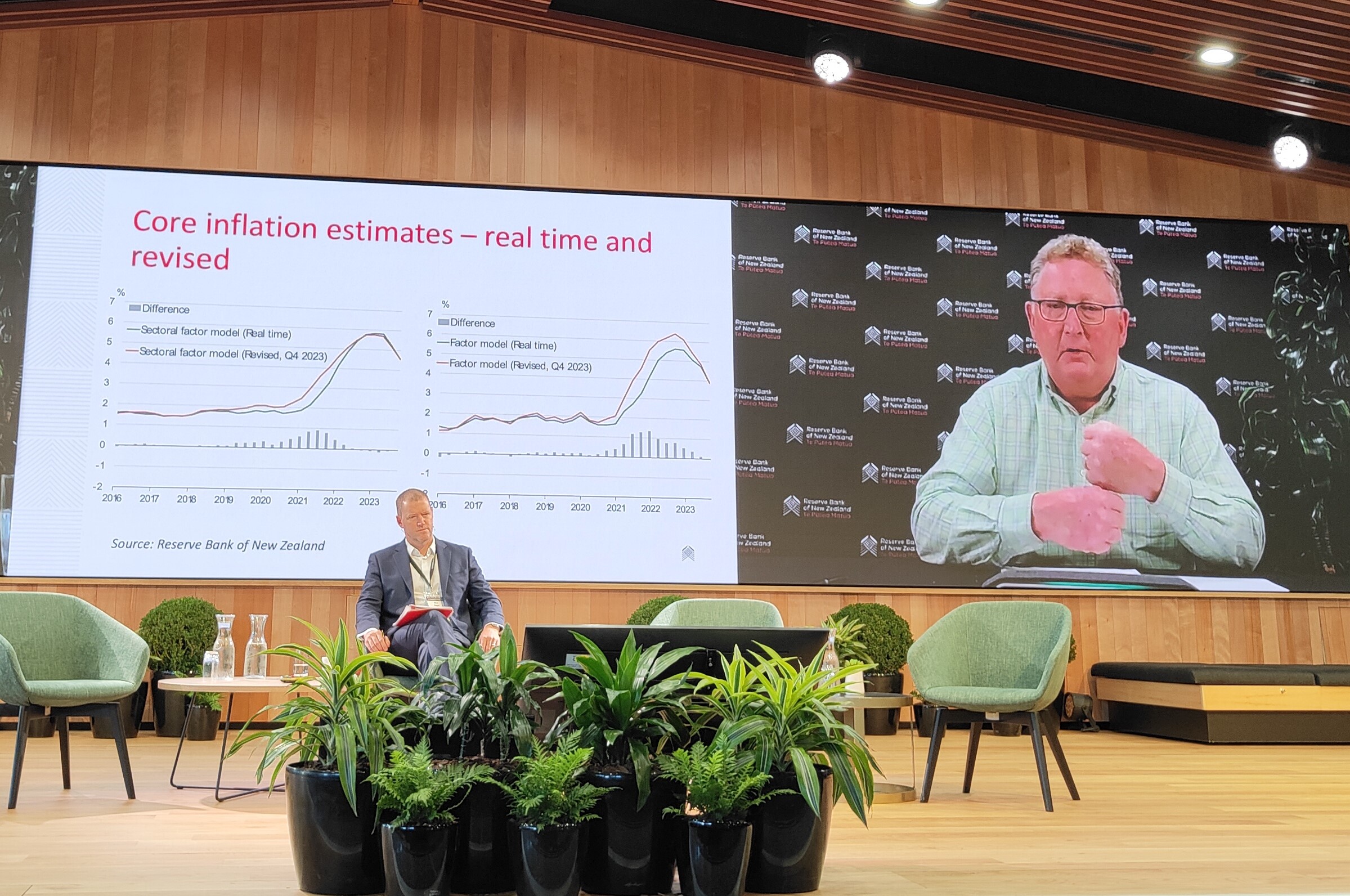
Adrian Orr with one of his slides, showing that core inflation as it actually transpired over 2020-22 was stronger than the lower real-time estimates available when decisions needed to be made (with Waikato's Prof Matt Bolger as moderator)

Takeaways? Some sympathy for the RBNZ's (and other central banks') challenges over the past few years: Covid, where Adrian reasonably asked, which mistake did you most want to avoid in the high-uncertainty crisis, and the answer was too-tough policy that might aggravate a downturn, hence the almost universal let-it-rip of both fiscal and monetary policy; the Team Transitory/Team Core debate; the interruption to normalisation from the Auckland lockdown; the Ukraine; and a recent rise in household inflation expectations. 

Expectations - which are interlinked with people's trust in the competence of a central bank (what us older folks used to call 'credibility') - look high on the bank's agenda. I noted in the speech that while inflation has come down, "tackling the tail end of these persistent inflation pressures in the domestic economy remains key to achieving 2 percent inflation. Just how persistent these pressures might be depends on how factors, such as capacity pressures and inflation expectations, evolve going forward". Adrian was giving nothing away about the next monetary policy decision (February 28) but if I were in the room I'd be looking at the latest annual non-tradable inflation rate (5.9%) and wondering if those capacity pressures and expectations levels needed a further knock on the head.

Onwards to fiscal policy, first with a keynote from Caralee McLiesh, Secretary to the Treasury, followed by a panel discussion on 'Treasury and the state of the books'.

Caralee's speech doesn't appear to be up on the Treasury website, but you can get the gist of it from the excellent 'Economic and Fiscal Context Slide Pack' which was part of Treasury's Briefing to the Incoming Minister of Finance. A key point was that our fiscal deficit is structural, not cyclical: as Caralee said, it tends to be easy to loosen fiscal policy in a downturn, and a lot harder to wind back the spend in better times, and we've now reached the point where belated policy tightening is needed (we'd got the same message from Nicola Willis the previous day). "Difficult distributional decisions lie ahead": quite.

Treasury Secretary Caralee McLiesh speaking to our rise in net public debt

The 'State of the books' panel - Craig Renney from the CTU, Eric Crampton from the New Zealand Initiative, Sarah Hogan from the New Zealand Institute of Economic Research - may have been intended to have been a battle of "duelling economists", as one person put it, but it turned out to be a lovefest of harmony and mutual understanding which coalesced around the theme of the importance of getting the best value for money from the public spend. 

As Craig said, there's nothing inherently "right-wing" in demanding value for money and nothing inherently "left-wing" in spending the right amount. Sarah pointed to health as one area where we are not getting value for money: Pharmac (she said) may take its lumps from its critics, but on the other hand it is a rare example in the sector when it comes to revealing its prioritisation. Other areas are either not transparent, or may not even prioritise in the first place. Eric would like us to retreat from the post-Covid spending bloat, perhaps to the same share of GDP that the Wellbeing Budget of 2019 represented (core crown spending of 29.1% of GDP, compared to the 33.0% expected for 2023-24 in last year's Budget forecasts): one reason was that people would be less likely to sign up to future rainy day spendups if they see previous ones sitting there unpaid for. And all the panellists were very keen on a really rigorous framework of prioritisation and evaluation: as Craig put it, "Think hard, and then think hard again".

The "duelling economists": Craig Renney, Eric Crampton, Sarah Hogan, with (on left) panel moderator Waikato's Prof Anna Strutt

Then we got a panel on 'Infrastructure: Unclogging the arteries', a topic close to my and I'd guess every other New Zealander's heart, given the increasingly shabby state of virtually all the infrastructure we use, from hospitals, classrooms, and roads to those infamous three waters. I drove down to Hamilton from outside Warkworth. The good news is that Warkworth to the approaches to the Harbour Bridge went fine (thanks to the new Puhoi motorway extension, even if it took forever to build), and Drury to Hamilton was fine (thanks to the new Waikato Expressway, also remarkably protracted). The bad news was that the intervening Harbour Bridge to Drury stretch remains an absolute nightmare, undoing a fair amount of the Puhoi/Waikato benefits, and the throttleneck looks like staying that way for some considerable time. There's a huge deferred bill looming: one speaker mentioned the Infrastructure Commission's estimate that we will need to spend $30 billion a year for the next 30 years.

Alison Andrew, CEO at Transpower, told us that while the current transmission grid is in good shape, (a) most of it was built in the '50s and '60s and is getting to its use-by and (b) there's an opportunity to green the country through electrification, but we will need 22 gigawatts of generation (and associated transmission) compared to today's 10 gigawatts. She didn't say it, but I personally wondered why the Commerce Commission regulates Transpower in 4-5 year bites, rather than over a longer-term horizon. Chris Joblin, CEO at Tainui Group Holdings, said it wasn't so much unclogging the arteries that's needed, but more like a double or triple bypass after being on the fags since the '70s: we just haven't being looking after our infrastructural health. And when we do bestir ourselves,  the consenting takes forever: he mentioned that it took 17 years to get Tainui's inland port at Ruakura (just beside Waikato University, as it happens) up and running. Among the issues: we look for perfection, which causes procrastination, and we load too many objectives onto projects, blowing out the costs and causing further rethinks. And Nick Leggett, CEO at Infrastructure New Zealand, agreed that we need to get our project management process right: we can occasionally rise to the occasion but mostly we're bad at it.

In passing, if the planning and project mismanagement omnishambles gets your goat, too, you'll like Daryl McLauchlan's piece for Democracy Project, 'Unjarndycing the State'. And if you'd like a piece on how we might do better, here's one I prepared earlier for Acuity magazine, 'Getting results'.

Life's too short, so I'll just pass briefly over the final two sessions. 'Climate & Weather: So what happens if we don't curb emissions?': answer, bad stuff,  and for some of the same reasons that our infrastructure record is so poor. As Sir Brian Roche said, we make a virtue of recovery from disasters, but we don't provide for preparedness in the first place. If 'value for money' was a recurring theme of the Forum, 'dynamic inefficiency', not investing enough to keep the show on the road, ran it a close second.

And in 'Fintech Futures: The end of cash?', no, cash is not dead, with the RBNZ's Karen Silk reminding us of why we still use it (full and final settlement, in privacy, plus benefits when, say post-Gabrielle, the ATMs and EFTPOS go down). And on the fintech side, we've had some successful financial innovation - we heard from Brooke Roberts, co-CEO of one of the successes, Sharesies - and while Brooke hoped that we will eventually have a global fintech come out of New Zealand, it's generally not as easy to get things up and running as it is in, say, Australia. Shane Marsh, cofounder of DOSH, also wondered about us falling behind. In my mind, I've always thought of New Zealand as a digitally advanced place - we were using EFTPOS for everything when our friends and rellies in Ireland, the UK or the US were still writing cheques - but the world's moved on, and we haven't. In Shane's view, our payments landscape is now well behind the rest of the world and even behind some of the 'developing' world .

Matt Bolger, Pro Vice-Chancellor of the Waikato Management School, sent us on our way with an uplifting message. While it's tempting to think that today's rate of change is unprecedented, Matt said we shouldn't get so up ourselves: how do we compare, really, with the generations who went through the Great War, the Depression, fascism and communism, and World War Two? And despite our current inability to plan properly for tomorrow's challenges, maybe he's right that we shouldn't get overwhelmed, and we should stay optimistic. It would be nice to think that New Zealand Economic Forum 2025 will be able to document that we're getting more of a grip on the issues that face us.

Wednesday, 21 February 2024

The New Zealand Economic Forum - Day 1

The University of Waikato's New Zealand Economic Forum 2024, on the theme of 'A briefing to the incoming government', kicked off in Hamilton last Thursday with a speech by Finance Minister Nicola Willis (below).

Nothing headline-making, but solid stuff: I liked the aim to lift our growth rate by removing go-slow regulation, the plan to have fast one-stop consenting for major projects, and to have more 'social investment', meaning prioritising social spending on the groups most at risk of being stuck in persistent disadvantage. In Q&A, someone asked about investment plans: there's apparently going to be a coordinated 30 year pipeline of projects, and about bleeding time. There are decision-making models maintained in the public sector that let you assemble optimal investment portfolios, and they badly need to be deployed, however belatedly, to make our infrastructure spend all that it can be. Chatting to another attendee afterwards, he wondered if the benefits and costs you need to feed into those models were reliable enough to avoid garbage in, garbage out results, but anything's got to be better than the lack of coordination we've had up to now.

The next two topics - agriculture and health - weren't my thing, but they had their moments. In agriculture, I'd never heard of AgriZeroNZ before: "A partnership between the New Zealand government and major agribusiness companies, we're helping farmers reduce emissions while maintaining profitability and productivity". Good stuff. In health, I heard a lot of sense from Professor Des Gorman. He said that we don't have a 'health' system, we have a disease and injury management system, paid for on annual levels of activity, which is self-evidently not ideal. He argued for a better 'tight, tight, loose' system focused on value for money: it would be tight in defining the health outcomes you'd like to see, tight in measuring what providers actually achieve, but loose or agnostic about what sort of providers you use. For those who would cry 'privatisation' of the public health system, his answer is that the system is largely private already, notably including your local GP practice. And for those worried about those dreadful private providers making a profit, in a competitive value-for-money system the answer is, "They're delivering more for less. What bit don't you like?".

After lunch we had a choice of 'Demographics are history' or 'Running tax differently', and my inner nerd chose tax. Graham Scott (gamely filling in for the unavoidable late withdrawal of Max Rashbrooke, also contactable here) reminded us that tax has its own comparative advantage - it has things it can and cannot do - and threatening to load it with multiple policy aims risked taking us back to the bad old days when we had a mad patchwork of specific sales taxes and other distortions and complexities. PwC's Sandy Lau was mostly happy with things as they are, though wondered if we need capital gains taxes, if only to reduce our currently disproportionate reliance on personal income tax. And Victoria's Professor Lisa Marriott's main point was over enforcement: she felt genuinely ratbag behaviour wasn't being sufficiently prosecuted by the IRD. Not only were people getting away with malfeasance, tax compliant businesses were being put at a competitive disadvantage relative to the scofflaws.

The session on 'Social investment: What difference will it make', led to a strong consensus that (a) there is a large group of people who suffer from persistent disadvantage (b) current social policy isn't cutting the mustard (c) by finding out what these people most need we can get better much better results especially if we focus on value for money from what we do and (d) we should regard what we do as an investment in people rather than as a cost. As Merepeka Raukawa-Tait put it, the time for wasted spending is over. Subsequent speakers pointed to a dramatically successful example that Maria English gave us, where providing tailored housing to a particular person saved nearly all of the very expensive 100 nights a year they'd previously been spending in a hospital bed. The session made complete sense to me, and I was quietly bemused how the winds have changed since Bill English (Maria's dad) championed this very approach, and got roundly rubbished for it.

My initial reaction to 'Trade: Dealing with a divided world' left me worrying: there's been an end of the "golden weather" of increasingly free and rules-based trade. Now there's fragmentation, rules flouting, disempowerment of the World Trade Organisation, protectionism, and 'security' concerns (real and paranoid). It very much felt like the trade front of Cold War II. MFAT's Vangelis Vitalis replied to my downbeat tweet that "I hope the conclusion left you feeling  more positive, i.e. we have a plan, agency, new options & advantages in key markets and are determined to protect and defend our hard won benefits through FTAs", and that we are showing "Policy entrepreneurship in international trade policy". He'd mentioned, for example, us successfully taking Canada on about their dairy trade protectionism. All fair comment, and it's good to know we're fighting our corner, but it's still a trickier wicket to bat on than it was before.

And the day wrapped with a session chaired by Steven Joyce on 'Monetary policy: Controlling what we can control'. Grant Spenser, ex deputy governor at the Reserve Bank, reminded us that the RBNZ, when it last reviewed how it had been going, found nine things it could work on, and wondered how they were getting on with them: he also noted that there appeared to be quite a blowout in operational spending and in headcount over the past six years. He also wanted to see more of a challenging culture at the Monetary Policy Committee from the independent members. I totally agreed: Australia's moved in that direction recently as well, with a boost in expertise and a requirement that independent members put their view into the public domain at least once a year. Bryce Wilkinson revisited some of the territory he'd covered in his publication co-authored with Graeme Wheeler, 'How central bank mistakes after 2019 led to inflation',  reminding us that monetary policy everywhere was relied on as being more of an exact science than it actually was, and that central banks made very poor inflation forecasts, even though that was their day job. Bryce said the global financial markets had also missed what was developing. And Henry Russell found himself in something of the spotlight given that the ANZ Bank had just made a big off-consensus call that the RBNZ would hike rates again (two moves of 0.25%), its reasoning being that the RBNZ had indicated back in November that it had little tolerance for any upside inflation risks, but they looked like they were getting some.

The monetary policy panel: Henry Russell (ANZ Bank), Bryce Wilkinson (Capital Economics / The New Zealand Initiative), Grant Spencer (ex RBNZ, Victoria University), Steven Joyce at the lectern

There was a really interesting discussion after the speakers' opening remarks, including around the ANZ forecast of hikes to come. Bryce thought that interest rates were now where they out to be on a Taylor Rule basis, and also that money supply growth had slowed down to very little growth at all (the latest 'broad money' measure, for example, is up only 3.6% on a year ago), both of which argued against hikes. Grant felt that with inflation already down quite a bit, maybe it would be better to hold and stay at current rates for a bit longer to see what happens. Henry, however, said that arguably a global disinflation supporting tailwind has blown out, that domestic inflation is still not good and might surprise on the upside again, and that while the pricing indicators in the ANZ business survey have stabilised, it was an open question whether they had stabilised at a level consistent with the RBNZ's inflation target. Policy issues raised but unresolved for another day: whether unconventional monetary policies (like quantitative easing) had been worth it; how monetary policy should respond to supply shocks; and whether the RBNZ ought to be both the setter of monetary policy and the financial prudential authority. Evidence from overseas is mixed, and against the canonical practice of economists having an answer to everything, I can't say I've got any clear opinion, either.