Showing posts with label inflation. Show all posts

Tuesday, 24 May 2022

When there's a will ...

You don't often see competition reform feature in the Budget, but we did last week.

"We are ... committed to boosting competition in the New Zealand’s grocery sector to ensure people pay fair prices for food and other basics", Grant Robertson said in the Budget speech. "Today, we are introducing legislation that will remove barriers to new retailers entering the market. Specifically, this will prohibit the restrictive covenants on land that major grocery retailers use to limit site availability for competitors. Such covenants will be prohibited immediately once the Bill comes into effect, and I anticipate that competitors can begin to consider new sites shortly thereafter".

The Commerce (Grocery Sector Covenants) Amendment Bill is here. It defines Foodstuffs North Island Limited, Foodstuffs South Island Limited, and Woolworths New Zealand Limited as 'designated grocery retailers', and creates a new s28A of the Commerce Act whereby "Certain grocery-related covenants are treated as prohibited and unenforceable" by deeming them as "having the purpose, or as having or being likely to have the effect, of substantially lessening competition in the relevant market", and so pinging them under the existing s27 and s28 of the Act. s27 we all know and love - contracts, arrangements and understandings substantially lessening competition - and s28 is its equivalent for anti-competitive covenants.

In its grocery market study (summary here, whole shebang here), the Commerce Commission had identified "more than 90 restrictive covenants entered into by the major grocery retailers, the majority of which are still active" (6.77) and "over 100 exclusivity covenants in leases entered into by the major grocery retailers, the majority of which are still active" (6.80). Clearly, this isn't a small issue, and it may be rather bigger than the Commission thought. On its helpfully proactive 'Market study reporting dashboard', Foodstuffs North Island says that it alone has removed restrictive covenants from 78 out of 135 affected properties (the outstanding ones are on land it doesn't own any more, and they are approaching the current owners to bop those off, too).

So it's good news that the government has moved quickly to implement the Commission's recommendations 2A, 'Prohibit restrictive covenants that relate to the development of retail grocery stores' (discussed at 9.68 - 9.72) and 2B, 'Prohibit exclusive covenants in leases that relate to the operation of retail grocery stores' (9.73 - 9.79). Their impact may be overstated - my guess is that planning laws restricting the supply of land available for supermarkets may be more important, as may planners' inclination to protect competitors rather than to protect the competitive process (hence the Commission's 'Recommendation 1F: Retail grocery store development should not be able to be declined on the basis of adverse retail distribution effects on existing commercial centres') - and the supermarkets look to have been dismantling them anyway, but it's progress. 

It's helpful that the political pressure to 'do something' about rising prices in the shops - a key focus of the Budget - helped bring about a quick competition policy response, and you'll excuse me if I snarkily add, 'for once', given the tortuous processes in getting s36 reformed, cartels criminalised, and indeed setting up the market study regime itself. When there's a will, there's a way, as they say. Moving this quickly, incidentally, means that you've only got a very brief window for submissions: Friday, in fact. The submission link is here.

But I hope that the "it's the supermarkets wot done it" line about inflation doesn't get taken much further. In April the Commerce Minister, Dr David Clark, commented on the 7.6% rise in New Zealand food prices over the year to March, and said that "The March increase is above general inflation figures and highlights the role the grocery sector is playing in driving up prices. Rising food prices is a global issue. Omicron, ongoing disruptions to global supply chains and Russia’s invasion of Ukraine is putting pressure on prices in every country, but that is exacerbated here by the lack of competition at the checkout".

Hmmm. In the US, annual food price inflation was 8.8% in March; in Canada it was 9.7%; in the UK it was 6.7% in April. Overwhelmingly, inflation is not a matter of grocery industry structure, but a result of those other global factors that the Minister mentioned: he might have thrown in monetary policy, here and overseas, being left too stimulatory for too long after the initial Covid hit. Blaming the supermarkets, if only in part, for current food price inflation may play well to the galleries, but it's not a strong argument. If, as he said at the time, he had "not ruled out going further than the options that the Commission tabled in its final report", fair enough: quite a few folks (but not me) reckon the Commission didn't go far enough. But I wouldn't take that step on the back of a not very convincing line of attack on inflation.

Wednesday, 13 November 2019

Good call

We've just had the Reserve Bank Monetary Policy Statement. In the pre-MPS poll that Daniel Dunkley ran for the Good Returns website I'd reckoned that it was a 50:50 call, but on balance (and in the minority who lucked into making a correct forecast) I leaned towards leaving the OCR at 1%. It's the right decision.

I'd been worried that another cut would risk the same counterproductive effect on consumer and business confidence that seems to have followed the Reserve Bank of Australia's latest cut to their cash rate - "if the RBA thinks things are bad, I'd better panic too" - and there were other factors suggesting doing nothing. Local business activity seemed to have bottomed out in the latest ANZ business survey; it could be a good idea to leave some monetary policy ammo in the locker rather than creeping ever closer to zero interest rates; and in any event in current global geopolitical conditions it might pay to wait and see how things unfold.

Plus domestic non-tradables inflation had gone over 3% in the September CPI (as shown below in blue, with the 2010 GST hike taken out): I like to look at it ex housing and housing utilities (in red), but either way it looks as if local inflation is already heading towards where the Bank would like it to go, and has been for two years. So sit on your hands, I thought, made sense for the Bank.


In responding to the survey I forgot to add that the RBNZ itself thought, at its August MPS, that inflation would get back to 2% by late 2021 with the OCR effectively unchanged. The forecast OCR track in August's MPS isn't easy to interpret - there are, for example, three successive quarters where the OCR is shown as 0.9%, and if you can explain the OCR track that gives rise to that pattern you're smarter than I am - but essentially the RBNZ thought we looked to be headed for 2% inflation last time without doing anything much extra.

Since then, two other things have occurred to me. One is that I wonder whether the distortions involved in driving inflation up from its current 1.5% to the target 2.0% are worth it. And the other is whether easing monetary policy further (and in Oz they now appear to be contemplating unconventional tactics as well - 'Reserve Bank gets the money printers ready') would be effective: what if we ventured even further into unknown territory and we still couldn't get a 2% inflation outcome? What would be the point?

On the distortions, I'm leaning towards the view that there is precious little effective difference between a 1.5% and a 2% inflation outcome: both are low enough not to distort economic decisions, but both are high enough to allow that little bit of lubrication that allows relative price changes to take place without some prices having to be cut in absolute terms. I wouldn't therefore invest a lot of effort in pushing 1.5% to 2%, and I note that the Monetary Policy Committee's 'remit' says "a focus on keeping future inflation near the 2 percent mid-point" not "the focus" (my emphasis).

So there's little upside benefit from straining harder for 2%, but there are costs. Current settings are already undermining, for example, much of the rationale for retail investors to invest in term deposits, and market commentary suggests that much of the recent sharemarket price gains reflect Mr and Mrs Bloggs taking money out of the bank and plonking it in dividend-paying equities. I can't say I'm hugely enthused about the incentives on the other side of the ledger, either, for corporate treasurers to tank up on artificially cheap debt.

There has to be some risk of inflating asset or debt bubbles. On Standard & Poor's calculations, the S&P / NZX 50 index at the end of October was trading at 24.8 times expected earnings. That's even more expensive than the U.S. market. Looking at the MPC's remit again, it says at 2(b)(i) that "the MPC shall ... have regard to the efficiency and soundness of the financial system": have any members started asking questions about the allocative efficiency consequences of where we are?

Even if that's a hard question to answer, I think it's pretty clear that whatever the distortionary costs are, they're likely more than deploying fiscal policy would involve. There's plenty of efficiency-improving infrastructural investment (including building the human capital skills of the unemployed and underemployed) that could push on our output gap and generate the desired inflationary pressure.

And can we even be sure, given the state of the rest of the world, that there is any sensible setting for local monetary policy that would actually deliver the 2% target? By sensible I mean a setting that does not have the exchange rate a long way away from purchasing power parity, or interest rates at very high or very low levels in real terms. The assumption has been that all we have to do is push the official cash rate to some non-absurd position on the dial, and 2% inflation will follow in due course. As the old DB ads might say, is that right?

The reason I ask that question is that I think there is some risk of forgetting the fact that we only have a limited control of our own monetary policy destiny. As Friedman's 'trinity' put it, you can have two, and only two, out of the following three: control of your own interest rates, control of your own exchange rate, and control of cross-border money flows. We've opted for our own interest rates, and free capital flows: the exchange rate which we can't control will be whatever it will be. What guarantee is there that the autonomous exchange rate will settle at a level compatible with 2% local inflation? None at all.

Chuck in the fact that we have only partial control of our own interest rates in the first place - we're effectively squeezed into the territory constrained by the zero lower bound and other countries' currently ultra-easy monetary policy settings - and it may well be that our limited room for interest rate manoeuvre (combined with that free-ranging exchange rate) isn't compatible with a 2% outcome. There's room to be sceptical about pushing ever harder on a piece of string.

Tuesday, 17 October 2017

Will the RBNZ hold off till late '19?

The inflation numbers we got this morning - headline annual rate 1.9%, with tradables inflation running at 1.0% and non-tradables at 2.6% - were a tad higher than expected.

The numbers are always hard to interpret. On the tradables side we get inflation dealt to us by developments in the rest of the world and  movements in the exchange rate, neither of which we can do much about. On the non-tradables side - the domestically generated inflation which is all the RBNZ can influence over the longer haul - the numbers are distorted by what's going on in the housing markets, which are currently running hot.

But at least we can strip out the housing element in various ways and see what's happening ex housing. Here's the picture (I've adjusted the data mechanically to take out the GST-related blip in 2010-11). The data starting points are driven by when they start on Stats' Infoshare database.


It doesn't really matter which ex-housing measure of domestic inflation you look at: they've all risen to a little over 2%.

So the question I'm left asking is: will the RBNZ really leave monetary policy unchanged till late 2019, as is currently its stated intention? Domestic inflation (ex housing) is already at the mid-point of the Bank's target, and tradables inflation could also easily be running at 2.0% or more: the IMF's latest World Economic Outlook has inflation in the developed world at 1.7% next year and inflation in emerging/developing economies at 4.4%. If you weight those up to get a world inflation rate, it comes out around 3.3%. Call it  3%: then if the NZ$ stays where it is, and domestic inflation (even after taking out the hot housing bits) stays at say 2.25%, then you get overall inflation running at around 2.5%.

That doesn't sound to me like a great case for leaving monetary policy on an accommodative setting all the way out to late 2019. The financial futures market doesn't think so either: 90 day bank bill futures, for example, are pricing in a 0.25% increase by the end of next year, a full year before the RBNZ says it will increase rates. Some folks think it could be earlier again: the BNZ's latest forecasts, earlier this month, see the RBNZ hiking the official cash by 0.25% in the September 2018 quarter.

Any sane central bank won't react to one quarter's numbers, and everyone - central bankers and private sector forecasters, and that includes me being as wrong as anyone else - have all been repeatedly blindsided by inflation not appearing like it was supposed to. But on the latest data I think I'd be sketching in the prospect of higher interest rates a good deal earlier than the Bank has been signalling.

Thursday, 10 November 2016

"My work here is done"...

All as expected from the Reserve Bank today, the OCR cut to 1.75% and expected to stay there "for a very long time", as its head of economics John McDermott put it. All going well, Governor Graeme Wheeler can put his feet up for the final year of his current contract: his work here is done. And the economic outlook, while still beset by significant uncertainties, is looking good by developed economy standards: GDP growth in the pipeline of around 3.5% a year or a tad more, and the unemployment rate dropping to 4.5%.

Some interesting graphs from the Monetary Policy Statement. First up, what's been happening to the domestic 'non-tradables' inflation we generate here in New Zealand (I'd had a look too when then the latest data came out).


It looks like it's bottomed out and is now rising. More importantly, here's where the RBNZ thinks it is headed.


So we'll have to start recalibrating our thinking about what to expect when those brown envelopes hit the letterbox.

And then there's this, which shows how the RBNZ thinks the OCR might need to move if different combos of possible scenarios were to play out. Not everyone likes these 'fan' charts, but they have their uses, and in this one you can see the indefinitely-low OCR as the Bank's best call right now, but you can also see the range of uncertainty around it, running from an OCR of 0.5% through to 2.75%.


And I put it up just to remind people that, even with models up the wazoo, forecasting is an inexact art (as a certain election yesterday vividly reminded us), and that we ought to be a bit more charitable about those faced with making tough calls in uncertain circumstances (as I've also argued here and, especially, here).

The post-Statement press conference had its interesting moments. We now know, for example, that the "neutral" level of the OCR is now estimated to be around 4% rather than the 4.5% that might have been appropriate in a world where inflation was higher (an estimate adroitly winkled out by the NBR's Rob Hosking, whose write-up of today's decision is here).

Only the anointed get invited to the press conference these days, but if I'd been admitted to the elect, I'd have liked to have asked about what the Bank meant when it found, in its latest soundings with businesses around the country (reported on p25 of the MPS), that
High levels of competition are compressing margins and firms are thinking strategically about how to ease this pressure.
I'm pleased to hear about vigorous levels of competition, and not surprised businesses are looking for clever ways to cope. The smartest way would be to innovate yourself into a position where you can charge better prices for a better product.

But there can be less benign strategic responses to easing competitive pressure. These strategists are, I trust, planning to stay on the right side of s27 of our Commerce Act ("contracts, arrangement or understandings substantially lessening competition"), s30 (price fixing), and s47 ("A person must not acquire assets of a business or shares if the acquisition would have, or would be likely to have, the effect of substantially lessening competition in a market").

Wednesday, 19 October 2016

Now you see it, now you don't

Yesterday's inflation data held no great surprises. Everybody expected a pretty low number for inflation during the September quarter and for the year to September, and they got it: 0.2% for the quarter, 0.2% year on year.

Cue for hand wringing over the Reserve Bank yet again allowing inflation to stay too low.

But here's the thing.

We know the overall headline rate of 0.2% can be split into two bits, the bit that happens in the 'tradables' world of exports and imports, and the 'non-tradables' bit that happens in our own economy, the likes of the local authority rates, the doctor's bill, or the school fees. And we know that the overall 0.2% outcome was made up of tradables prices falling over the past year by 2.1%, while non-tradables prices rose by 2.1%.

The Reserve Bank has sod all influence over the tradables bit, except to the extent that it might manage to control the exchange rate, which influences how much of the world inflation rate comes through to us. But it (and any other central bank) tends not to be able to steer exchange rates terribly well, so in practice whether the Reserve Bank is on top of things comes down to whether it is steering non-tradables inflation to where it needs to be.

So let's have a look at that non-tradables inflation in more detail. Here it is.


The blue line is annual non-tradables inflation, which is running at 2.1%. So remind me again how the Reserve Bank hasn't got inflation back up to 2%, the midpoint of the 1% to 3% band it's supposed to be focussed on?

But (you'll say) that 2.1% rate of non-tradables inflation isn't all it's cracked up to be. It's not really 2.1%. It's inflated, innit, by the housing market. And you're right, it is. But if you take out the cost of new houses, you get the green line, non-tradables ex housing. It's running at 1.8%. That's not too bad, either, if you're supposed to be aiming at 2%.

Course (you'll reply), there are other housing-market-related things still being counted in that non-tradables ex housing line, in't there? Rent. The cost of keeping the house in good running order. The rates. And again, you're right. So let's purge the non-tradables inflation of every damn house-related thing - the cost of a new house, the rent, yadda yadda yadda.

That gives you the red line, non-tradables less anything to do with a house. On that basis non-tradables inflation is running at 1.25%. That's short of the Reserve Bank's 2% focus, so you could beat them about the ears if you felt like it. On the other hand, it's at least crept back into the 1% to 3% band, and it's clearly headed in the right direction. Every one of these measures has been on the rise all year.

One of the big mysteries of macroeconomics recently has been, where's the inflation gone? Why hasn't it come back like it used to when things pick up? That's a big topic, and everyone from Janet Yellen at the Fed to Philip Lowe, the new governor of the Reserve Bank of Australia have been having a crack at it, and I'll come back to it one of these days.

My thought today, though, is this: maybe it's actually come back, and we haven't noticed.

Thursday, 13 October 2016

A picture is worth...

What is it about graphs?

We're supposed to be living in a new world of 'dataviz' journalism where bright young things are taking data and doing clever stuff to it and turning it into attractive visualisations with insight and oomph. And some people are, like the folks at figure.nz. But as far as I can tell nobody in the major mainstream or social media has run with any of the graphs that the Reserve Bank's John McDermott included in his speech on Tuesday, 'Understanding low inflation in New Zealand'.

So here are some of the more interesting ones.

This is where inflation (or the lack of it) has been coming from, by sector.


Ex sin taxes on fags, and ex anything to do with housing (admittedly a fairly large 'ex' to 'ex'), there's precious little inflation around. Some of that is pure luck (world oil prices). And some of it, I'm pleased to say (wearing my 'competition is good for you' hat), is down to stronger competition in areas like air travel and (especially) telecommunications.

Here's another way of looking at it - roughly speaking, how much of our inflation is coming at us from world markets ('tradables') and how much we're creating in our essentially domestic markets ('non-tradables').


You'll notice that we're not generating much inflation of our own. John's not convinced that there's anything long-term about this, and reckons that there's cyclical stuff happening that explains it. Me - I'm not too sure. I suspect that the GFC put the fear of God into many business decision-makers and households, and the impacts haven't worn off yet: we could have inherited a change in behaviour that is more 'structural' than cyclical. It could be that greater caution about raising prices or asking for a pay rise helps explain why we're raising prices more slowly than we would have in previous cyclical upturns. We'll see.

Another interesting one is this age breakdown of net migration


You might have had some preconception, especially given the publicity around the government's recent move to tighten up on 'family reunion' style bring-in-your-mum-and-dad-too immigration, that there was a lot of it about. There is some, and the number of older people coming in has been rising, but the reality is that by far the largest parts are younger people, and people in their prime earning years. John raised it in the context of different age breakdowns having different effects on inflation: more younger people (as at the moment) have a smaller impact on inflation than more older people.

And finally, there's this, which shows the Reserve Bank's history of trying to guess where the Kiwi dollar is going next (in overall trade-weighted value).


There will be those who will use this to poke the RBNZ in the eye, and I'm kinda bemused myself. It's odd that everywhere you go, from central banks to surveys of businesspeople, people (and I've done it too) keep making the same rather mechanical forecast: if the exchange rate is going up, it'll go up a little more, but then fall, and if it's going down, it'll drop a bit more, and then go up.

But it's a seductively easy thing to do, especially if you believe the exchange rate has wandered away from the One True Level where it needs to be, and that sooner or later it will revert to it. Easy - yes. Accurate? Not so much.

Thursday, 11 August 2016

Interesting detail from today's Monetary Policy Statement

There is some really interesting material in today's Monetary Policy Statement (pdf file).

On the downside, there's an analysis of world dairy production, which shows (in the graph below) a strong and probably ongoing surge in world dairy supply. We can't see the demand curve as easily, but it may not be strong enough to absorb this new supply: as the MPS said, "While demand for dairy products is expected to be supported in the long term by growth in emerging markets, high global production is likely to weigh on prices in the medium term. These factors have led the Bank to revise down its medium-term assumption for whole milk powder prices". I'm no expert on dairying, but unless there is some quick and large fall in the NZ$, I'd say the already high levels of financial stress on our dairy farmers are going to be stronger, for longer. Not good at all.


Housing is top of mind for a lot of people at the moment. Here's a fascinating graph: look at that black line in the graph showing house price inflation ex Auckland and ex Canterbury. Basically it shows that quite a few people have been saying, "My house in Pakuranga is worth $1.5 million? Sold, it's yours, I'm off to Nelson", and quite a few other people have been saying, "Here come those jafas. Jack the price up".


Is it all going to fall over anytime soon? No, says the RBNZ. It has house prices still rising, at a national level, over the next few years, though rising at a far slower rate. We'll see.


If I parted company with the RBNZ over any of its analysis, it's over net migration and our output gap. On migration, the RBNZ has net migration dropping away quite a lot, and reasonably quickly. They could be right, but I'm more inclined to believe any drop-off will be more modest than that. There seems to be a political anti-immigration head of steam building up which might curtail inflows, but if that doesn't eventuate, our relative cyclical positioning in the global economy seems to me to be more consistent with net immigration holding up more than the Bank is picking.


The output gap - is there lots of spare capacity (a "negative" output gap, and so little domestic inflation), or very little (a "positive" gap, with stronger inflationary pressure) - is a key variable. Measuring it is inherently iffy, but the RBNZ's best guess is that the economy is currently roughly at capacity: the output gap is neither strongly positive nor strongly negative. As the graph below shows, the Bank believes the output gap will turn increasingly positive in the next couple of years, helping to push prices up.


I'm not quite there myself. On a very basic calculation, if the labour force keeps growing at its current 1.7%, and business investment grows by 6% (the Bank's forecast), the economy has the potential to grow by around 3.1% (two-thirds weight on labour, one-third on capital), plus throw in some modest overall productivity gain, and you get to 3.3% or 3.4% growth in the country's output capacity. If the economy actually grows at around the same rate - which is the Bank's forecast - then the output gap doesn't change at all, and domestic price pressures don't build up like the Bank expects. Its job of getting inflation back to 2% will be harder than it thinks it is.

But we knew that.

Friday, 5 August 2016

We are not alone

Although we are heavily intertwined with the global economy, us New Zealanders are not terribly good at living with its corollary: while we like gotcha! blame-finding of local bigwigs, the reality is that a lot of what happens here has precious little to do with anything we've done (or neglected to do), and has a great deal more to do with the great sweep of world affairs. Even our surging house prices (as I argued yesterday) have a substantial international context to them.

Along those lines, I've had a go recently at suggesting (in 'Give the guy a break') that we should cut our Reserve Bank governor some slack. Yes, inflation is still below target. Yes, forecast inflation has been too high. Yes, the Bank raised interest rates in 2014 and (with hindsight) probably shouldn't have. But none of this is at all unique to New Zealand. It's not all, or mostly, or even a fair bit, down to Graeme Wheeler and the team at No 2 The Terrace.

What got me thinking about it again was today's Statement on Monetary Policy from the Reserve Bank of Australia. Here's one graph from it that's worth poring over. It shows that we are in the same boat as the rest of the world: with few exceptions (certainly in the developed world), inflation everywhere is lower now than it used to be, and lower than central banks would like it to be (Australia ditto). Local missteps or inaccuracies can't be any big part of the story.


Here's another, showing how the US Fed - arguably the most sophisticated central bank in the world - has been wrong-footed by this unexpectedly low inflation: again, it's not just us. Earlier this year the Fed thought that it would be marching the Fed funds rate smartly up to 3% by late 2018 ('FOMC' in the graph is the Federal Open Market Committee, the Fed's policy-setting group). Now it thinks it'll be more like 2.4%, and chances are that 2.4% is still miles too high: the financial markets' expectations are for sub 1%. The financial markets themselves have also been forced to have a rethink.


Just as ours have. Here's the comparison between the March and June consensus forecasts for our 90 day bank bill rate (from the NZIER's latest consensus poll). You can see (near the bottom) the expected track has been revised down by 0.5%, which is a large change for a single quarter.


Of course we should avoid making any egregious errors of our own. And of course we should aim to do a bit better than the international average. But when things appear to have gone off the economic rails and we're tempted to bag someone for it, it will often be a good idea to take a deep breath and check whether we're wrestling with the same issues as everyone else.

Monday, 18 July 2016

How low is it really?

You'll have likely seen the news that overall inflation has come out lower than the Reserve Bank's target, and lower than forecasters had expected: 0.4% in the year to June, made up of tradables prices down 1.5% and non-tradables up 1.8%. Full details from Stats here.

With the overall CPI at the mercy of exchange rates and international commodity, things that the Reserve Bank has little or no control over, I like to look at one of the sub-components that gives us a better idea of how domestic inflation is going - non-tradables inflation (i.e. generated domestically), but excluding housing and the housing utilities group, which as we all know is running hot. And yes, the housing inflation is a real phenomenon in its own right, but for present purposes I'd like to see how everything from the school fees to the vet's bill are going. Here it is. I've included a mechanical "but for the GST rate increase in 2010" adjustment.


If you're the Reserve Bank, this is (at best) slightly encouraging. Domestic inflation has stabilised, and it's a bit higher (0.9%) than the headline 0.4%. But it too is just below the bottom of the 1% to 3% target band, and well adrift of the 2% mid-band point the Bank is aiming for.

Thursday's economic update from the Reserve Bank is going to be interesting...

Monday, 27 June 2016

It's all in your head

The Reserve Bank came out with a new discussion paper last week, 'Inflation expectations and low inflation in New Zealand'. While Discussion Papers are "mainly for academic and professional economists" - and, I should add, represent the staffers' views and not the Reserve Bank's - this one is relatively easy going, and worth a look, because the authors (Özer Karagedikli and Dr John McDermott) have had a go at investigating one of the major puzzles in modern macroeconomics: why inflation has stayed unusually low.

There are other biggies - why has productivity growth (assuming we've measured it right) slowed down and what if anything can we do about it, and what can (or should) policymakers do if they run out of fiscal space and/or hit the zero lower bound for interest rates - but the unexpectedly low inflation puzzle is front and centre across the developed world.

I'd love to say they nailed it, but once I'd got my head around what they'd done, I wasn't totally convinced.

The heart of their argument runs like this. Inflation expectations affect actual inflation: if (for example) people expect low inflation, they'll settle for low wage rises, which will feed into low actual inflation. Fair enough. And then they say: what if inflation expectations don't just arrive out of the blue but are (partially or largely) influenced by actual inflation? Suppose actual inflation is, unexpectedly, only 1.5% instead of 2.0%. People revise their expectations down in line with the lower actual rate, and their lowered expectations (and the price and wage behaviours that follow) drive actual inflation lower again, to say 1.0%. Expectations are revised again ... you get the idea. Voilà - a self-fulfilling circle driving inflation down (or up, if the initial surprise had been higher than expected actual inflation) and one that has nothing to do with the strength of the economy or other things you might have expected to dominate what happened to inflation.
So they built a nice little model, which worked just as they argue. If you'd like to go through the details I've got a summary below, though you'll find the paper accessible enough in its own terms if you'd prefer to go to the source.

It is an interesting paper. But I was left with several questions at the end of the exercise.

The first is around how they model expectations. They say, people's expected rate of inflation will be some blend of (a) the latest actual outcome over some recent period, a backward looking measure, and (b) the expected inflation rate as measured in a survey, a forward looking measure. And they find that, modelled this way, not only do expectations have a strong influence on actual inflation but the weight that people apparently place on the latest actual inflation rate has increased markedly since 2008-09. So you have an explanation for the persistence of low inflation: a self-validating and strengthening feedback loop from low inflation to even lower expectations to even lower inflation again.

But this is all rather odd. The survey that asks about people's expected inflation rate is their inflation expectation, by definition. Subsequently saying that expectations are actually a mixture of those expectations and actual inflation is a bit of logical gymnastics I can't quite follow. But, as they say, "The empirical treatment of inflation expectations is crucial for the purpose of this paper", and if you're not convinced by their formula (and I'm not), some of the results fall over.

Even if you go along with their approach, though, you're still left with other questions.

One is: why? Why did people change in recent years from putting more weight on what they expect to happen, to putting more weight on what's actually happened? Have they suddenly stopped believing that they can get a handle on what lies around the corner - which wouldn't surprise me, in a post-GFC, post Brexit world? The researchers may well have unearthed an interesting mechanism or process, but we're still left with an unsolved, if different, problem.

Another question is: in the world they've modelled, what's happened to central bank credibility? If everybody believed their local central bank would indeed keep inflation around 2% (or wherever), then their expectations would stay around 2% irrespective of any wobbles in actual inflation along the way. Perhaps people in New Zealand (and the eurozone, and Japan) have indeed thrown in the towel and now prefer to believe the evidence of their own lying eyes rather than subscribe to what central bank governors say. If true, that's important, but again it raises a whole new research agenda to unpick the next layer of answers.

Bottom line? Because of the somewhat idiosyncratic modelling of expectations in this research, I wouldn't get too hung up on its exact outcomes. But I think it does make a good, wider point. Expectations have always mattered: that's seen most obviously in hyperinflations and deflations. But clearly they matter in more normal times, too, and they may not have got the policy attention from central banks that they should have.

That's changing. In the US, the Fed has been paying more attention to the financial markets' view on five year forward inflation, for example, and recent Monetary Policy Statements from the RBNZ have been zeroing in on expectations, too: they've included an 'inflation expectations curve'. So far so good: the big issue, though, is having realised that expectations matter, and possibly matter a lot, do central banks know how to manage expectations back towards levels more consistent with the banks' inflation targets?

Monday, 7 December 2015

The dance of the seven veils (economist version)

..and what I mean is, I'm going to show you a series of graphs, but I'm going to take my time baring all.

Here's the first bit.


This shows our actual official cash rate (the OCR, the bold black line) over the last couple of years, compared with the Reserve Bank's projections of where it thought the cash rate would need to go (the various coloured lines, which are forecasts the Bank made at different times). You'll see that recently the OCR has gone down, though the Bank had thought it would need to go up. In our 'gotcha' culture, there have been plenty of people to say the Bank made a 'mistake', but as I've said before, that's probably not the best interpretation. People make the best decisions they can under considerable uncertainty, and every now and then they get blindsided.

Right. here's the next bit.


This is the entire history of the Bank's interest rate projections, since we started on the inflation targetting caper, compared with what actually happened.

I could look at this graph for hours. No, really, I could. It's fascinating.

If you were a blame-seeking muckraker, you could go to town on this. "For over twenty years the Bank has been saying that the OCR will need to go here, or there, and the OCR has gone somewhere else. Heads must roll!" But since we are reasonable people who understand nuance, reality, complexity and uncertainty, let's try some different responses.

My first thought was that it said something about forecasting. Very often, in the financial markets, the default forecast is that something that is going up, will go up a little more, and then drop back (or, if it's going down, will drop a little more, and then rise). You see it all the time in, for example, forecasts of exchange rates. The default tends to be some kind of "reversion to the mean" - people tend to think the current trend could run on a bit more, but will eventually drop back to something more "normal". So my initial reaction was that this looked like a not very sophisticated forecasting scheme.

But in talking to some folks at the Reserve Bank's modelling workshop today, I came to the view that there's something else happening. These aren't really "forecasts" in the normal sense of "what will happen to something": rather, they're actually the RBNZ's view of what OCR will be needed to keep inflation inside the RBNZ's target range. Seen in that light, what the graph arguably shows is that the RBNZ has tended to think that monetary policy is more powerful than it actually is.

For example, over that period from 2004 to 2007, the Bank thought that modest increases in the OCR would have enough oomph to keep things under control: in fact, the OCR had to rise a lot more than that to do the job. Similarly, in the weaker post-GFC period, the Bank thought a brief period of stimulus would be enough to fire things up. In the event, it took a much longer time, and much lower rates than the Bank had expected to wield, to try and work inflation up again. And it hasn't succeeded yet: it thinks it's on track, and that today's low interest rates will be enough to get inflation back to near 2%. But on this showing it's just as likely that monetary policy still isn't as high-powered as you might imagine, and that even lower rates for even longer might be required.

You might think, why has our central bank held this overoptimistic view of the influence of monetary policy? I don't have a good answer to that, but - and here comes the next bit of the striptease - we're in good company. Here are the equivalent forecasts made by the Norwegian and Swedish central banks, in both cases dating from when they also embarked on the great inflation targetting adventure.


Interestingly, they have both tended to err in the same systematic way - they have persistently thought that interest rates would need to be higher than actually proved necessary. Part of it is happenstance: the post-GFC global economy has been a strange place, where central banks might have reasonably expected inflation to have picked up as the global economy has recovered, but it hasn't, for reasons that aren't clear yet. And part of it, in my view, is that when a central bank first sets out to be an inflation targetter, it's absolutely got to establish its credibility early in the piece. And above all, that means not letting inflation go above target. So there's an inevitable tendency to want to set rates at a conservatively high level that takes an inflation-above-target outcome out of play. You can see something much the same playing out in the early days of our own experience.

All of this, by the way, came from an excellent paper albeit with the rather opaque title, "Monetary policy forecast and global indicators", presented by Hilde Bjørnland (BI Business School and Norges Bank) at today's workshop. It's not up on the RBNZ's website yet, but it'll be well worth your while to have a read when it is. I'd also recommend "International inflation dynamics and the New Keynesian Phillips Curve: The role of the global output gap", by the Bank of Thailand's Pym Manopimoke, where she shows that global influences are playing a larger role in individual countries' inflation outcomes, and the rather inscrutably named "Foreign shocks" by Norges Bank's Drago Bergholt, where (if DSGE is your thing) he improves your workhorse DSGE model to allow for a greater influence for international linkages.

Friday, 18 September 2015

Extraordinary ignorance

We got a remarkable insight recently into something very odd indeed in New Zealand, and it came from a rather unlikely source, the latest Brookings Papers on Economic Activity conference.

One of the papers presented was 'Inflation targeting does not anchor inflation expectations: Evidence from firms in New Zealand', a paper with four co-authors, one being AUT's Saten Kumar. You can read the abstract and media release, or the whole paper: even if you don't often read more academic papers, this one's worth it. It's pretty easy to follow - indeed, the authors have a rather non-academic flair for making their points crisply and colourfully.

The main focus of the paper is whether inflation expectations are 'anchored': roughly, do people clearly believe that inflation will stay reliably low? They look at five possible ways of assessing it: for example, do expectations vary very widely across the population rather than most people being in the same sort of place? Do expectations jump all over the place from one time period to the next? And so on.

On all five criteria, they find that the business managers they polled did not have settled inflationary expectations. As the abstract puts it
Managers of these firms display little anchoring of inflation expectations, despite twenty-five years of inflation targeting by the Reserve Bank of New Zealand, a fact which we document along a number of dimensions. Managers are unaware of the identities of central bankers as well as central banks’ objectives, and are generally poorly informed about recent inflation dynamics. Their forecasts of future inflation reflect high levels of uncertainty and are extremely dispersed as well as volatile at both short and long-run horizons. Similar results can be found in the U.S. using currently available surveys.
This leads into all sorts of serious cogitation about the efficacy of monetary policy, the need for central banks to communicate better, and how people form their inflation expectations, and if you're a monetary policy tragic you'll love it.

But it also says something pretty damning about the level of ignorance among New Zealand's business community. I'll pass quickly over the facts that only 31% of managers could identify the main objective of the Reserve Bank, and that only 30% could name its governor (even when, in both cases, they were given prompt sheets of the possible answers), and concentrate on this one. Here's a table (clipped from table 7 of the paper) of responses to the question, what inflation rate do you think the RBNZ is trying to achieve? Column 1 shows the possible answers, column 2 shows the percentage of managers who opted for each possible answer, and column 3 shows what they thought actual inflation would be over the following year.


As the authors summarised it, "Of the respondents, only 12% correctly responded 2%, although an additional 25% said either 1% or 3%, the bottom and top of the target range of the RBNZ. But 15% said the RBNZ’s target inflation rate was 5%, 36% said the target was more than 5%, with 5% of respondents saying that the RBNZ’s target inflation rate was 10% or more". Just over half (50.9%) thought that inflation was going to be at least 5%. It turned out to be 0.8% (year to December '14).

Now, I know that there will be a lot of managers doing a perfectly acceptable job of getting the widgets made and out the door, with or without knowing what the rate of inflation is or exactly what the Reserve Bank is trying to do. I'd suggest, particularly if they come anywhere near the strategic planning end of the business, that they're nowhere near as effective as they might be, but there's surely a valid role for heads down, bums up, and get the salads packed and despatched.

And I know that those of us who are into macroeconomics can sometimes forget that others aren't as familiar with the jargon and the details, and that you can actually have a life without delving into the national accounts or the CPI. People get caught up in their own preoccupations, but we don't all need to know the niceties of the LBW rule.

And I know that other countries can be just as bad: the paper documents a similar pattern in the US, though that's little comfort. Not many of us would like to be found on a par with what's happening in twilight Trump-or-Cruz America.

Apologetics apart, though, let's face it: this is a staggering level of ignorance. It makes you ask, among many other things, what on earth the secondary schools can have been teaching in their economics classes over the last twenty years. It leaves you thinking that one of the reasons for our well-documented issues with productivity might well be ill-equipped management. And it makes you wonder about the level of understanding voters have brought into the polling booths: as I've written before, every general election has brought proposals for changing our monetary policy regime, ranging from the potentially promising to total nonsense. How likely is it we'll get a good outcome when people have only the foggiest idea of the current arrangements?

A statistical addendum The first, and often the only, rule when you find extraordinary data like these, is that the data are wrong. They've been mismeasured, someone didn't clean the test tubes, there's an error in the spreadsheet. And I can't quite shake the doubt in this case that there might be a self-selection bias in the survey the researchers carried out. When they first sent the questionnaires out, they got a 20% response - a pretty good outcome. But what if the more clued-in managers opened the envelope and said, "Jeez, I've done enough of these, I'll pass", and the less clued-in ones said, "Wow, no-one's asked for my opinion before"? And if that happened, the potential self-selection bias probably became more acute as an issue in later waves of the survey, since the researchers only went back to people who responded to the first wave. There's a risk that the surveys could have progressively zeroed in on the most clueless. Whether it happened, or what difference it might have made, I can't tell, and it might be completely off the mark, so I'll take the data at face value. Overseas evidence of the same ignorance is rather suggestive that this paper is broadly right anyway.

Thursday, 10 September 2015

Nothing to see here, folks, move along

No surprises in today's Monetary Policy Statement - and that's fine: it's best if central banks don't have to make abrupt moves, and it's also a good thing when market expectations, and what the RBNZ actually delivers, are lined up. One 0.25% cut today, and another one likely by the end of the year, is what everyone expected,  and that's what they got. All good.

Sometimes the most interesting things are in the details of the text (pdf), but again there's not a lot to pick over this time. You may have seen some folks talking about potential recession ahead: that's not the RBNZ's view. Here's their forecast for GDP growth: the low point for growth is around now, with things picking up next year.


If I had to pick on anything, it's on the inflation outlook, and especially the outlook for the inflation that we generate here in New Zealand ('non tradables inflation'). Here's the Bank's best guess at what's going to happen.


You'll see that non-tradables inflation is expected to drop a bit more (in June it was 2.1%), and then pick up again. But inflation everywhere in the western world has turned out lower than central banks had expected: will it actually pick up again like the Bank thinks?

The reason I ask, is that domestic non-tradables inflation tends to be associated with the economy running flat tack - or in the jargon, at or above its 'potential output' level. But on the Bank's own projections (shown below), the economy isn't likely to be going flat tack (the forecast blue line in the graph never heads well above 0).


So there's still a risk that inflation, which has been somewhat stubbornly below the middle of the Bank's target 1%-3% range (and indeed, currently below the 1% end, never mind the midpoint), will stay that way. But that said, this was otherwise very much an 'as expected' announcement.

Wednesday, 29 July 2015

Where has inflation gone?

I know, I know, the media are already full of coverage of today's speech by Graeme Wheeler, the Governor of the Reserve Bank (short version here, full thing here), and you probably don't want much more, especially if you've already had enough of the partisan point-scoring.

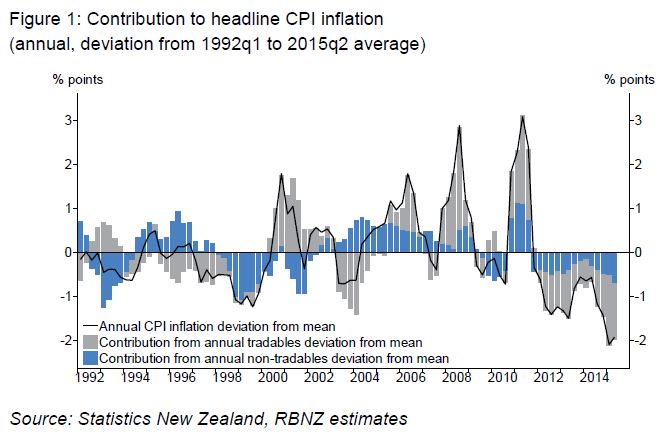
But I would like to expand a bit on the graph below, from the speech, which shows inflation consistently coming in below the Bank's target mid-point in recent years, and which has been fuelling some of the criticism of the Bank - either because its forecasting has been poor, or (hence or otherwise) because it's been running monetary policy too tight.


I'm interested in the blue, non-tradables, part, which is the only bit under our control. It's been lower than usual, and we partly know why (investment in capital equipment and a larger labour force have boosted capacity, so growing demand can be accommodated without inflation). But even after that's accounted for...
Non-tradables inflation has been about ½ of a percentage point weaker on an annual basis than the Bank’s modelling estimates would suggest is normal for this phase of the economic cycle, even allowing for the stronger growth in economic capacity. This underestimate of inflation has also occurred in other countries and could be due to several factors. For example, inflation expectations may be weaker than survey data suggests, the tradables component of non-tradable products and services may be higher than previously thought, or online commerce may be increasing competition and squeezing margins in non-traded sectors, such as retail.
I'd love to think that increased competition - from online commerce or other sources - is helping to discipline price increases for our domestic goods and services. That aside, it's clear that both here and overseas our overall state of knowledge about this unusually low inflation is inadequate. Until that gap is filled in, there's the possibility that central banks everywhere may be needlessly on guard against an inflation threat that isn't there.

Thursday, 11 September 2014

So far so good

Today's Reserve Bank monetary policy decision came as no surprise - as predicted, for example in this survey, the cash rate was left unchanged. Can't argue with the decision, either: more "wait and see" was exactly right while we see the ramifications of previous rate increases (which are indeed cooling the housing market), lower export prices (especially in the dairy trade), and, of course, what the post-election government looks like.

I was also encouraged by a graph (below) which the RBNZ included in the Monetary Policy Statement, and which showed that the rate of domestic non-tradables inflation is very modest indeed outside of the construction sector.The overall non-tradables inflation rate is 2.7%, but on the RBNZ's estimates nearly all of this is down to the understandable cost pressures in the building trades.


I'd thought that our home-generated non-tradables inflation, other than on the building site, was running hotter than this, and didn't like the look of it, but so far, so good. Looking ahead, domestically sourced inflation will pick up from here, given that the currently strong economy is running above its "potential output" level, so let's hope that the Bank's view is correct that "the pick-up in non-tradables inflation is assumed to be gradual, and annual non-tradables inflation is forecast to peak at 3.4 percent in 2016". I'm a bit more agnostic about a 'cost plus' mentality in the more sheltered parts of the New Zealand economy, but let's see.

Another interesting graph (below) was the one showing the relationship between export prices in our main trading partners and import prices here in New Zealand.


The Bank has been fortunate that global events have helped keep local imported inflation low: export prices in our main trading partners have actually been falling, reflecting sub-par or outright weak economic conditions in some of our import suppliers. At some point the international tide will turn, and the global economic cycle won't be flattering our apparent inflation control quite so much: if there's a place the Bank does not want to find itself in, it's the one where imported inflation rises and domestic non-tradables inflation rises around the same time. That would produce some really ugly headline inflation rates.

Finally, and maybe this is just an issue of shades of terminology, I was left wondering how to reconcile this statement on the Kiwi dollar in the 'Policy assessment' bit - "Its current level remains unjustified and unsustainable. We expect a further significant depreciation, which should be reinforced as monetary policy in the US begins to normalise" - with this one on p17 of the Statement: "The New Zealand dollar is assumed to remain relatively strong given New Zealand’s relatively favourable economic outlook and positive interest rate differentials". I suppose the overall message is, "we expect the Kiwi to come a cropper, but maybe not as much of a cropper as it deserves, and it mightn't be tomorrow or the day after", which is probably as specific as anyone is ever able to be in the very inexact art of exchange rate forecasting.

Thursday, 14 August 2014

Behind the retail sales numbers

This morning's retail sales statistics made the headlines for the strong overall growth in spending - up 1.2% in real terms during the quarter, and up 3.6% on a year ago. As I've noted before, I think we're just past our peak rate of economic growth for this economic cycle, but even if we're easing off a little, on this showing things are still running along at a pretty robust rate.
Behind the big number there were quite a few interesting patterns. The total volume of retail sales was up 3.6% on a year ago, while the total value of retail sales was up only 3.8%, which implies that prices in the shops went up by only 0.2% over the past year. With people's incomes up anywhere from 1.7% to 2.5% (a guide to the different estimates is here), but prices in the shops broadly stable, their purchasing power has got a sizeable boost.
One possibility, as we get nearer September 20 and the voting booths, is that households might be a bit happier with the state of the economy than some of the numbers would lead you to believe. Yes, the overall cost of living in the year to June was up 1.6%, thanks to electricity, the housing market, and central and local government charges, but on the other hand every time you go into Harvey Norman or Noel Leeming, your money goes further than it did before.
And households have certainly noticed. Prices for electrical and electronic equipment are 6.7% lower than a year ago, and shoppers have responded in a big way: the quantity of electrical stuff bought over the past year is up 13.8% (he said at the keyboard of his new Dell laptop).
Some of this is technological progress as TVs and cameras and phones continue to plummet in price, but the rest is is obviously down to the high Kiwi dollar. Cars have been another big beneficiary (down 1.5% in price on a year ago, which has meant that 8.6% more cars have been driven off the dealers' forecourts), and, I'd guess from those sharp European wine offers I keep getting (and accepting), liquor too (down 2.2% in price, up 5.3% in quantity). The high dollar won't last forever, but while it's there we seem to be taking full advantage of it.
On the downside, some of our domestic sectors keep spitting out price increases. Accommodation, for example: prices up 2.7% over the past year. I can partly understand it - if you're in the accommodation trade, I suspect the rates, the electricity, and the wage bills are your big outgoings, and they've all been rattling along - but I also think it's symptomatic of quite a few of our domestic industries still living in a world where you take out last year's rate card and add 3% to it.

Thursday, 17 July 2014

Calm down, folks

Yesterday Stats told us that inflation in the June quarter was 0.3%, a little less than the 0.4% that forecasters and the Reserve Bank had expected. And out came all sorts of OTT reactions, mostly along the lines that the RBNZ would now hold off on some interest rate hikes, or had been running too tight a monetary policy all along. The kiwi dollar dropped a cent against the US dollar.
Puh-leez. Let's get a grip here.
One. Even in a world where Stats measured the CPI with complete precision, there is no real difference from any perspective whatever between a 0.3% inflation rate and  a 0.4% rate. Especially as the numbers have the capability of setting off entirely spurious tripwires because of the rounding process. Yesterday's "0.3%" was actually 2.517%. If the CPI index had been the teentsiest bit lower, it could have been 2.499%, in which case we'd have had a headline rate of 0.2% and forex dealers leaping to their deaths from their dealing rooms. All on the basis of the third decimal point in a percentage change between two large numbers. Give me a break.
Two. Stats doesn't measure the CPI with complete precision (and this, I think, is going to be my only original input into the conversation). The CPI numbers come from a survey, and just like opinion poll surveys get reported these days with their "margin of error", the CPI number has some uncertainty around it. Somewhat oddly, after I read all the CPI release stuff, even the rather boring and technical (but important) bits way down the back, I couldn't find what the CPI's margin of error was.
So I rang The Man, who in this instance is the ever helpful CPI guru Chris Pike at Stats (and everything from here on is my view, not his, by the way). It transpires that I hadn't made a cockup of browsing the Stats website: there aren't, in fact, published estimates of the margin of CPI error.
The reason is that the CPI isn't a random survey, where you can use standard statistics to estimate sampling error: it's a purposeful survey that decides on certain outlets and certain product lines. But just because we don't know exactly what the survey error is, that doesn't mean there isn't any. There surely is, for example because the CPI relies on other surveys such as the Household Expenditure Survey which have their own sampling errors. The HES might say, for example, that households spend 23% of their income on food, and Stats will use that as an expenditure weight in the CPI,  but it might be 22%, or it might be 24%. And of course the CPI will have its own survey errors as the price collectors wander through the aisles and misread the label on the baked beans. And so on.
So not only would a real difference between 0.3% and 0.4% not matter a damn,  there may not even be a real difference in the first place. Allowing for survey error, 0.3% and 0.4% could well be statistically indistinguishable. I don't know what that margin of error is, but it's highly plausible that numbers only 0.1% apart fall within it.
Three. Even if 0.3% is absolutely beyond doubt the right number, and definitely different to 0.4% or 0.2%, the over-excited "lower than expected inflation" and "pressure off the Bank" and "overzealous inflation fighting" reactions don't make much sense to me. Brian Fallow, as is his balanced wont in his article in the Herald, made the key points: the headline figure is being flattered by the high NZ$, which lowers import prices,and in any event it's more important to look at non-tradables inflation (the inflation in purely domestic sectors, like most of the services sectors). And there you don't see inflation at a comfortable level. The CPI may be running at a 1.6% annual rate. But non-tradables inflation, which for monetary policy matters more, is running at a 2.7% rate. Even if you take out the housing and household utilities bits (which are running hot at the moment), core non-tradables inflation is either 2.2% (ex housing and household utilities) or 2.6% (ex purchases of new houses).
I've gone on about this before (here and here, for example) but our domestic non-tradables inflation keeps trundling along, as the chart below shows (the hump in 2010-11 is the effect of GST going from 12.5% to 15%, so don't pay that too much mind), and generally towards the top of the RBNZ's 1%-3% target band.


It's pretty evident that as and when the kiwi dollar goes for a burton, we're going to see some very ugly headline inflation numbers indeed, unless the non-tradables inflation rate drops, and so far it's shown a remarkable ability to hang in there. I'd also point out the sizeable and unhelpful contribution of central and local government charges to the non-tradables inflation. Okay, there's an element of sin taxes in there that maybe I can go along with (ideally if it's taxes on the other fellow's fags and not on my Côtes du Rhône). But it looks very much to me as if large swathes of central and local government still feel as if they can write any number they like on the price ticket.
Bottom line - park all that guff about unexpected victory in the battle against inflation.

Tuesday, 1 April 2014

Why can't you get a 30 year fixed rate mortgage?

I was re-reading Charles Wheelan's excellent Naked Economics: Undressing the Dismal Science - one of the best books I know for explaining to non-specialists what economics is all about, as well as being a good reminder to those in the trade that you can actually write professionally about economics in accessible and entertaining English - when I came across this (on p232, in the chapter on the Federal Reserve and monetary policy):
Massive inflation distorts the economy massively...Fixed-rate loans become impossible...Even today, it is not possible to get a thirty-year fixed mortgage in much of Latin America because of fears that inflation will come roaring back.
And then I thought, hang on a sec, you can't get thirty-year fixed rate mortgages in New Zealand either. Nor twenty, nor ten: five years fixed looks to be as far as it goes, as you can see (for example) in the mortgage rates quoted at Good Returns. And it's not just mortgages that are relatively short term: our government bond market stops at 10 years, when many other countries' go for far longer.

Here's a table I collated (from the useful data on government bonds at Investing.com) showing the longest conventional (i.e. fixed coupon, not inflation-indexed) government bond in most of the usual comparator suspects.


No doubt about it - we're right down the short end with a maximum bond maturity of 10 years. So what's going on? Why can't someone in New Zealand do what people can routinely do in the US - get a 30 year fixed rate mortgage (current rate 4.5%), or buy a 30 year Treasury bond (current yield 3.6%)? Or if 30 years sounds a bit outlandish, a 15 year fixed rate mortgage (it costs 3.5%)? Do we have some kind of fear of resurgent inflation that is preventing the development of markets in long duration assets and liabilities?

Interestingly, we do have a long-maturity market in one kind of government bond. In recent years the government has issued 12-year, 13-year and 17-year inflation-indexed bonds, where the capital value gets adjusted for movements in the CPI. They've been quite popular, with an issued face value of $9.75 billion, and in recent bond tenders they've been bid for pretty solidly.

But that kind of makes the same point again - we're only prepared to buy long-dated assets with explicit inflation protection. We don't look at all happy to incur, or offer, longer term uninsured interest rate risk, though it's perfectly common behaviour elsewhere. At least one side, and maybe both sides, of really long-term borrowing or lending transactions don't look prepared to strike a deal in New Zealand. Why is that? Is it, as Wheelan noted about Latin America, a subliminal fear of Muldoon-style inflation returning?

Among financial market professionals, there doesn't seem to be much of a concern. The AON Hewitt survey of economists asks for their expectations of inflation seven years out (shown below), which is the longest forecast of inflation that I'm aware of: the numbers in bold are the latest reading, the italics the previous survey's. It gives the All Clear. But it's a very small sample of insiders, and it's the general public's perceptions that matter more.


We do have some evidence that the citizenry as a whole aren't as relaxed. The Reserve Bank tracks households' expectations of inflation, and in the chart below I've shown what people believe inflation to be, what it actually is, and households' expectations of inflation one year ahead and five years ahead (the furthest looking measure, surveyed since December '08). I've used the median measure from the survey results.


This may be typical of households everywhere, and not just in New Zealand, but even so it's kind of disquieting. As a summary, households generally believe inflation is higher than it actually is (a perceived 2.9% over the period, versus the actual 2.3%), and they expect it to be higher in a year's time (by 0.5% on average, with an expected 3.4%). And the five year inflation rate says much the same thing - on average people expect the long-term inflation rate to be 3.5%. Both the one year and five year forecasts are above the top of RBNZ's inflation target band. Even if you knock off 0.6% as some kind of inherent subjective over-reading of what inflation has been, you still get to the point where people apparently believe inflation is always going to be very close to the top of the RBNZ's target band. And this after over a decade of generally successful inflation targetting.

I'm not too sure where all this leads to in its implications for monetary policy or the development of the capital markets, other than to the obvious and well-known conclusion that inflation-fighting credibility takes forever to accumulate, but can die overnight. I do wonder, though, about our short electoral cycle: every three years, we get one political group or other threatening to change the inflation targetting regime. Baldrick couldn't have improved on it as a Cunning Plan to undermine stable inflationary expectations.