With our mainstream media generally undercovering our closest geographical and philosophical neighbour, you'll have to educate yourself about Australia. For your latest edification, try Troy Bramston's Paul Keating: The Big-Picture Leader, which as the author says "offers a broadly favourable but not uncritical account of of Keating's public life and legacy". It's well written, convincing, highly informed: Bramston has talked to everyone who was anyone. I didn't know, for example, that Keating was the ultimate 'numbers man', with a Lyndon Johnson ability to steer issues through factions, caucuses and Cabinets. It will get you thinking, in particular about the future of once successful combos of social liberalism and economic reform - Hawke/Keating, Lange/Douglas, New Labour in the UK (Blair was influenced by Keating) - who now find themselves uncomfortable coalitions of Chardonnay socialists and the old union-centred left, and have yet to work out a renewed, electorally viable role.
As you read, you'll find many parallels with New Zealand. Critics of our 'Rogernomics' like to think we went on a weird extremist trip of our own, but as this book shows, Australia started before us (1983), as did the UK and the US, and although we blitzed the Aussies for a while with the speed and depth of our own reform programme, and in some respects (eg fiscal policy) we're still ahead, by and large they've kept going while we've slacked off. Few would doubt that (as this book demonstrates) Australia's reforms in Keating's time formed the bedrock for the recession-free period Australia has enjoyed since, and conversely our low productivity record suggests unfinished domestic agendas.
Still on politics, the upcoming French presidential election is in the near term one of the bigger risks to currently richly-priced financial markets and in the longer term to the prospects for the eurozone and the global economy. If, like me, your knowledge of French history goes a bit hazy between the French Revolution/Bonaparte and the World War Two Resistance, then the book for you is Jonathan Fenby's The history of modern France: from the revolution to the present day. He's got some sharp insights: "Successive presidents and governments had applied a self-serving logic in refusing structural change to the economy - if times were hard and growth was low, reform was impossible; if things were going better and there was no expansion, there was no need to change anything. It was an evasion of reality, and of necessity" (p484), which explains why France has been running a Nordic social welfare system but not paying for it (the fiscal budget been in deficit for 35 years).
Does history give us any tips on how the election might go? If you're worried about Le Pen (as you should be), you won't take much comfort from Fenby's conclusion that "the various narratives of the last two centuries have shown that the country invariably opts for right over left with occasional eruptions to prove that its revolutionary legacy is not dead" (p463). Nor from "The idea of the Hexagon [France] as a model for the world is not one which many people could objectively defend in the twenty-first century, but it remains a potent reason to repel change of foreign influences. The French want to see their country as the bearer of a special mission bequeathed by their history...If the present really contradicts such a vision...this leaves them deprived of what they believe should be theirs by historic right and opens them to the temptation of extremist illusions" (p461).
History also reminds us of the suicidal factionalism of the French Left. In 2002 Marine Le Pen's dad Jean-Marie came second (with 16.8%) to Jacques Chirac (19.8%) and made the run-off second round, principally because the Left split between Lionel Jospin (16.1%) and 10 (!) others. And guess what? This year the Left has fielded two big name candidates - the official Socialist, Benoît Hamon, polling around 13%, and independent far-left Jean-Luc Mélenchon (around 11-12%). Unsplit, the left vote could see off the right's François Fillon (around 19%) and give the independent Emmanuel Macron (low to mid 20s) a real run for the second run-off slot, behind Le Pen. What is it about déjà vu the French left doesn't understand?
Showing posts with label France. Show all posts
Showing posts with label France. Show all posts
Friday, 3 March 2017

Wednesday, 26 November 2014
Let's take in more talent from overseas - and quickly
The latest net migration figures got a fair amount of media airtime, and even though a fair slab of it was on the invidious "aren't we doing better than Australia" track, the numbers were still pretty impressive - we had the biggest ever annual level of net immigration in the October '14 year (+47,700), beating the previous records set in the August '14 year (+43,500) and the May '03 year (+42,500). Net immigration is running at over four times its annual average over the past 20 years (+11,700). If you're interested in the details, the big pdf release from Stats is here and the actual data here.
It's interesting to see how sensitive these migration flows are to economic conditions at both ends of the migration journey: a lot of the media commentary, for example, picked up on the big impact on trans-Tasman flows of the strong New Zealand business cycle, compared with the currently sub-par Aussie one. But the same mechanism also works on migrant flows from other places, and it's left me wondering whether we're missing a good opportunity to attract European talent in particular.
We know, for example, that employment conditions in France are pretty grim, particularly for younger people, mostly down to the weak French economy, but aggravated by an inflexible labour market. So it's not surprising to see that the number of French people coming here on work visas has been rising strongly, from 1,187 in the October '12 year to 2,642 in the October '14 year. Unemployment isn't anywhere near as bad in Germany, but again the local slow economy is encouraging more Germans to look for jobs here, and the numbers coming on work visas have risen from 1,703 to 2,723 over the past two years.
But these opportunities to get talented people to come here from overseas don't last forever: the flows are very sensitive to relative changes in the business cycle at both origin and destination. Ireland's the classic example: business conditions were dire in Ireland until this year, when there has been a reasonably robust recovery. And the link to the net work migration flows from Ireland has been immediate: we had 1,298 Irish people coming here on work visas in the October '12 year, and 1,378 in the October '13 year, but it's already started to ebb, with a drop to 1,032 in the October '14 year.
I'd say we have a short but highly promising opportunity to get more skilled people to come here from the recessionary Eurozone. Jobs fairs in Australia are all well and good: but what about also doing a one-off liberal offer of work visas around Europe?
And by liberal, I mean one that doesn't pay too much mind to MBIE's 'Long Term Skill Shortage List', the thing that prioritises the kinds of skills we're normally looking for, partly because the list looks to me rather odd in places - I can believe we're short of engineers of all kinds, a fair array of medical specialists, and anything to do with ICT, but social workers? chefs? education lecturers? statisticians? external auditors? quantity surveyors? - and partly because we can't actually achieve that degree of precision in knowing what we'll need or in linking credentials to innovation or entrepreneurship. For all we know the next big app could be written by a self-taught enthusiast who left school with no qualification.
So I'd be inclined to hoover up as many of Europe's skilled and talented people as we can, while we can, and I'd relax the current immigration criteria to do it. Paper Marseilles and Düsseldorf with easy to complete work visa forms, and see what happens.
It can only be good for us. And if you're not too sure that immigration is good for a country, then read this opinion piece from the Brookings Institution, "Even Piecemeal Immigration Reform Could Boost the U.S. Economy", which says
It's interesting to see how sensitive these migration flows are to economic conditions at both ends of the migration journey: a lot of the media commentary, for example, picked up on the big impact on trans-Tasman flows of the strong New Zealand business cycle, compared with the currently sub-par Aussie one. But the same mechanism also works on migrant flows from other places, and it's left me wondering whether we're missing a good opportunity to attract European talent in particular.
We know, for example, that employment conditions in France are pretty grim, particularly for younger people, mostly down to the weak French economy, but aggravated by an inflexible labour market. So it's not surprising to see that the number of French people coming here on work visas has been rising strongly, from 1,187 in the October '12 year to 2,642 in the October '14 year. Unemployment isn't anywhere near as bad in Germany, but again the local slow economy is encouraging more Germans to look for jobs here, and the numbers coming on work visas have risen from 1,703 to 2,723 over the past two years.
But these opportunities to get talented people to come here from overseas don't last forever: the flows are very sensitive to relative changes in the business cycle at both origin and destination. Ireland's the classic example: business conditions were dire in Ireland until this year, when there has been a reasonably robust recovery. And the link to the net work migration flows from Ireland has been immediate: we had 1,298 Irish people coming here on work visas in the October '12 year, and 1,378 in the October '13 year, but it's already started to ebb, with a drop to 1,032 in the October '14 year.
I'd say we have a short but highly promising opportunity to get more skilled people to come here from the recessionary Eurozone. Jobs fairs in Australia are all well and good: but what about also doing a one-off liberal offer of work visas around Europe?
And by liberal, I mean one that doesn't pay too much mind to MBIE's 'Long Term Skill Shortage List', the thing that prioritises the kinds of skills we're normally looking for, partly because the list looks to me rather odd in places - I can believe we're short of engineers of all kinds, a fair array of medical specialists, and anything to do with ICT, but social workers? chefs? education lecturers? statisticians? external auditors? quantity surveyors? - and partly because we can't actually achieve that degree of precision in knowing what we'll need or in linking credentials to innovation or entrepreneurship. For all we know the next big app could be written by a self-taught enthusiast who left school with no qualification.
So I'd be inclined to hoover up as many of Europe's skilled and talented people as we can, while we can, and I'd relax the current immigration criteria to do it. Paper Marseilles and Düsseldorf with easy to complete work visa forms, and see what happens.
It can only be good for us. And if you're not too sure that immigration is good for a country, then read this opinion piece from the Brookings Institution, "Even Piecemeal Immigration Reform Could Boost the U.S. Economy", which says
High-skilled immigrants are good for America, and we should encourage more of them to come here given recent trends in entrepreneurship, where more firms are dying than being created every year. But high-skilled immigrants could help turn that trend around — they are twice as likely to start businesses as native-born Americans. This is especially true in high-tech sectors, where immigrants are not only more likely to start firms, but also to patent new technological discoveriesA bit of piecemeal immigration liberalisation would work for us, too.
Friday, 29 August 2014
Don't put the safety net on the credit card
New Zealanders - or maybe just the males of the species - are stoic folk. An eye isn't working too well on Tuesday? She'll be right. Wednesday - hmm, worse, never mind, mustn't grumble. Thursday - can't really use that eye, bit of a nuisance, that. Until finally pain and dysfunction drive us into seeking help.
So I'm hugely grateful to all the professional folks at Green Lane Hospital who, when I at last fronted up, reattached a retina, solved some later complications, and sent me back out with two good eyes and only slightly pained reactions to my 'will I ever play the violin again' half-witticisms.
You'll hear people saying there's a crisis in our health system: I didn't see it. Yes, the emergency eye unit is very busy, especially, I gather, on a Friday, when people like me finally give in after trying to struggle through the work week. But the throughput is pretty heavy 24/7: you'd be surprised how many people have eye injuries. Even so, the place copes well, gets the delicate surgery done, and all with friendly staff in a modern facility.
Even if I hadn't just been a recent beneficiary, you wouldn't have found me bad-mouthing the safety nets of a modern welfare state. As Thomas Piketty says (p481) in his Capital: "Modern redistribution, as exemplified by the social states constructed by the wealthy countries in the twentieth century, is based on a set of fundamental social rights: to education, health, and retirement. Whatever limitations and challenges these systems of taxation and social spending face today, they nevertheless marked an immense step forward in historical terms", and I wholeheartedly agree.
Which (and if this seems like a swerve, bear with me) is why it's good to see National, Labour and the Greens all committing - albeit with varying degrees of credibility - to running fiscal surpluses in years to come (I don't know about NZ First, having been unable to find anything in the policies on its website about its stance on fiscal surpluses or deficits, and I haven't bothered with any of the others).
Because if there's one single thing that most threatens to undermine the foundations of a modern welfare state, with its provision of of educational opportunity and health and income support safety nets, it's fiscal indiscipline - letting the welfare state blow out to an unaffordable,unmanageable, ineffective leviathan, or (even if it's kept to a fit for purpose size) not raising the money from taxpayers to fund it.
Ironically, Piketty's France is a fine example of what not to do.
First, the French let the size of the welfare state get out of hand. Government spending was an already fairly sizeable 46% of the economy in 1980: it's 57% now.
And second, they never paid for it. Not once, since 1980, did the French run a balanced budget, and on occasions it got very unbalanced indeed: in the first half of the 1990s, deficits were running around 5% of GDP a year.
What happens if you expand the welfare state over 35 years, but never once pay for all of it?
Your debts explode.
Back in 1985 (the first year that I've got IMF data for both France and New Zealand), we were just emerging from the wreckage of Muldoon's economy, and our gross government debt was an unpleasantly high 67% of GDP. France by contrast was in quite good shape, with government debt less than half our level, at 31% of GDP.
But fast forward to 2014, and three decades of not paying their way have blown French debt out to a worrying 96% of GDP. We, on the other hand, got our act together. We ran surpluses pretty much all the way from 1993/94 to the GFC. As a result, our debt (even after the impact of the Christchurch earthquakes) is down to 33% of GDP. Relative to GDP, French debt has trebled: ours has halved.
And it's not even as if the French got a whole lot of obvious extra value for the immense sums they put on the credit card. Life expectancy is a bit better than ours (83 to our 81), but then we don't drink enough Côtes du Rhône. On a lot of other social measures, though, we're at least as good. The latest (March quarter) French youth unemployment rate was 22.9% (and it's been over 25%, in late 2012): ours for the same quarter was 13.1%.
Because they didn't have the political honesty or courage to raise the money to pay for the benefits, the French have now painted themselves into a dead end: something has to give. We, on the other hand, still have lots of options to cope with whatever the global economy sends us next, and we don't have any issues about the sustainability of our safety nets.
I wouldn't rule out backsliding and apostasy later on, but for now it's encouraging that all our major parties plan to stay on a responsible fiscal track.
So I'm hugely grateful to all the professional folks at Green Lane Hospital who, when I at last fronted up, reattached a retina, solved some later complications, and sent me back out with two good eyes and only slightly pained reactions to my 'will I ever play the violin again' half-witticisms.
You'll hear people saying there's a crisis in our health system: I didn't see it. Yes, the emergency eye unit is very busy, especially, I gather, on a Friday, when people like me finally give in after trying to struggle through the work week. But the throughput is pretty heavy 24/7: you'd be surprised how many people have eye injuries. Even so, the place copes well, gets the delicate surgery done, and all with friendly staff in a modern facility.
Even if I hadn't just been a recent beneficiary, you wouldn't have found me bad-mouthing the safety nets of a modern welfare state. As Thomas Piketty says (p481) in his Capital: "Modern redistribution, as exemplified by the social states constructed by the wealthy countries in the twentieth century, is based on a set of fundamental social rights: to education, health, and retirement. Whatever limitations and challenges these systems of taxation and social spending face today, they nevertheless marked an immense step forward in historical terms", and I wholeheartedly agree.
Which (and if this seems like a swerve, bear with me) is why it's good to see National, Labour and the Greens all committing - albeit with varying degrees of credibility - to running fiscal surpluses in years to come (I don't know about NZ First, having been unable to find anything in the policies on its website about its stance on fiscal surpluses or deficits, and I haven't bothered with any of the others).
Because if there's one single thing that most threatens to undermine the foundations of a modern welfare state, with its provision of of educational opportunity and health and income support safety nets, it's fiscal indiscipline - letting the welfare state blow out to an unaffordable,unmanageable, ineffective leviathan, or (even if it's kept to a fit for purpose size) not raising the money from taxpayers to fund it.
Ironically, Piketty's France is a fine example of what not to do.
First, the French let the size of the welfare state get out of hand. Government spending was an already fairly sizeable 46% of the economy in 1980: it's 57% now.
And second, they never paid for it. Not once, since 1980, did the French run a balanced budget, and on occasions it got very unbalanced indeed: in the first half of the 1990s, deficits were running around 5% of GDP a year.
What happens if you expand the welfare state over 35 years, but never once pay for all of it?
Your debts explode.
Back in 1985 (the first year that I've got IMF data for both France and New Zealand), we were just emerging from the wreckage of Muldoon's economy, and our gross government debt was an unpleasantly high 67% of GDP. France by contrast was in quite good shape, with government debt less than half our level, at 31% of GDP.
But fast forward to 2014, and three decades of not paying their way have blown French debt out to a worrying 96% of GDP. We, on the other hand, got our act together. We ran surpluses pretty much all the way from 1993/94 to the GFC. As a result, our debt (even after the impact of the Christchurch earthquakes) is down to 33% of GDP. Relative to GDP, French debt has trebled: ours has halved.
And it's not even as if the French got a whole lot of obvious extra value for the immense sums they put on the credit card. Life expectancy is a bit better than ours (83 to our 81), but then we don't drink enough Côtes du Rhône. On a lot of other social measures, though, we're at least as good. The latest (March quarter) French youth unemployment rate was 22.9% (and it's been over 25%, in late 2012): ours for the same quarter was 13.1%.
Because they didn't have the political honesty or courage to raise the money to pay for the benefits, the French have now painted themselves into a dead end: something has to give. We, on the other hand, still have lots of options to cope with whatever the global economy sends us next, and we don't have any issues about the sustainability of our safety nets.
I wouldn't rule out backsliding and apostasy later on, but for now it's encouraging that all our major parties plan to stay on a responsible fiscal track.
Thursday, 7 November 2013
What a terrific outcome
Yesterday's employment and unemployment numbers were awesome, and defied even the most determined begrudgers to undermine them, though Radio New Zealand did its best by simply ignoring them in its 7.00am news bulletin this morning, preferring more important national items like the cost of insurance for maraes and Winston Peters' sniping at our chance of a Security Council seat at the UN.
The ever dependable Brian Fallow covered the data well at the Herald. His piece, 'Economic upswing flows into jobs', in particular pointed out that the unemployment rate fell, even as the participation rate rose. In other words, despite more people opting to join the labour force, there were more than enough new jobs to go round and still see the numbers unemployed going down.
Some critics like to say, "Aha! But this doesn't count the underemployed!", such as people working fewer hours than they ideally would have liked. That's right. But even on that score the latest numbers show things turning for the better: the underemployment rate, as opposed to the unemployment rate, dropped from 4.4% last September to 4.2% this September (you've got to use annual comparisons because the quarterly underemployment data aren't seasonally adjusted).
Another good outcome was what happened to the 'NEET' rate. This is mainly relevant to younger people, as it's the 'Not in Employment, Education or Training' rate (unemployment rates make less sense as a measure, as many young people tend not to be in the labour force in the first place). On that measure, which I rate as one of the more important social indicators, it's again all good. The NEET rate for all 15-24 year olds dropped to 11.4% in September, from 12.1% in June (it's seasonally adjusted, so the quarterly comparison is kosher), and is markedly down on the 13.4% of a year ago.
Despite all this good news, there's still been some attempt to have a beat-up on what looks like a lowish rise in pay. It's true that the 1.6% rise in what's called 'the labour cost index' over the past year isn't a huge rise. But that understates what's actually happened to folks' actual earnings.
The labour cost index is essentially what's happened to the rate of pay for a particular job. It doesn't include increases people might have got for working longer hours, or merit or performance bonuses, or the impact of promotions, or of people moving from one job to a better paying one. For that, you need to know what's happened to 'average ordinary time hourly earnings'. That's up by a more respectable 2.6% over the past year - not dancing in the streets material, I know, but still handily ahead of inflation over the past year (1.4%).
It doesn't usually get a lot of coverage, but there's also a table included in the labour market data that shows how we're faring by international comparison (using a standardised definition of unemployment). Here it is.

The ever dependable Brian Fallow covered the data well at the Herald. His piece, 'Economic upswing flows into jobs', in particular pointed out that the unemployment rate fell, even as the participation rate rose. In other words, despite more people opting to join the labour force, there were more than enough new jobs to go round and still see the numbers unemployed going down.
Some critics like to say, "Aha! But this doesn't count the underemployed!", such as people working fewer hours than they ideally would have liked. That's right. But even on that score the latest numbers show things turning for the better: the underemployment rate, as opposed to the unemployment rate, dropped from 4.4% last September to 4.2% this September (you've got to use annual comparisons because the quarterly underemployment data aren't seasonally adjusted).
Another good outcome was what happened to the 'NEET' rate. This is mainly relevant to younger people, as it's the 'Not in Employment, Education or Training' rate (unemployment rates make less sense as a measure, as many young people tend not to be in the labour force in the first place). On that measure, which I rate as one of the more important social indicators, it's again all good. The NEET rate for all 15-24 year olds dropped to 11.4% in September, from 12.1% in June (it's seasonally adjusted, so the quarterly comparison is kosher), and is markedly down on the 13.4% of a year ago.
Despite all this good news, there's still been some attempt to have a beat-up on what looks like a lowish rise in pay. It's true that the 1.6% rise in what's called 'the labour cost index' over the past year isn't a huge rise. But that understates what's actually happened to folks' actual earnings.
The labour cost index is essentially what's happened to the rate of pay for a particular job. It doesn't include increases people might have got for working longer hours, or merit or performance bonuses, or the impact of promotions, or of people moving from one job to a better paying one. For that, you need to know what's happened to 'average ordinary time hourly earnings'. That's up by a more respectable 2.6% over the past year - not dancing in the streets material, I know, but still handily ahead of inflation over the past year (1.4%).
It doesn't usually get a lot of coverage, but there's also a table included in the labour market data that shows how we're faring by international comparison (using a standardised definition of unemployment). Here it is.

We're doing pretty reasonably, though not outstandingly, by OECD standards. There are 34 OECD members in this graph, and we rank 13th. I suspect we'll improve our ranking: I've highlighted Australia in green (5.8% on this basis), and it's pretty clear that we're going to overtake them, as consensus forecasts have the Aussie unemployment rate rising and ours falling.
Germany shows up to advantage, 7th in this group, with 5.2% unemployment. You might think this reflects well on how Germany's conducted its affairs (both at a business and policy level). You might be surprised, then, to discover that in recent weeks some of the blogosphere's heavyweights have climbed into Germany, essentially saying that they're exported their problems to the rest of the Eurozone. If you're interested, you could start with 'The real problem with German macroeconomic policy', or with Martin Wolf's critical piece in the FT, 'Germany is a weight on the world'.
Form your own views, but if the question is, should Germany be more like (say) France, or should France be more like Germany, I know which camp I'm in. Germany's got an efficient labour market, and France doesn't, and the social consequences of France's poor policy are enormous.
Last month I read in the French business paper Les Echos about the latest annual survey put out by a French organisation that promotes the employment of younger people - '47 % des jeunes diplômés en 2012 sont sans emploi un an après', it said, '47% of young graduates in 2012 are without a job a year later'. And of the 53% that were employed, 30% were on short-term contracts, because of the employment 'protection' legislation that makes employers reluctant to take on full-time permanent staff.
'Structural reform of the labour market' isn't exactly a snappy electioneering phrase, but in France's case it would go a long way to tackling appalling levels of youth unemployment and making proper use of the talents of its qualified young people.
Thursday, 3 October 2013
The curious case of the concierge and microeconomic reform
Many years ago, I fetched up in Paris on a quiet summer Sunday afternoon, and went to look up a friend who was living there at the time.
When I reached her address, I found it was one of those old Parisian houses converted into apartments, with a large central door which (I guessed from the outside) would lead, on the typical Paris pattern, through an archway into an interior courtyard and to staircases up to the apartments.
The door was closed. Nobody came or went. I couldn't get in. And this is long before you'd get your mobile out and ring up to be let in.
In those days - and for all I know, still - Parisian apartment blocks tended to come with a live-in manager cum overseer cum general busybody, the concierge. I took a punt that the shuttered windows on the ground floor might be the windows of the concierge's apartment, and knocked on them.
Nothing happened. I knocked again.
The shutters banged open and the concierge appeared: indeed, the concierge of all concierges, a wizened old hag with a voice that could file horseshoes at a hundred metres.
I did my polite best to explain that I was a friend of Mademoiselle R, but she interrupted me.
"Do you work on Sundays?"
"No, Madame..."
"Neither do I!", and she slammed the shutter in my face.
In her grizzled Parisian way, she was doing no more than stating the law of the land: Sunday trading was (in theory) not allowed, until liberalised to a degree in 2009. The sorts of places you might imagine should be open on Sundays (cafés, restaurants, petrol stations, museums, markets, and places like florists and fish shops with perishable produce) were allowed to be open on Sundays as of right (there's a bit of extra legal hoo-hah, but that's the gist), and other places could apply for permission.
Fast forward to today, and France is embroiled in a series of industrial disputes over both Sunday trading and late night opening.
Sephora, a fancy jewellery store, used to keep its flagship Champs Elysées outlet open till midnight: it's been forced to close at 9.00pm instead (never mind that it did a good slab of its trade after 9.00pm). Two DIY/hardware places, the likes of our Bunnings or Mitre 10, have been told to stop trading on Sundays at their outlets around the Paris region, much as our own Ministry of Labour dogsbodies harass garden centres that open on Easter Sunday (to their credit, they've told the local tribunal of jobsworths to stick their ban).
Maddeningly, the latest dispute is about exactly the sort of place you'd imagine should be open 24/7. Monoprix runs a chain of those centre-city mini-supermarkets you pop into when you need to pick up dishwasher powder or a pint of milk on the way home. Now, it's been told that the stores that used to open till 10.00pm (and a few that used to open till midnight) will have to close at 9.00pm.
Even more maddening again, the court only got involved in the first place because of a demarcation dispute. Younger folk will likely not know what a demarcation dispute is: it's when there's industrial action because of a fight between unions as to who's got the right to something. We used to have a lot of them, as did Australia, as we'd both imported the virus from the UK. In Monoprix's case,
management had actually cut an entirely voluntary deal with some of the unions representing its workforce, which had included sizeable pay increases (the company says 25% to 35%), time off in lieu, and other bits and bobs. But the biggest union, the CGT, wouldn't go along. And under French law, it can stymie the arrangements Monoprix made with the other unions.
 There's good news here, and there's bad news.
First, the bad news. If there's a single thing that many of the Eurozone economies could do to revitalise their moribund economies, it would be to deregulate their service industries, and on this evidence they're still not doing it. They're riddled with inefficient, inequitable service industries that are a drag on the economy in multiple ways (I'll do a post shortly on 'employment protection' arrangements). Every man and his dog, from the IMF and the OECD and the European Commission to their own 'wise man' panels have told them the same thing, and they're still resisting despite the damage the existing arrangements are doing to consumer welfare, employment, cost competitiveness, innovation, flexibility, and economic growth.
But second, on the more positive side, there is, perhaps, a smidgeon of evidence emerging that the great European public is getting mightily sick of all of this.
In the sidebar on the left there's one of those online opinion polls that newspapers run (in this case from L'Express). It asks for readers' views on Sunday opening.
Only 9% took the unions' line ("une atteinte" etc, "an attack on workers' rights"). 9% were opposed on the reasonable enough view that "Sundays should be special". And 12% couldn't give a damn either way (that's the "cadet de mes soucis" answer).
But 9% said it was handy for shopping (the "bien pratique" answer, which includes one vote from me). And fully 67% of the responses were in favour of Sunday trading as "makes good sense in a period of high unemployment" (I didn't pick that one, because my view is that it makes good sense at any time).
Maybe we're seeing the beginning of a pushback from consumers finally pushed too far by one idiocy too many. Maybe. We'll see how it plays out.
When I reached her address, I found it was one of those old Parisian houses converted into apartments, with a large central door which (I guessed from the outside) would lead, on the typical Paris pattern, through an archway into an interior courtyard and to staircases up to the apartments.
The door was closed. Nobody came or went. I couldn't get in. And this is long before you'd get your mobile out and ring up to be let in.
In those days - and for all I know, still - Parisian apartment blocks tended to come with a live-in manager cum overseer cum general busybody, the concierge. I took a punt that the shuttered windows on the ground floor might be the windows of the concierge's apartment, and knocked on them.
Nothing happened. I knocked again.
The shutters banged open and the concierge appeared: indeed, the concierge of all concierges, a wizened old hag with a voice that could file horseshoes at a hundred metres.
I did my polite best to explain that I was a friend of Mademoiselle R, but she interrupted me.
"Do you work on Sundays?"
"No, Madame..."
"Neither do I!", and she slammed the shutter in my face.
In her grizzled Parisian way, she was doing no more than stating the law of the land: Sunday trading was (in theory) not allowed, until liberalised to a degree in 2009. The sorts of places you might imagine should be open on Sundays (cafés, restaurants, petrol stations, museums, markets, and places like florists and fish shops with perishable produce) were allowed to be open on Sundays as of right (there's a bit of extra legal hoo-hah, but that's the gist), and other places could apply for permission.
Fast forward to today, and France is embroiled in a series of industrial disputes over both Sunday trading and late night opening.
Sephora, a fancy jewellery store, used to keep its flagship Champs Elysées outlet open till midnight: it's been forced to close at 9.00pm instead (never mind that it did a good slab of its trade after 9.00pm). Two DIY/hardware places, the likes of our Bunnings or Mitre 10, have been told to stop trading on Sundays at their outlets around the Paris region, much as our own Ministry of Labour dogsbodies harass garden centres that open on Easter Sunday (to their credit, they've told the local tribunal of jobsworths to stick their ban).
Maddeningly, the latest dispute is about exactly the sort of place you'd imagine should be open 24/7. Monoprix runs a chain of those centre-city mini-supermarkets you pop into when you need to pick up dishwasher powder or a pint of milk on the way home. Now, it's been told that the stores that used to open till 10.00pm (and a few that used to open till midnight) will have to close at 9.00pm.
Even more maddening again, the court only got involved in the first place because of a demarcation dispute. Younger folk will likely not know what a demarcation dispute is: it's when there's industrial action because of a fight between unions as to who's got the right to something. We used to have a lot of them, as did Australia, as we'd both imported the virus from the UK. In Monoprix's case,
management had actually cut an entirely voluntary deal with some of the unions representing its workforce, which had included sizeable pay increases (the company says 25% to 35%), time off in lieu, and other bits and bobs. But the biggest union, the CGT, wouldn't go along. And under French law, it can stymie the arrangements Monoprix made with the other unions.

First, the bad news. If there's a single thing that many of the Eurozone economies could do to revitalise their moribund economies, it would be to deregulate their service industries, and on this evidence they're still not doing it. They're riddled with inefficient, inequitable service industries that are a drag on the economy in multiple ways (I'll do a post shortly on 'employment protection' arrangements). Every man and his dog, from the IMF and the OECD and the European Commission to their own 'wise man' panels have told them the same thing, and they're still resisting despite the damage the existing arrangements are doing to consumer welfare, employment, cost competitiveness, innovation, flexibility, and economic growth.
But second, on the more positive side, there is, perhaps, a smidgeon of evidence emerging that the great European public is getting mightily sick of all of this.
In the sidebar on the left there's one of those online opinion polls that newspapers run (in this case from L'Express). It asks for readers' views on Sunday opening.
Only 9% took the unions' line ("une atteinte" etc, "an attack on workers' rights"). 9% were opposed on the reasonable enough view that "Sundays should be special". And 12% couldn't give a damn either way (that's the "cadet de mes soucis" answer).
But 9% said it was handy for shopping (the "bien pratique" answer, which includes one vote from me). And fully 67% of the responses were in favour of Sunday trading as "makes good sense in a period of high unemployment" (I didn't pick that one, because my view is that it makes good sense at any time).
Maybe we're seeing the beginning of a pushback from consumers finally pushed too far by one idiocy too many. Maybe. We'll see how it plays out.
Monday, 29 July 2013
How microeconomic reform helps the young find jobs
There's quite a bit of revisionism going on at the moment. In potted format the logic is that deregulation of finance helped, led towards, or even caused, the GFC, hence deregulation in general (or liberalisation, structural reform, microeconomic reform, 'economic rationalism', Rogernomics, call it what you will) is a bad thing, too. Given that microeconomic reform always had its sceptics or outright opponents even pre-GFC, people making this argument have got the wind in their sails. There's some risk that this is becoming the latest conventional wisdom.
I think this line of argument is deeply wrong, and jeopardises many well-deserved successes for microeconomic reform.
Putting finance to one side for a moment, the reality is that in many markets deregulation has produced more flexible, efficient and equitable outcomes than previously, and it is becoming increasingly clear that the economies that took the liberalisation route is the 1980s and 1990s are making a better fist of coping with the post-GFC world than the ones that didn't.
Here's one particularly good, though socially tragic, example of what I mean.
In an earlier post about how the OECD has come up with a very good way of presenting data on unemployment rates in the OECD area, I mentioned in passing the unusually high rate of youth unemployment in France (with its fossilised labour market policies) and how it compared badly with the US's 'sack at will' regime, and in another I noted how France's largely unreformed labour market compared badly with Germany's, which has had a dose of microeconomic reform (adding to the efficiency of a market that was already doing pretty well).
Now four researchers - two French, two German - have just published a discussion paper, "Youth Unemployment in Old Europe: The Polar Cases of France and Germany" (available here) which shows, first, the poor youth unemployment and inactivity outcomes for France and the much better ones for Germany, and second, goes on to analyse why the two large Eurozone economies have behaved so differently.
The relatively poor French outcomes came despite France being hit relatively lightly by the GFC: as this graph from the paper shows, the immediate post-GFC hit to French GDP was significantly less than the hit to Germany's (though Germany subsequently has recovered faster and more strongly).

Here's the NEET (not in employment, education or training) rate for 20-24 year olds for the same group of countries: the French rate has generally been high, and in the past few years has been rising, while Germany's has fallen substantially.

Why these patterns? It's down to the microeconomics of labour market institutions and policies.
Germany has a respected, effective apprenticeship system that efficiently matches employers' needs and education provided. In France, apprenticeships are somewhat sneered at (I'm paraphrasing here, but that's the gist) and the link with business isn't there: "in particular [French] SMEs are reluctant to hire apprentices"(p12).
A national minimum wage in France shuts out many low-skill young workers: "A large number of young people in France are not sufficiently qualified to be as productive as the minimum wage requires them to be" (p13). Germany has more flexible, locally negotiated minimum wage rates, with the predictable result that "The vast majority of skilled younger workers still have good prospects of entering open-ended contracts in Germany" (p13).
The French labour market is also highly segmented, with an 'insider' group (my description) of "employees in permanent contracts, protected by many rules, often leading to contentious litigation, and not effectively protecting employees while at the same time resulting in very uncertain outcomes for employers" (pp14-15), and everybody else on, at best, short-term contracts. Germany's no paragon, either, but it doesn't have anything like the rigidity of the French system, which again hits the young and inexperienced particularly hard.
It doesn't help that the French network of local placement offices is nigh on useless (much like large swathes of the rest of the French bureaucracy), though to be fair there probably isn't a lot they could achieve, even if they got their act together, when faced with all the other institutional rigidities of the French labour market. And finally the demographics don't help, either, with modest increases in the size of French youth cohorts in coming years (Germany doesn't have the same issue).
The bottom line is that "The situation in France is very alarming and the future prospects of French youths are increasingly dire. This is a socially explosive situation and politicians must act now to avert a lost generation" (p21). The authors are unambiguous about the reason for this social tragedy: "The roots of the problem are located in the structural design of national labor markets and education systems. Hence, Europe’s youth unemployment disease has to be cured with structural reforms" (p25, their emphasis), and they've got a bunch of reform proposals lined up (see the Table, p22), recognising that you can't readily 'cut and paste' things that have taken decades to embed, like the German apprenticeship system, from one country to another.
There are over 5.5 million young people unemployed in the European Union. For them, liberalisation and deregulation isn't the problem: it's the answer.
I think this line of argument is deeply wrong, and jeopardises many well-deserved successes for microeconomic reform.
Putting finance to one side for a moment, the reality is that in many markets deregulation has produced more flexible, efficient and equitable outcomes than previously, and it is becoming increasingly clear that the economies that took the liberalisation route is the 1980s and 1990s are making a better fist of coping with the post-GFC world than the ones that didn't.
Here's one particularly good, though socially tragic, example of what I mean.
In an earlier post about how the OECD has come up with a very good way of presenting data on unemployment rates in the OECD area, I mentioned in passing the unusually high rate of youth unemployment in France (with its fossilised labour market policies) and how it compared badly with the US's 'sack at will' regime, and in another I noted how France's largely unreformed labour market compared badly with Germany's, which has had a dose of microeconomic reform (adding to the efficiency of a market that was already doing pretty well).
Now four researchers - two French, two German - have just published a discussion paper, "Youth Unemployment in Old Europe: The Polar Cases of France and Germany" (available here) which shows, first, the poor youth unemployment and inactivity outcomes for France and the much better ones for Germany, and second, goes on to analyse why the two large Eurozone economies have behaved so differently.
The relatively poor French outcomes came despite France being hit relatively lightly by the GFC: as this graph from the paper shows, the immediate post-GFC hit to French GDP was significantly less than the hit to Germany's (though Germany subsequently has recovered faster and more strongly).

Here's the NEET (not in employment, education or training) rate for 20-24 year olds for the same group of countries: the French rate has generally been high, and in the past few years has been rising, while Germany's has fallen substantially.

Why these patterns? It's down to the microeconomics of labour market institutions and policies.
Germany has a respected, effective apprenticeship system that efficiently matches employers' needs and education provided. In France, apprenticeships are somewhat sneered at (I'm paraphrasing here, but that's the gist) and the link with business isn't there: "in particular [French] SMEs are reluctant to hire apprentices"(p12).
A national minimum wage in France shuts out many low-skill young workers: "A large number of young people in France are not sufficiently qualified to be as productive as the minimum wage requires them to be" (p13). Germany has more flexible, locally negotiated minimum wage rates, with the predictable result that "The vast majority of skilled younger workers still have good prospects of entering open-ended contracts in Germany" (p13).
The French labour market is also highly segmented, with an 'insider' group (my description) of "employees in permanent contracts, protected by many rules, often leading to contentious litigation, and not effectively protecting employees while at the same time resulting in very uncertain outcomes for employers" (pp14-15), and everybody else on, at best, short-term contracts. Germany's no paragon, either, but it doesn't have anything like the rigidity of the French system, which again hits the young and inexperienced particularly hard.
It doesn't help that the French network of local placement offices is nigh on useless (much like large swathes of the rest of the French bureaucracy), though to be fair there probably isn't a lot they could achieve, even if they got their act together, when faced with all the other institutional rigidities of the French labour market. And finally the demographics don't help, either, with modest increases in the size of French youth cohorts in coming years (Germany doesn't have the same issue).
The bottom line is that "The situation in France is very alarming and the future prospects of French youths are increasingly dire. This is a socially explosive situation and politicians must act now to avert a lost generation" (p21). The authors are unambiguous about the reason for this social tragedy: "The roots of the problem are located in the structural design of national labor markets and education systems. Hence, Europe’s youth unemployment disease has to be cured with structural reforms" (p25, their emphasis), and they've got a bunch of reform proposals lined up (see the Table, p22), recognising that you can't readily 'cut and paste' things that have taken decades to embed, like the German apprenticeship system, from one country to another.
There are over 5.5 million young people unemployed in the European Union. For them, liberalisation and deregulation isn't the problem: it's the answer.
Friday, 19 July 2013
NZAE conference update - some slides from Maurice Obstfeld's speech
I posted earlier a summary of Prof Obstfeld's impressive keynote speech at the NZAE conference on "Finance at Center Stage: lessons from the Euro Crisis". At the time I mentioned I'd write some of his slides when they became available on the NZAE conference website, so here they are.
The first one that especially piqued my interest was this one about house prices in the Eurozone (with the US included for reference). Bubbles had developed pre-GFC in a wide range of housing markets, and are mostly deflating since, notably in Ireland (green), the US (dashed red), Greece (solid red), and Spain (light purple). On the downside, the unwind poses major problems for banks (who lent on the boom-time valuations of property) and households (negative equity and serviceability issues), but, on the upside, at least the process of setting saner prices and cleaning up the mess is underway.
It's more troubling, however, that some markets rose strongly but haven't dropped from their pre-GFC levels, notably France (bright blue), Finland (brown), and Italy (purple). It may be that the underlying supply/demand characteristics of the French housing markets genuinely explain the ongoing high prices: Paris for example is still a highly desirable city with limited supply. And there may be good reasons for the behaviour of the Finnish market (about which I know nothing). House prices holding up in Italy, however, look harder to explain.
Overall, you're left with the queasy feeling that there is still quite a bit of house price adjustment yet to happen in parts of the Eurozone, and on the policy front some urgency to have Eurozone-wide bank assistance programmes in place before it happens.

The second slide that caught my eye was this one, which shows real interest rates in the PIIGS (Prof Obstfeld prefers to call them by the less offensive GIIPS) compared to Germany. And the lesson here is that one monetary policy did not fit all. In Ireland, in particular, the economy pre-GFC was very strong, prices and wages were rising, and real interest rates were piffling or negative. No wonder the house market ignited.
This is all, of course, with 20:20 hindsight, but even at the time it would have been a good idea to have had some levers to pull to offset an ECB setting of monetary policy that was wildly too loose for parts of the Eurozone (or possibly this is a roundabout way of saying the Eurozone economies never met the criteria for a monetary union in the first place). Either way, the lesson here is something to remember if the idea of a common currency with Australia ever resurfaces.


The first one that especially piqued my interest was this one about house prices in the Eurozone (with the US included for reference). Bubbles had developed pre-GFC in a wide range of housing markets, and are mostly deflating since, notably in Ireland (green), the US (dashed red), Greece (solid red), and Spain (light purple). On the downside, the unwind poses major problems for banks (who lent on the boom-time valuations of property) and households (negative equity and serviceability issues), but, on the upside, at least the process of setting saner prices and cleaning up the mess is underway.
It's more troubling, however, that some markets rose strongly but haven't dropped from their pre-GFC levels, notably France (bright blue), Finland (brown), and Italy (purple). It may be that the underlying supply/demand characteristics of the French housing markets genuinely explain the ongoing high prices: Paris for example is still a highly desirable city with limited supply. And there may be good reasons for the behaviour of the Finnish market (about which I know nothing). House prices holding up in Italy, however, look harder to explain.
Overall, you're left with the queasy feeling that there is still quite a bit of house price adjustment yet to happen in parts of the Eurozone, and on the policy front some urgency to have Eurozone-wide bank assistance programmes in place before it happens.

The second slide that caught my eye was this one, which shows real interest rates in the PIIGS (Prof Obstfeld prefers to call them by the less offensive GIIPS) compared to Germany. And the lesson here is that one monetary policy did not fit all. In Ireland, in particular, the economy pre-GFC was very strong, prices and wages were rising, and real interest rates were piffling or negative. No wonder the house market ignited.
This is all, of course, with 20:20 hindsight, but even at the time it would have been a good idea to have had some levers to pull to offset an ECB setting of monetary policy that was wildly too loose for parts of the Eurozone (or possibly this is a roundabout way of saying the Eurozone economies never met the criteria for a monetary union in the first place). Either way, the lesson here is something to remember if the idea of a common currency with Australia ever resurfaces.

And the third and final one I'd like to show you is this, which charts the competitiveness of the peripheral GIIPS back to the start of the Euro: a rising graph means worsening competitiveness. If you want to look at the data for yourself, these are the Harmonised Competitiveness Indices that the ECB prepares, they come in three flavours (based on consumer prices, GDP deflators, or unit labour costs), and you can access them here.
Very notably, competitiveness in Ireland (green) and Spain (red) deteriorated badly in the early 2000s - but only Ireland has been able to do anything effective about it, and without getting into the whole austerity debate, you can see why it has been the poster-child for getting its act together. You can also see where Greece's reputation for failing to deliver on reforms has come from, and what effect its inactivity has been having on its eventual ability to trade its way out of its problems. And while Italy's and Portugal's competitiveness never blew out the way it did in Greece, Ireland and Spain, they haven't been doing much to improve theirs, either.
Finally you can see how well Germany has been doing, at least in part because it was fortunate to do some labour market reform before the GFC struck. As a result its latest (May) unemployment rate is 5.3%, under half the rate of largely unreconstructed France (10.9%). Prof Obstfeld's graph didn't include France, so I've dug out the data: on the same basis (Q1 1999 = 100 to Q1 2013), French competitiveness on a unit labour cost basis deteriorated by 1.7%, whereas Germany's improved by 18.5%.

Wednesday, 17 July 2013
From zeroes to heroes: the OECD gets its online presence right
Used to be, the OECD's website was one of the most user-hostile around. Finding anything with the help of its alleged search engine was hopeless.
And now look at it. It's improved so much, that it's actually provided me with one of the best bits of data presentation I've seen in a long time.
I was looking up its summary of its latest Employment Outlook 2013 - which is just as grim as you'd expect - and at the bottom of the page I found a magnificent and interactive way of showing overall unemployment, youth unemployment, long-term unemployment and the age structure of employment.
The gizmo loads the overall OECD data for each variable, and you can then choose whatever countries you like to compare with it. I picked youth unemployment as the variable, and New Zealand as the comparator country. The result looked like this. Answer: we're about par for the course.

Have a play with it. If you didn't know already, some of the numbers (eg for Greece, Ireland, Spain, Portugal) will make you realise just why the austerity protesters are so infuriated.
Though that's only part of the story. Labour market over-regulation in some countries benefit a privileged 'insider' group, on permanent contracts that are hard to terminate. The impact of austerity (or other economic setbacks) consequently falls on the less privileged, particularly the young, who at best get short-term employment contracts. As the accompanying country report on France points out, for example, in 2011 78% of all hirings and 71% of all firings were of people on short-term contracts.
The somewhat paradoxical outcome is that a country like the US, with effectively a 'fire at will' employment regime, has lower overall and lower youth unemployment than a country like France which supposedly 'protects' employees.
And now look at it. It's improved so much, that it's actually provided me with one of the best bits of data presentation I've seen in a long time.
I was looking up its summary of its latest Employment Outlook 2013 - which is just as grim as you'd expect - and at the bottom of the page I found a magnificent and interactive way of showing overall unemployment, youth unemployment, long-term unemployment and the age structure of employment.
The gizmo loads the overall OECD data for each variable, and you can then choose whatever countries you like to compare with it. I picked youth unemployment as the variable, and New Zealand as the comparator country. The result looked like this. Answer: we're about par for the course.

Have a play with it. If you didn't know already, some of the numbers (eg for Greece, Ireland, Spain, Portugal) will make you realise just why the austerity protesters are so infuriated.
Though that's only part of the story. Labour market over-regulation in some countries benefit a privileged 'insider' group, on permanent contracts that are hard to terminate. The impact of austerity (or other economic setbacks) consequently falls on the less privileged, particularly the young, who at best get short-term employment contracts. As the accompanying country report on France points out, for example, in 2011 78% of all hirings and 71% of all firings were of people on short-term contracts.
The somewhat paradoxical outcome is that a country like the US, with effectively a 'fire at will' employment regime, has lower overall and lower youth unemployment than a country like France which supposedly 'protects' employees.
Thursday, 4 July 2013
Eurosclerotic price setting
My previous post on Miles Parker's excellent research into how New Zealand firms set their prices mentioned, in passing, how little attention Eurozone firms appeared to pay to competitive conditions in their markets when they set their prices.
I didn't expect to come across such a wonderful example in such short order, but when I signed out from blogging about Miles' research and went trolling through some of the French websites I follow, I found this gem.
It's about how the French post office apparently wants to raise its prices - by 1% more than inflation in 2014 and 2015, and by (wait for it) 3% more than inflation in each of 2106, 2017, and 2018. The article says that, if inflation is 2% a year, this translates into a cumulative price increase of 24%. I make it 22.8%, but same diff.
It's a lovely insight into where many Eurozone businesses' minds are. My business in in free fall (the number of letters carried is expected to fall by 6% a year, similar to what's happening to mail carriers everywhere). So I'm entitled to big price increases to keep my revenue where it used to be.
Yeah, right.
I didn't expect to come across such a wonderful example in such short order, but when I signed out from blogging about Miles' research and went trolling through some of the French websites I follow, I found this gem.
It's about how the French post office apparently wants to raise its prices - by 1% more than inflation in 2014 and 2015, and by (wait for it) 3% more than inflation in each of 2106, 2017, and 2018. The article says that, if inflation is 2% a year, this translates into a cumulative price increase of 24%. I make it 22.8%, but same diff.
It's a lovely insight into where many Eurozone businesses' minds are. My business in in free fall (the number of letters carried is expected to fall by 6% a year, similar to what's happening to mail carriers everywhere). So I'm entitled to big price increases to keep my revenue where it used to be.
Yeah, right.
Wednesday, 12 June 2013
Pierre Mauroy
Pierre Mauroy, French Prime Minister 1981-84, died last week, and there were nice tributes from across the French political spectrum.
Variously described as France's first Socialist Prime Minister, or at the least the first Socialist Prime Minister under the Fifth Republic (i.e. since 1958), Mauroy was recognised as a real person, with a large and approachable personality, who had paid his dues in the gritty left-wing politics of northern France, unlike the slick management school types who succeeded him. And he was responsible for some admirable initiatives that have stood the test of time, most notably in championing the abolition of capital punishment in France. You could well add extension of the national health service to more people and for more procedures, and you might possibly add some decentralisation measures in a country that was, and is, pretty tightly run from Paris.
You have to acknowledge the personal qualities of the man, and you have to recognise that in much of what was to happen next he was President Mitterrand's agent rather than the prime mover himself. Indeed, he was very much under the thumb of Mitterrand and Mitterrand's appointed minders. It's also the case that pre-Mitterrand's election Mauroy was personally keen to avoid the degree of rupture with free markets that the more radical Socialists wanted, and went on to see introduced.
All that said, you'd also have to say (though the French obituaries haven't) that the French economic rot either started or accelerated on his watch. Many of France's current fiscal and competitiveness issues either got underway, or took a decisive turn for the worse, during his term of office. Widespread nationalisations - this at a time when privatisation was about to sweep through the rest of the western world - a lowered retirement age (to 60), paid holidays increased to five weeks, the workweek reduced to 39 hours (a precursor of the later Socialist move to 35 hours), big rises in the minimum wage, in pensions, in family allowances, and all done without any apparent appreciation that loading extra costs on this scale onto French businesses affected their ability to compete internationally.
When the French economy, understandably, wilted under the burden - unemployment rose, inflation hit 12%, the then French franc had to be devalued - Mauroy was forced to change tack and bring in what we would now call "austerity" policies, some of them realistic (shutting down uneconomic state enterprises), some of them (as nationalisation had been) anachronistic at the time they were implemented. Wage and price freezes had done their dash in both the US and the UK by the late 1970s: reaching for them in the France of the 1980s was, simply, out of touch. And Mauroy was replaced when his drive to curb private education got up the noses of even the usually public-sector-friendly French.
It makes you remember that policies, and politicians, matter, and especially at critical periods. New Zealand was especially badly served by having an economically inept set of policies and politicians at the helm when OPEC 1 hit and the UK joined the then EEC, and again when OPEC 2 hit. I can't help feeling, despite the understandable tributes within France, that the same is true of Mitterrand (in particular) and, sadly, to some degree of Mauroy, too.
Variously described as France's first Socialist Prime Minister, or at the least the first Socialist Prime Minister under the Fifth Republic (i.e. since 1958), Mauroy was recognised as a real person, with a large and approachable personality, who had paid his dues in the gritty left-wing politics of northern France, unlike the slick management school types who succeeded him. And he was responsible for some admirable initiatives that have stood the test of time, most notably in championing the abolition of capital punishment in France. You could well add extension of the national health service to more people and for more procedures, and you might possibly add some decentralisation measures in a country that was, and is, pretty tightly run from Paris.
You have to acknowledge the personal qualities of the man, and you have to recognise that in much of what was to happen next he was President Mitterrand's agent rather than the prime mover himself. Indeed, he was very much under the thumb of Mitterrand and Mitterrand's appointed minders. It's also the case that pre-Mitterrand's election Mauroy was personally keen to avoid the degree of rupture with free markets that the more radical Socialists wanted, and went on to see introduced.
All that said, you'd also have to say (though the French obituaries haven't) that the French economic rot either started or accelerated on his watch. Many of France's current fiscal and competitiveness issues either got underway, or took a decisive turn for the worse, during his term of office. Widespread nationalisations - this at a time when privatisation was about to sweep through the rest of the western world - a lowered retirement age (to 60), paid holidays increased to five weeks, the workweek reduced to 39 hours (a precursor of the later Socialist move to 35 hours), big rises in the minimum wage, in pensions, in family allowances, and all done without any apparent appreciation that loading extra costs on this scale onto French businesses affected their ability to compete internationally.
When the French economy, understandably, wilted under the burden - unemployment rose, inflation hit 12%, the then French franc had to be devalued - Mauroy was forced to change tack and bring in what we would now call "austerity" policies, some of them realistic (shutting down uneconomic state enterprises), some of them (as nationalisation had been) anachronistic at the time they were implemented. Wage and price freezes had done their dash in both the US and the UK by the late 1970s: reaching for them in the France of the 1980s was, simply, out of touch. And Mauroy was replaced when his drive to curb private education got up the noses of even the usually public-sector-friendly French.
It makes you remember that policies, and politicians, matter, and especially at critical periods. New Zealand was especially badly served by having an economically inept set of policies and politicians at the helm when OPEC 1 hit and the UK joined the then EEC, and again when OPEC 2 hit. I can't help feeling, despite the understandable tributes within France, that the same is true of Mitterrand (in particular) and, sadly, to some degree of Mauroy, too.
Thursday, 6 June 2013
Some more business opinion surveys
As I've posted before, I'm very keen on the information that can be gleaned from business and consumer opinion surveys: they start with some simple questions but generate sophisticated information about what's happening in an economy.
In most countries, including here and in Australia, they're generated by the private sector, but some governments have also embraced them, notably France, where the statistics office INSEE has a suite of long-running ones.
Here are some recent examples. Below is the latest (May) survey of business opinion in the services sector in France (just by way of illustration - you'd get the same sorts of results from INSEE's other sectoral surveys).

This is interesting in itself as a snapshot of the current state of the economy - you can see the weak state of things in France, which will come as no surprise - but it also shows something more permanent. In France, as in other countries, businesspeople tend to be generally more optimistic about their own businesses than they are about the economy as a whole (the 'general outlook' line tends to be well below the two lines about what's happening to the respondents' own and expected activity).
Here are the longer-term numbers.
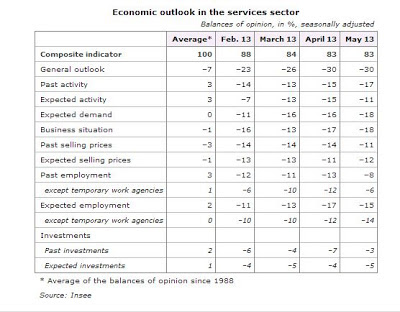
On average (over the past 25 years) French businesses tend on balance to be mildly negative (-7) on the general outlook and on the 'business situation' (-1) but mildly optimistic about their own past (+3) and expected (+3) activity, as well as on their own employment and investment intentions. You could well read into this that French businesses have little time for the idiots at the wheel in Paris, but are carrying on regardless as best they can.
If you think businesses' scepticism about the French economic environment is high, wait till you see what the person in the street thinks. Here's the data from INSEE's May consumer confidence survey.

On average, over the past 25 years, French households have rated the 'general economic situation' as dire, with a net balance of -43 (equivalent to 28.5% of respondents rating it good, and 71.5% rating it bad). And they're currently reporting it as substantially worse again, with a net balance of -79 (equivalent to 89.5% downbeat, and 10.5% upbeat). Interestingly, you can see one of their responses - they're planning to save more than usual (+30 now compared to the long-term average of +18), partly because they are overwhelmingly convinced (+81) that unemployment is going to get even worse than its current 10.6%.
If you haven't fossicked around in these opinion surveys, give them more of a go. They're invaluable for getting a sharp insight into the state of economic activity.
In most countries, including here and in Australia, they're generated by the private sector, but some governments have also embraced them, notably France, where the statistics office INSEE has a suite of long-running ones.
Here are some recent examples. Below is the latest (May) survey of business opinion in the services sector in France (just by way of illustration - you'd get the same sorts of results from INSEE's other sectoral surveys).

This is interesting in itself as a snapshot of the current state of the economy - you can see the weak state of things in France, which will come as no surprise - but it also shows something more permanent. In France, as in other countries, businesspeople tend to be generally more optimistic about their own businesses than they are about the economy as a whole (the 'general outlook' line tends to be well below the two lines about what's happening to the respondents' own and expected activity).
Here are the longer-term numbers.

On average (over the past 25 years) French businesses tend on balance to be mildly negative (-7) on the general outlook and on the 'business situation' (-1) but mildly optimistic about their own past (+3) and expected (+3) activity, as well as on their own employment and investment intentions. You could well read into this that French businesses have little time for the idiots at the wheel in Paris, but are carrying on regardless as best they can.
If you think businesses' scepticism about the French economic environment is high, wait till you see what the person in the street thinks. Here's the data from INSEE's May consumer confidence survey.

On average, over the past 25 years, French households have rated the 'general economic situation' as dire, with a net balance of -43 (equivalent to 28.5% of respondents rating it good, and 71.5% rating it bad). And they're currently reporting it as substantially worse again, with a net balance of -79 (equivalent to 89.5% downbeat, and 10.5% upbeat). Interestingly, you can see one of their responses - they're planning to save more than usual (+30 now compared to the long-term average of +18), partly because they are overwhelmingly convinced (+81) that unemployment is going to get even worse than its current 10.6%.
If you haven't fossicked around in these opinion surveys, give them more of a go. They're invaluable for getting a sharp insight into the state of economic activity.
Tuesday, 28 May 2013
France and the ratings agencies
Three articles in the online May 27 issue of La Tribune won't bring much joy to people worried about the Eurozone's economic outlook and its ongoing potential for disruption of global financial markets.
The High Council for the Public Finances - maybe there's a more elegant translation of the Haut Conseil des Finances Publiques, but you get the drift - has trolled through the revised 2012 national accounts published by INSEE, the French statistical agency, and has established that the nominal fiscal deficit was 4.8% of GDP (worse than the previously thought 4.5%), and that the underlying structural deficit was 3.8% (up from the previously estimated 3.5%). The good news was that the 2012 figures were better than 2011's: the bad news (and this is my view, not the Council's) is that the improvement took place under previous management (Sarkozy's).
And we heard from both major ratings agencies.
S&P is expecting a poor economic outlook (-0.2% fall in GDP this year, +0.6% growth in 2014), fiscal deficits of 3.8% of GDP this year and 3.3% in '14, and says it remains to be seen if debt will stabilise in 2105 (the government's projections are debt/GDP of 93.6% in '13, 94.3% in '14, and 93% in '15). It also says would threaten France's credit rating, and its own assessment will depend on how France deals with its main reform challenges, and it mentions rigidities in the labour market and the services sectors.
Moody's has the same hymn sheet: GDP down this year (-0.4%), weak recovery in '14 (+0.5%), and a question mark over structural reform. It gives credit for some recent labour market reforms, but notes that we haven't yet seen what their impact has been, and it says its negative outlook on France's credit rating reflects its "worry on the loss of competitiveness of the country, on its fragmented labour market, and its budgetary situation".
The High Council for the Public Finances - maybe there's a more elegant translation of the Haut Conseil des Finances Publiques, but you get the drift - has trolled through the revised 2012 national accounts published by INSEE, the French statistical agency, and has established that the nominal fiscal deficit was 4.8% of GDP (worse than the previously thought 4.5%), and that the underlying structural deficit was 3.8% (up from the previously estimated 3.5%). The good news was that the 2012 figures were better than 2011's: the bad news (and this is my view, not the Council's) is that the improvement took place under previous management (Sarkozy's).
And we heard from both major ratings agencies.
S&P is expecting a poor economic outlook (-0.2% fall in GDP this year, +0.6% growth in 2014), fiscal deficits of 3.8% of GDP this year and 3.3% in '14, and says it remains to be seen if debt will stabilise in 2105 (the government's projections are debt/GDP of 93.6% in '13, 94.3% in '14, and 93% in '15). It also says would threaten France's credit rating, and its own assessment will depend on how France deals with its main reform challenges, and it mentions rigidities in the labour market and the services sectors.
Moody's has the same hymn sheet: GDP down this year (-0.4%), weak recovery in '14 (+0.5%), and a question mark over structural reform. It gives credit for some recent labour market reforms, but notes that we haven't yet seen what their impact has been, and it says its negative outlook on France's credit rating reflects its "worry on the loss of competitiveness of the country, on its fragmented labour market, and its budgetary situation".
Saturday, 18 May 2013
A bright idea from Hollande
I didn't get much from President Hollande's big set-piece press conference this week - apart from a vaguely expressed desire to get Europe "moving" again, and some predictable side-swipes at the UK's lack of enthusiasm for the European project, there wasn't anything to indicate what his administration intends to do about competitiveness, structural reform, and the ongoing fiscal haemorrhage. And a government reshuffle - which might have indicated that structural progress was being taken more seriously, especially if the current nutbar in charge of industrial policy, Arnaud Montebourg, got shifted or sacked - is still possible, but "not yet".
But there is one initiative that caught my eye. Currently, if you want something from Town Hall, or the local office of one of the government departments, or from the various social and medical funds, and you don't get an answer within two months, it's a deemed No. Naturally, this gives all the bargaining power to the famously obstructive French bureaucracy. The proposed initiative would change the deemed No, to a deemed Yes.
It's an excellent plan. It's not perfect - as one guy said when interviewed about it on France's TV2, sometimes you'd prefer a quick No to a delayed Yes - but it's absolutely on the right general track.
How much of it will actually get into legislation (apparently scheduled for September) remains to be seen, especially from a government with strong ties to the public sector unions, but hopefully it might be a wee straw in the wind of some new thinking.
And don't you love the word paperasserie, the French term for the cumbersome paperwork you need to get officials' approval? To English ears (and perhaps French, too), it neatly combines papers and harass.
But there is one initiative that caught my eye. Currently, if you want something from Town Hall, or the local office of one of the government departments, or from the various social and medical funds, and you don't get an answer within two months, it's a deemed No. Naturally, this gives all the bargaining power to the famously obstructive French bureaucracy. The proposed initiative would change the deemed No, to a deemed Yes.
It's an excellent plan. It's not perfect - as one guy said when interviewed about it on France's TV2, sometimes you'd prefer a quick No to a delayed Yes - but it's absolutely on the right general track.
How much of it will actually get into legislation (apparently scheduled for September) remains to be seen, especially from a government with strong ties to the public sector unions, but hopefully it might be a wee straw in the wind of some new thinking.
And don't you love the word paperasserie, the French term for the cumbersome paperwork you need to get officials' approval? To English ears (and perhaps French, too), it neatly combines papers and harass.
Wednesday, 8 May 2013
Eurozone risks - France (2)
I referred in an earlier post to the inability and unwillingness of the current French government to confront the main issues France faces. And there's been a lot of comment, especially after last weekend's anti-Hollande protest demonstrations made them topical, about his government's lack of grip and the President's own consequent poor standing in the polls.
It's certainly true that many current French economic policies are either wrong-headed or inadequate. Examples are Hollande's campaign pledges to hire 60,000 more teachers when the fiscal deficit is already too high, and to wind back the one headline reform his predecessor, Nicolas Sarkozy, had managed to implement (raising the age of eligibility for superannuation to 62).
What's striking in particular is how out of date some of them are. 75% top income tax rates, one of President Hollande's cunning plans, take us all the way back to the counterproductive policies of 50 years ago. Remember when the Beatles wrote 'Mister Taxman'? - "Let me tell you how it will be, There's one for you, nineteen for me...Should five percent appear too small, Be thankful I don't take it all". Is 75% way above any kind of optimal tax rate? Is it likely to produce a flight of the most talented, internationally mobile, and most productive? Is the flight already happening? Will the policy result in a lower rather than a higher tax take? Could all of this have been predicted? Respectively, yes, yes, yes, probably, and yes.
Perhaps it's because France's Socialists rarely command all the levers of power, and when they do eventually get hold of them (as they do today at all national and virtually all regional levels), they take over with the policies in vogue when they last held sway. Whatever the reason, their policies often tend to be decades behind the times. I'm reminded that, just as the Western world was about to embark on a massive privatisation programme, the French government under President Mitterrand moved to nationalise the French banks in 1981 (prompting, by the way, banker Baron Guy de Rothschild's mordant comment, ""A Jew under Pétain, a pariah under Mitterrand. For me, it's enough. To rebuild on ruins twice in a lifetime is too much").
All that said, I wouldn't be entirely sure that Hollande is as inept as the commentariat and the latest polls would make out. Hollande is intellectually smart (an énarque, a graduate of the prestigious Ecole Nationale d'Administration), politically astute (he manoeuvred through the fratricidal currents of the Socialist Party for decades), and electorally lucky: first, the front runner for the Socialist presidential nomination, Dominique Strauss-Kahn, imploded spectacularly, and second, Hollande benefitted from the "anyone but Sarkozy" vote. He didn't have much to spare - he got 51.7% of the final run-off vote - but he knocked off a sitting President, no mean feat.
There are also some recent signs of more rational economic policy - a warmer approach to business, revisions to an ill-judged capital gains tax proposal, some changes to labour laws - and, for me, one good sign in the appointment of Jean Pisani-Ferry, previously the director of the highly regarded Bruegel think-tank, as director of the French Prime Minister's Economic Policy Planning staff. You can get a flavour of what Pisani-Ferry is likely to be advising, as well as a very good analysis of the Eurozone's issues, here.
The policy outlook, in sum, is very much in the balance right now. The Eurozone's second largest economy could be starting to move to more conventional, effective management, or it might drift on in the muddle-headed way of the past year. I'll update with any developments that indicate which path looks the more likely.
It's certainly true that many current French economic policies are either wrong-headed or inadequate. Examples are Hollande's campaign pledges to hire 60,000 more teachers when the fiscal deficit is already too high, and to wind back the one headline reform his predecessor, Nicolas Sarkozy, had managed to implement (raising the age of eligibility for superannuation to 62).
What's striking in particular is how out of date some of them are. 75% top income tax rates, one of President Hollande's cunning plans, take us all the way back to the counterproductive policies of 50 years ago. Remember when the Beatles wrote 'Mister Taxman'? - "Let me tell you how it will be, There's one for you, nineteen for me...Should five percent appear too small, Be thankful I don't take it all". Is 75% way above any kind of optimal tax rate? Is it likely to produce a flight of the most talented, internationally mobile, and most productive? Is the flight already happening? Will the policy result in a lower rather than a higher tax take? Could all of this have been predicted? Respectively, yes, yes, yes, probably, and yes.
Perhaps it's because France's Socialists rarely command all the levers of power, and when they do eventually get hold of them (as they do today at all national and virtually all regional levels), they take over with the policies in vogue when they last held sway. Whatever the reason, their policies often tend to be decades behind the times. I'm reminded that, just as the Western world was about to embark on a massive privatisation programme, the French government under President Mitterrand moved to nationalise the French banks in 1981 (prompting, by the way, banker Baron Guy de Rothschild's mordant comment, ""A Jew under Pétain, a pariah under Mitterrand. For me, it's enough. To rebuild on ruins twice in a lifetime is too much").
All that said, I wouldn't be entirely sure that Hollande is as inept as the commentariat and the latest polls would make out. Hollande is intellectually smart (an énarque, a graduate of the prestigious Ecole Nationale d'Administration), politically astute (he manoeuvred through the fratricidal currents of the Socialist Party for decades), and electorally lucky: first, the front runner for the Socialist presidential nomination, Dominique Strauss-Kahn, imploded spectacularly, and second, Hollande benefitted from the "anyone but Sarkozy" vote. He didn't have much to spare - he got 51.7% of the final run-off vote - but he knocked off a sitting President, no mean feat.
There are also some recent signs of more rational economic policy - a warmer approach to business, revisions to an ill-judged capital gains tax proposal, some changes to labour laws - and, for me, one good sign in the appointment of Jean Pisani-Ferry, previously the director of the highly regarded Bruegel think-tank, as director of the French Prime Minister's Economic Policy Planning staff. You can get a flavour of what Pisani-Ferry is likely to be advising, as well as a very good analysis of the Eurozone's issues, here.
The policy outlook, in sum, is very much in the balance right now. The Eurozone's second largest economy could be starting to move to more conventional, effective management, or it might drift on in the muddle-headed way of the past year. I'll update with any developments that indicate which path looks the more likely.
Friday, 3 May 2013
Eurozone risks - France (1)
There's been a real mix of developments in the Eurozone recently. On the positive side, Italy's finally got a government with some credibility, and Ireland is arguably in the early stages of coming out the other side of a severe austerity programme. On the negative side, the banking crisis in Cyprus materialised largely out of the blue, the rescue plans were very badly mishandled, and there are other banking problems on the horizon (Slovenia, for example). And in the middle we have the ongoing uncertainties about Greece, Portugal, and perhaps Spain. The Eurozone remains capable of generating substantial shocks to global financial markets.
Lurking in the background is perhaps the greatest threat to Eurozone stability and recovery - the structural and cyclical weaknesses of the French economy, and the inability and unwillingness of the current French administration to come to grips with them.
Watch the French 8.00pm news any day of the week - I like TV2's coverage, which is streamed over the Internet, http://www.france2.fr/ - and see the amount, and angle, of coverage given to any proposed redundancies. Job losses are distressing, we all know that, but we also know that employment growth happens because new job creation exceeds old job destruction. The French don't accept that: it's not much of an exaggeration to say that the French world view is that every job has a right to exist in perpetuity, and every incumbent in that job is entitled to stay there.Here's just one illustration of the issues.
The IMF calculates a measure of the true underlying fiscal position, which it calls the 'structural' balance, and is the cyclically-adjusted fiscal balance, further adjusted for any one-offs. France has been systematically worse than Germany as far back as these series go for the two countries (1991). Even if you accept the IMF's projections that both countries will get their houses in order over the next five years - yeah, right - France is starting from a worse position, and will take longer to get back to balance.
One final illustration: youth unemployment. France's rate of youth unemployment (26.5%, on Eurostat's data), is actually worse than the dire Eurozone average (24%). France doesn't break out racial or ethnic unemployment rates - "we are all equally French in the colour-blind eyes of the French State" is the official line, which is partly admirable and partly deeply convenient - but you can guess that, for the Arab and North African kids in the slum-like banlieues, it must be approaching 100%.
Financial markets at the moment have their concerns about France, though real alarm bells are still a long way off: the 10 year French government bond trades at only a modest 50 basis points higher yield than its German equivalent. Even so, there are already people who are of the view that, if there is a big road wreck coming in the Eurozone, it could well happen on the autoroute.
Lurking in the background is perhaps the greatest threat to Eurozone stability and recovery - the structural and cyclical weaknesses of the French economy, and the inability and unwillingness of the current French administration to come to grips with them.
Watch the French 8.00pm news any day of the week - I like TV2's coverage, which is streamed over the Internet, http://www.france2.fr/ - and see the amount, and angle, of coverage given to any proposed redundancies. Job losses are distressing, we all know that, but we also know that employment growth happens because new job creation exceeds old job destruction. The French don't accept that: it's not much of an exaggeration to say that the French world view is that every job has a right to exist in perpetuity, and every incumbent in that job is entitled to stay there.Here's just one illustration of the issues.
 |
| Structural fiscal deficit, % of GDP. Source: IMF WEO database |
One final illustration: youth unemployment. France's rate of youth unemployment (26.5%, on Eurostat's data), is actually worse than the dire Eurozone average (24%). France doesn't break out racial or ethnic unemployment rates - "we are all equally French in the colour-blind eyes of the French State" is the official line, which is partly admirable and partly deeply convenient - but you can guess that, for the Arab and North African kids in the slum-like banlieues, it must be approaching 100%.
Financial markets at the moment have their concerns about France, though real alarm bells are still a long way off: the 10 year French government bond trades at only a modest 50 basis points higher yield than its German equivalent. Even so, there are already people who are of the view that, if there is a big road wreck coming in the Eurozone, it could well happen on the autoroute.
Subscribe to:
Posts (Atom)