Showing posts with label trade. Show all posts

Wednesday, 21 February 2024

The New Zealand Economic Forum - Day 1

The University of Waikato's New Zealand Economic Forum 2024, on the theme of 'A briefing to the incoming government', kicked off in Hamilton last Thursday with a speech by Finance Minister Nicola Willis (below).

Nothing headline-making, but solid stuff: I liked the aim to lift our growth rate by removing go-slow regulation, the plan to have fast one-stop consenting for major projects, and to have more 'social investment', meaning prioritising social spending on the groups most at risk of being stuck in persistent disadvantage. In Q&A, someone asked about investment plans: there's apparently going to be a coordinated 30 year pipeline of projects, and about bleeding time. There are decision-making models maintained in the public sector that let you assemble optimal investment portfolios, and they badly need to be deployed, however belatedly, to make our infrastructure spend all that it can be. Chatting to another attendee afterwards, he wondered if the benefits and costs you need to feed into those models were reliable enough to avoid garbage in, garbage out results, but anything's got to be better than the lack of coordination we've had up to now.

The next two topics - agriculture and health - weren't my thing, but they had their moments. In agriculture, I'd never heard of AgriZeroNZ before: "A partnership between the New Zealand government and major agribusiness companies, we're helping farmers reduce emissions while maintaining profitability and productivity". Good stuff. In health, I heard a lot of sense from Professor Des Gorman. He said that we don't have a 'health' system, we have a disease and injury management system, paid for on annual levels of activity, which is self-evidently not ideal. He argued for a better 'tight, tight, loose' system focused on value for money: it would be tight in defining the health outcomes you'd like to see, tight in measuring what providers actually achieve, but loose or agnostic about what sort of providers you use. For those who would cry 'privatisation' of the public health system, his answer is that the system is largely private already, notably including your local GP practice. And for those worried about those dreadful private providers making a profit, in a competitive value-for-money system the answer is, "They're delivering more for less. What bit don't you like?".

After lunch we had a choice of 'Demographics are history' or 'Running tax differently', and my inner nerd chose tax. Graham Scott (gamely filling in for the unavoidable late withdrawal of Max Rashbrooke, also contactable here) reminded us that tax has its own comparative advantage - it has things it can and cannot do - and threatening to load it with multiple policy aims risked taking us back to the bad old days when we had a mad patchwork of specific sales taxes and other distortions and complexities. PwC's Sandy Lau was mostly happy with things as they are, though wondered if we need capital gains taxes, if only to reduce our currently disproportionate reliance on personal income tax. And Victoria's Professor Lisa Marriott's main point was over enforcement: she felt genuinely ratbag behaviour wasn't being sufficiently prosecuted by the IRD. Not only were people getting away with malfeasance, tax compliant businesses were being put at a competitive disadvantage relative to the scofflaws.

The session on 'Social investment: What difference will it make', led to a strong consensus that (a) there is a large group of people who suffer from persistent disadvantage (b) current social policy isn't cutting the mustard (c) by finding out what these people most need we can get better much better results especially if we focus on value for money from what we do and (d) we should regard what we do as an investment in people rather than as a cost. As Merepeka Raukawa-Tait put it, the time for wasted spending is over. Subsequent speakers pointed to a dramatically successful example that Maria English gave us, where providing tailored housing to a particular person saved nearly all of the very expensive 100 nights a year they'd previously been spending in a hospital bed. The session made complete sense to me, and I was quietly bemused how the winds have changed since Bill English (Maria's dad) championed this very approach, and got roundly rubbished for it.

My initial reaction to 'Trade: Dealing with a divided world' left me worrying: there's been an end of the "golden weather" of increasingly free and rules-based trade. Now there's fragmentation, rules flouting, disempowerment of the World Trade Organisation, protectionism, and 'security' concerns (real and paranoid). It very much felt like the trade front of Cold War II. MFAT's Vangelis Vitalis replied to my downbeat tweet that "I hope the conclusion left you feeling  more positive, i.e. we have a plan, agency, new options & advantages in key markets and are determined to protect and defend our hard won benefits through FTAs", and that we are showing "Policy entrepreneurship in international trade policy". He'd mentioned, for example, us successfully taking Canada on about their dairy trade protectionism. All fair comment, and it's good to know we're fighting our corner, but it's still a trickier wicket to bat on than it was before.

And the day wrapped with a session chaired by Steven Joyce on 'Monetary policy: Controlling what we can control'. Grant Spenser, ex deputy governor at the Reserve Bank, reminded us that the RBNZ, when it last reviewed how it had been going, found nine things it could work on, and wondered how they were getting on with them: he also noted that there appeared to be quite a blowout in operational spending and in headcount over the past six years. He also wanted to see more of a challenging culture at the Monetary Policy Committee from the independent members. I totally agreed: Australia's moved in that direction recently as well, with a boost in expertise and a requirement that independent members put their view into the public domain at least once a year. Bryce Wilkinson revisited some of the territory he'd covered in his publication co-authored with Graeme Wheeler, 'How central bank mistakes after 2019 led to inflation',  reminding us that monetary policy everywhere was relied on as being more of an exact science than it actually was, and that central banks made very poor inflation forecasts, even though that was their day job. Bryce said the global financial markets had also missed what was developing. And Henry Russell found himself in something of the spotlight given that the ANZ Bank had just made a big off-consensus call that the RBNZ would hike rates again (two moves of 0.25%), its reasoning being that the RBNZ had indicated back in November that it had little tolerance for any upside inflation risks, but they looked like they were getting some.

The monetary policy panel: Henry Russell (ANZ Bank), Bryce Wilkinson (Capital Economics / The New Zealand Initiative), Grant Spencer (ex RBNZ, Victoria University), Steven Joyce at the lectern

There was a really interesting discussion after the speakers' opening remarks, including around the ANZ forecast of hikes to come. Bryce thought that interest rates were now where they out to be on a Taylor Rule basis, and also that money supply growth had slowed down to very little growth at all (the latest 'broad money' measure, for example, is up only 3.6% on a year ago), both of which argued against hikes. Grant felt that with inflation already down quite a bit, maybe it would be better to hold and stay at current rates for a bit longer to see what happens. Henry, however, said that arguably a global disinflation supporting tailwind has blown out, that domestic inflation is still not good and might surprise on the upside again, and that while the pricing indicators in the ANZ business survey have stabilised, it was an open question whether they had stabilised at a level consistent with the RBNZ's inflation target. Policy issues raised but unresolved for another day: whether unconventional monetary policies (like quantitative easing) had been worth it; how monetary policy should respond to supply shocks; and whether the RBNZ ought to be both the setter of monetary policy and the financial prudential authority. Evidence from overseas is mixed, and against the canonical practice of economists having an answer to everything, I can't say I've got any clear opinion, either.

Sunday, 1 January 2017

A good idea hits a snag

'Dumping'. What a good word for those wicked, wicked manufacturers overseas who 'dump' their goods here at lower-than-fair prices and drive our honest battlers to the wall. And when they've driven our fellows out, they have the market to themselves and can rip us off. Good job we've got anti-dumping laws to protect us, eh?

But hang on a minute. Let's just suppose you're in Malaysia and you make diaries. How likely is it, really, that one day you'll wake up in Kuala Lumpur and say to yourself, "I think I'll flood the New Zealand market with ultra-cheap diaries, and when I've cornered the market, I'll jack up prices and make a killing"?

Because there are two eentsy problems with that plan. One is you'll be making lower than normal profits (or even losses) in New Zealand when you could be making normal ones in New Zealand or somewhere else. And the other is that if you do indeed corner the market with temporarily low prices, the minute you try to jack up prices someone will come in and undercut you. After all, if the New Zealand market is so easy to enter and dominate, anyone can get into that game, including your mates on the other side of town when they spot what you're up to. Low profits now for high profits later doesn't look a realistic runner.

The reality is that 'predatory pricing' strategies like the Great Malaysian Cunning Diary Plan are likely to be rare and unsuccessful. If things turn up in New Zealand at unusually low prices, it's more likely that the low prices come from a genuinely cheap producer, and one who might well be sweetening the pot, if trying to break into a new market, with especially sharp pricing: nothing wrong with that. Or it could be that there's a temporary glut of something - tomatoes, peaches, steel - and producers everywhere are trying to shift what they're lumbered with for whatever it will fetch. Nothing wrong with that, either: you'd do the same. And in both cases New Zealand consumers (including businesses who use the cheap goods as industrial inputs) are the winner, and it's the effect on consumers that ought to be front of mind when we're thinking about policy issues like 'protection' from 'dumping'.

If only. At present, our anti 'dumping' legislation ignores consumers. If a Greek peach canner sells peaches in Athens for say $1 a can, and sells them in New Zealand at say 90 cents a can, a New Zealand peach canner can cry "Dumping!" and get MBIE to slap an import duty on the Greek peaches, even if consumers would have been happy to fill their trolleys with them. And our domestic monopoly peach canner, Heinz Wattie's, has indeed been protesting about those pesky Greek imports since 1998, and very successfully too. MBIE renewed the anti-'dumping' duties in July 2015 and lately there have been no Greek peach exports to New Zealand at all.

And those Malaysian diaries, by the way, are also a real life example. Malaysian diaries from a range of Malaysian makers - and from a range of Chinese ones, which proves my point about the Malaysian guy being unable to corner the market because others both in Malaysia and in China would undercut him - have been hit by anti-'dumping' duties from 2007 to 2015, as you can see on the MBIE web page listing all the completed anti-'dumping' investigations.

The anti-'dumping' law is long overdue for a fix which would allow competition and consumer benefits to be weighed in the balance, and not just the comfy position of the domestic incumbent. And it got one: it took them forever, but MBIE finally got round to it in August 2015. As I posted at the time, 'A good idea finally gets the nod', and you'll find links there to the history of the process. The guts was that there would be a new public interest test:
In future...domestic producers won't be able to have cheap peaches or tomatoes or building materials shut out of the New Zealand market unless they can show that the damage to them is more than the damage to New Zealand consumers. Which it often won't be: there's only a  few of them, and there's lots of us. A process that has been much abused for protectionist reasons, both here and abroad, is finally getting defanged
And then the politics kicked in, when the proposed legislation landed before Parliament's Commerce Select Committee. As the National Business Review reported,  'Politicians split on dumping penalties bill in run-up to Chinese steel inquiry': the National members wanted to go ahead, the Opposition members didn't. They split 5-5, deadlock: "we were unable to agree on whether to recommend that the bill be passed". The Committee's full report on their deliberations is here.

It's kind of strange how things have lined up. National might be thought of by some as in the pockets of big business, yet its members on the Commerce Committee took the pro-consumer side, while Labour, the Greens and NZ First, who some might expect to champion the consumer against the corporation, took the "protect New Zealand businesses" position.

To be fair, the Committee had to give due weight to the submissions in front of it, and the submissions were, as the Opposition members said in the report, "overwhelmingly opposed to this bill, warning that it would be likely to tilt the playing field in favour of dumped or subsidised imports rather than supporting local producers and jobs".

But of course the submissions were overwhelmingly opposed. They were overwhelmingly from the usual suspects (including Heinz Wattie's).That's precisely the problem.

As is often the case in policy matters (and overwhelmingly the case in trade policy ones) the small group of producers adversely affected by change make an unholy racket: the 99.5% of the population who'd quite like cheaper diaries or cheaper peaches don't get heard from.

This time, too, the consumer viewpoint went largely unheard, other than through The Warehouse Group's submission. True, it had its own barrow to push - it had been on the receiving end of various anti-'dumping' measures, including, as it happens, both diaries and tinned peaches - but even so it got to the right answer, that the new public interest test
is necessary to ensure that the legitimate interests of all stakeholders and the wider economy are routinely considered and balanced before punitive duties are imposed.
Yes, there will be genuine instances where domestic producers are getting unfairly shafted (overseas governments' subsidies to their exporters being an example) and we ought to have some backstop protection. Yes, we as a country resort far less to anti-'dumping' protectionism than other places do (notably Australia), so it's not a massive rort that needs a lot of fixing. And yes, you have to feel some sympathy for folks who might lose out from cheaper imports, as you will, for example, if you read the submission from people who grow the peaches for Wattie's. The solution is transitional help for people affected by policy changes, which should be part and parcel of all trade reforms but often isn't (and which has consequently helped provide the political oxygen for the protectionism of the Trumps and the Le Pens).

But for all that, the direction of reform is nonetheless right, and I'd say the same thing (just to be clear) if it were the Labour/Green/NZ First people for it and the Nats against. The process shouldn't cater solely to the "Woe is me" reactions, and it should take account of greater competition, greater choice, and lower prices.

The politics, however, is iffy, as the split on the Commerce Committee showed. Reform could conceivably be presented in a voter-friendly way - as making family budgets go further, for example, or as reducing input costs for New Zealand businesses. But the vocal views of the protected producers make it an uphill sell. Whether the government will have the bottle to keep on the right path in election year remains to be seen.

Wednesday, 24 February 2016

Sovereign irresponsibility

There was a fine article by Deborah Hart, the executive director of the Arbitrators' and Mediators' Institute of New Zealand, in Monday's Herald, making the sensible case that the supposedly controversial 'Investor State Dispute Settlement' (ISDS) process within the Trans Pacific Partnership (TPP) is actually a good idea. Read it for yourself: the gist is that ISDS "will work well for NZ" and that "Investor-state dispute settlement is therefore not something to be afraid of. It's part of being a trading nation in a globalised world".

What's baffled me most about the strong opposition to ISDS is the notion that "national sovereignty" is something that is sacrosanct, not to be jeopardised, diminished or traded away. If national sovereignty really trumps everything else, Dachau would still be open, apartheid flourishing, and every Tutsi in Rwanda and every Muslim in Serbia would be dead.

Progressives everywhere ought to welcome international controls on appalling behaviour by "sovereigns" - a useful crutch for the world's kleptocratic tyrants to lean on - as they have since (at least) the founding of the League of Nations in the wake of another fine exercise of national sovereignties, the Great War.

What "sovereigns" are demonstrating when they resist principles-based restraints - when, for example, neither China nor the US will participate in the International Criminal Court - is that they prefer the option of unprincipled behaviour. When countries sign up to the likes of the ICC, or to the ISDS provisions in the TPP, they're saying the opposite: we'll play fair, and we don't mind being judged on it. That's exactly where New Zealand should be.

Friday, 11 September 2015

Another blast from the past

Statistics NZ's Twitter feed just posted this fun item:


It has a link back to a piece that Stats published in 2012, 'Delving into the clothes basket - tracking women's and men's clothing in the CPI', which went back to 1924 to look at what men and women and children wore.

It's fascinating - today's girls will be pleased that they don't have to wear the woollen bloomers of 90 years ago, and today's women will be pleased they don't have to make their own clothes - and it's one of a terrific series of time capsules that Stats have unearthed and published. Last time I wrote about them, in 'The way we live now', I said that this analysis of past CPIs was "almost a complete social history in itself". It's also a great timewaster, so cancel an hour, head to my post, and follow up the links there to the various Stats publications.

For me - and here I stress this is my take, not Stats' view or interpretation - the clothes basket piece fortuitously showed the potential benefits of trade liberalisation. From the late '80s onwards, tariffs and quotas on clothing imports were lowered or abolished. The results were that clothes prices have risen much more slowly than prices more generally (as the first graph below shows) and people have been able to buy much more (as the second one shows).


And the "cost"? - "the number of jobs filled by paid employees in the clothing and knitted product manufacturing industry fell nearly 60 percent – from 9,550 to 4,120". Four million people, give or take, got a large benefit, while 5,500 people, give or take, lost their jobs. And I put "cost" in apostrophes because many - maybe all - of those people will have found other jobs, and in activities that the community values more highly than keeping a small-scale rag trade going.

It's also very likely that liberalising clothing imports was a progressive move (in the tax policy sense of "progressive" as opposed to "regressive"). At home, the household budgets of lower and middle income families, and particularly those with children, will have had one of their bigger costs reduced. And overseas, people in poorer countries will have got real jobs, instead of aid, and started down the road of economic development that will make them better off and, along the way, better customers for our exports. That's a pretty good outcome all round.

Saturday, 29 August 2015

A good idea finally gets the nod

First, the good news.

On Thursday Paul Goldsmith, the Minister of Commerce and Consumer Affairs, announced a welcome change to New Zealand's anti-dumping regime. In future, the plan is, domestic producers won't be able to have cheap peaches or tomatoes or building materials shut out of the New Zealand market unless they can show that the damage to them is more than the damage to New Zealand consumers. Which it often won't be: there's only a  few of them, and there's lots of us. A process that has been much abused for protectionist reasons, both here and abroad, is finally getting defanged.

But why has it taken so long?

The Ministry of Business, Innovation and Employment, MBIE, first came up with options for changing the anti-dumping regime in the middle of last year: I wrote about them last July. It was extremely obvious at the time that this new "consumer interest" test was the way to go: as I said, "Free trade often struggles to prevail against producer interests, but even so this should be the easiest, "where do I sign", shoo-in of a policy contest that's ever been run".

Last year rolled by. In December I wondered where the dumping reform had got to: with a number of other small but promising reform proposals, it seemed to have gone to ground within MBIE. Finally, in August, over a year after the obvious way forward had been identified, it gets the tick, though it's still got to go through Parliament. It'll be next year at the earliest before the changes see the light of day.

I understand that there's got to be time allowed for public consultation, and for Ministers to get their colleagues' heads around things. I understand that the legislative hopper can get backlogged. But we like to think we're a small but informal and flexible country, and in any event we need to be if we're going to be internationally competitive. This speed of reform is just too slow.

Wednesday, 6 May 2015

Overgenerous protection?

I'd never heard of the Express Scripts prescription-price index before I read 'Much ado about something', an article on generic drugs companies in the latest issue of the Economist (it may be available here but it may be paywalled, I can't easily tell as I've got a subscription). The article said that "whereas the average price for branded medications in America has risen by 127% over the past seven years, the average for generics is down by 63% over that period".

I was rather intrigued by this from a competition perspective, so I went to the source. Express Scripts is a US listed company that provides various pharmacy processing and management services, and it has a website, 'The Lab', where it publishes a range of interesting analysis and research. One of its publications is its Drug Trend Report, and on p57 you'll find this graph of the prescription-price index, which measures the prices of the most commonly prescribed drugs in both their branded and generic versions (it's also on p6 of the Executive Summary pdf).


It's hazardous drawing conclusions from one country, and one country with a rather dysfunctional health system at that, but these patterns do lead you to wonder whether patent protection hasn't been overdone. Yes, of course, the costs of developing safe new drugs are high and rising, and patents should enable drugmakers to recover their costs and earn an appropriately risk-adjusted rate of return on their outlays. And yes, you'd have to do the heavy lifting of comparing actual and fair WACCs to be make a fully informed call (and even then there'd be judgement calls involved). But price divergences of this order at a minimum make you wonder whether the length or scope of protection haven't been overdone. Overgenerous protection  would also help explain the squalid trade of branded producers bribing potential generic competitors not to produce (as I wrote about here, here and here).

I'm hesitant even to mention the Trans Pacific Partnership - every anti-trade nutter in the country will be reaching for their tin-foil helmet - and I'm going to reserve final judgement on the thing till I see all of it as a package. But if, as has been widely speculated, one of the elements is extended life for intellectual property protection, then it's probably a step in the wrong direction.

Thursday, 26 March 2015

Playing monopoly

Monopoly is in the air. The kiwi fruit people want more of it: the Herald's coverage of their recent industry poll is here - where I learned that the polite word for "monopoly" these days in kiwifruit circles is "single point of entry" - and the meat industry would like some, too.

That's one of the core recommendations in a recent report by Meat Industry Excellence (and I should tip a hat in the direction of John Small's website, where I first saw mention of it). They're a ginger group who describe themselves as "passionate farmers and industry supporters who can clearly see the opportunities (and the barriers to progress) for our red meat sector. They are a diverse group who are prepared to stand up, collaborate and work with farmers and industry to create sustainable profitability for all players".

Fair enough, and actually I have some sympathy for their diagnosis of what ails the meat industry and for their vision of creating and capturing high value add through a focus on the end consumer (though if you can also hear the hoofbeats of a "But" galloping towards us, you're right). Stock numbers have dropped sharply, stranding processing assets, which means that a deadly game of musical chairs is underway. Processors are playing over the odds to get stock through their plant rather than the other fellow's, adding to the financial costs of carrying the surplus capacity, and leaving nothing over to pay for the marketing and innovation that would raise industry incomes all along the value chain (there's an argument that that the processors were never that good at the marketing end even in better times, but that's for another day).

Their suggested ways forward are some combination of industry aggregation (to something like a Fonterra-sized processor), a collective approach to rationalisation of the spare capacity including a cunning plan, 'chain licensing', which would cap capacity, and a collective or coordinated approach to export marketing, perhaps along Zespri lines. That's my potted summary: Rod Oram's got one here, and Lincoln's Agribusiness and Economics Research Unit have a rather longer one here.

What bothers me about this is the strong lean towards monopoly market solutions at the expense of competitive market solutions. It's not universal:  the draft paper on the chain licensing says, for example, that
Competition and choice at the farm gate must remain. Animosity by some processors against competition is misplaced.
Competition is essential for the Industry. It is overcapacity and lower livestock numbers which has led to the low plant utilization within the Industry...Marginal pricing, refusal to close plants because of high redundancy costs, focus on throughput and fixed cost amortization, excessive use of third party buying agents, and adding extra capacity are all competitive responses that are rational within the current structure of so much additional capacity. They result not from the principle of competition but from overcapacity
But otherwise it's pretty much pervasive among those casting around for potential ways forward to reach for Fonterra and/or Zespri as proven models from other industries. Fortunately, some of these ideas are non-starters. Animosities and incompatibilities among the processors likely put the kibosh on all the grander schemes of agglomeration, as would the Commerce Commission, since I don't see the required authorisation as likely to be forthcoming: orchestrated stitch-ups to create monopsony power against suppliers and monopoly power against consumers rarely get the nod, and for good reason. And the chain licensing idea would also need some get of jail free card, as it too looks bang to rights under the Commerce Act. But even if they were enabled through the meat industry equivalent of the legislation that created Fonterra, they look to me to be the wrong approach, for two reasons.

One is that there are, in fact, good working examples of thriving, competition-based, agricultural export industries, with the outstanding example being our own wine industry (and arguably another in the making, in the craft beer trade). And the French wine and cheese trades successfully get their Cotes du Rhone and Roquefort to me using exactly that model of large numbers of French companies competing against each other for the same overseas customers that is supposedly the "problem" that the Zespri route is meant to "solve". So it's by no means a given that Fonterra-style or Zespri-style models beat market models, where competing companies are forced to add value and to innovate to succeed. And  it is worth remembering that the Commerce Commission, when the original Fonterra idea came through their door in 1999 before the thing got its own legislation, found that "the Commission has reached the preliminary view that it cannot be satisfied that the public benefits of the proposed merger are likely to outweigh the competitive detriments".

And the other is that chain of links that goes: create a monopoly, generate more profit, use the money to fund product and market development. You can certainly do the first two, but the third leg looks highly suspect. A monopoly is just about the last organisational form you would expect to be highly consumer-focussed and highly innovative. We've got the magnificent diversity of our premium wine offerings, very largely driven by micro, small and medium-sized companies, all jostling with their ideas in the marketplace: does anyone seriously believe a Wine Export Board would have achieved a tenth of that success?

Monday, 22 December 2014

JFDI, MBIE!

There is a bit of a ruckus going on about the performance of MBIE, the Ministry for Business, Innovation and Employment, based on this report. I'm not interested in the point-scoring argy-bargy, though for what little it's worth I agree with the reviewers who noted (p58) their "impression of highly motivated and capable staff, doing things the hard way because they are struggling both to prioritise their efforts and to see the broader strategic context for their work".

What's irked me a bit is that there are three ideas that have gone into the MBIE hopper and haven't come out yet, even though all of them look good (or even very good), would be easy to implement, and would make the New Zealand economy a more competitive marketplace.

The first one, recommended by our Productivity Commission, and conveniently investigated in detail in an Australian context by the Aussies' Competition Policy Review, is to review s36 of the Commerce Act, the bit that aims at stopping companies with market power from interfering with competition. My conclusion, on reading the Aussie report, was "Save the time and money" on our own reinvention of the wheel at MBIE. "I say we send the Aussie Review members a thank you note and a couple of cases of our best Pinot Noir, declare victory, and go home". I know there are people in MBIE, and elsewhere, who thinks it's a big, complex issue, despite the Aussies having fortuitously solved it for us. It isn't.

The second one, again recommended by our Productivity Commission and also standard practice overseas, is to let the Commerce Commission conduct proactive fossicking ("market studies") into the state of competition. It can already do it in the telecoms market, but not generally. It would take part of a morning to write the amendment to the Commerce Act.

The third one is the state of our anti-dumping regime, which is too easily abused and which allows domestic producers to avoid competition from overseas and to rort the local consumer. In June 2014 MBIE came out with a good paper with three options, one of which clearly outclassed all the others. As I said at the time, "this should be the easiest, "where do I sign", shoo-in of a policy contest that's ever been run". So why hasn't it been?

Tuesday, 23 September 2014

More evidence of free trade payoffs

Post-election, thoughts have turned - finally - to policy. It's reported in the Herald that among the likely policy initiatives over the next three years, John Key "identified progress on a trade deal with South Korea, which is close to a conclusion, and the Trans Pacific Partnership as priorities".

A bilateral deal with South Korea is definitely a good idea: I know, in an ideal world we've have comprehensive multilateral trade agreements, but it's not an ideal world, and take what you can is the order of the day. These bilateral agreements can be quite handy: our agreement with China, for example, gave us a clear competitive advantage against the Aussies in the dairy trade with China (as I wrote up here).

Whether the TPP ever gets off the ground, and whether it will in fact be a genuine free trade agreement, is anyone's guess. There have been leaks about the negotiations that have raised suspicions of TPP as potentially protectionist of US intellectual property, rather than helping to free up trade, and I've also seen speculation that the Japanese will make sure that any agricultural trade liberalisation in the TPP will get watered down to meaninglessness.

One worry I've got is that a 'bad' TPP will taint the arguments for free trade, which tend to struggle at the best of times against the loud voices of anti-trade ideologues and of formerly protected interests. The voice of the family buying cheaper T-shirts and food tends not to get much of a look in.

So I thought I'd just point to some new research about one of the big free trade deals - NAFTA, the North American Free Trade Agreement of 1994. At the time the usual suspects came out in force against it: you might remember Ross Perot running for President in the US in 1992 on fears of the "giant sucking sound" of American jobs going down the gurgler towards Mexico (and finding nearly 20 million American voters to agree with him).

The latest research comes from the Peterson Institute for International Economics in Washington, "a private, nonprofit institution for rigorous, intellectually open, and honest study and discussion of international economic policy...The Institute is completely nonpartisan". The summary is here and the whole thing (pdf) is here.

How did this contentious agreement work out? Pretty well, as it happens, though one of the lessons is that proponents of freer trade need to be more realistic about the payoffs: it's not just the opponents that can go off the deep end. That said, the benefits were real: look at this.


This shows the initial level of  goods trade between the NAFTA countries (blue), the extra trade that would have happened in any case as the NAFTA economies grew (dark green), and the impact of NAFTA (light green). Trade was basically twice as large as it would have been without NAFTA. That's a bit of a heavy-handed summary on my part,  and the authors are more nuanced, but the guts is that trade got a large boost.

This increased trade in turn fed through into higher incomes everywhere. As the authors say, these higher levels of trade boosted GDP in all the countries involved (I've left out the footnotes):
Ample econometric evidence documents the substantial payoff from expanded two-way trade in goods and services. Through multiple channels, benefits flow both from larger exports and larger imports. As a rough rule of thumb, for advanced nations, like Canada and the United States, an agreement that promotes an additional $1 billion of two-way trade increases GDP by $200 million. For an emerging country, like Mexico, the payoff ratio is higher: An additional $1 billion of two-way trade probably increases GDP by $500 million. Based on these rules of thumb, the United States is $127 billion richer each year thanks to “extra” trade growth, Canada is $50 billion richer, and Mexico is $170 billion richer. For the United States, with a population of 320 million, the pure economic payoff is almost $400 per person. 
The same is true of the proposed agreement with South Korea, as MFAT's briefing page on the negotiations points out:
An independent joint study into the benefits and feasibility of an FTA was completed in 2007. It found that New Zealand and Korea are two of the most complementary economies in the Asia-Pacific region and that an FTA would deliver economic benefits for both countries. The analysis, by the New Zealand Institute for Economic Research and the Korean Institute for International Economic Policy, suggested that the FTA would provide gains to real GDP between 2007 and 2030 of US$4.5 billion for New Zealand and US$5.9 billion for Korea.
Opponents of trade liberalisation, in short, would take US$10 billion of benefits from a Korean agreement alone, and scatter them to the winds.

Monday, 4 August 2014

The payoff from a Free Trade Agreement

Last week the Business Council of Australia released a report, Building Australia's Comparative Advantage, which in turn built on another reportCompete to Prosper: Improving Australia’s global competitiveness, which they had commissioned from McKinsey Australia. I haven't read either of them fully yet, and I'm not too sure whether I buy into the "let's aggregate industries into globally competitive sectors" line taken in both of them, but in any event I also found this:


This is McKinsey's estimate, in Aussie cents per kilogram, of New Zealand's cost advantage over Australia in the international dairy trade. The total advantage in our favour is 55 cents per kg, which looks a sizeable amount in the context of (say) the dairy payout, and the largest part is down to our cost advantage in getting into the Chinese market duty-free as a result of our free trade agreement (FTA) with China.

You can also see the contribution of the FTA in the graph below, also from McKinsey, where after a short post-FTA lag, our dairy exports to China took off. Aussie dairy exports didn't. For completeness, I should add that McKinsey also credit the relative vigour of our dairy industry deregulation ("Australia...deregulated but without anything approaching the intent and ambition across the Tasman", p35), which I agree with, and also admire the creation of Fonterra ("New Zealand created a dairy industry structure that was designed to compete globally", and Australia needs "purposeful market design", p36), which I'm more ambivalent about, but there's no denying a big payoff from our free trade approach.


It's not often that we steal a diplomatic march on our friends across the sea - well done, our trade negotiators - and we may not enjoy it for long: their Business Council is recommending that Australia get a move on with FTAs with China, Hong Kong and Taiwan, and revisit existing ones to make them more agriculture friendly. But while it lasts it's a fine example of how free trade has brought a big benefit to one of our major export industries. And even if Australia levels the playing field, there will still be enduring pay-offs for both of us.

It's also a good riposte to some of those ugly anti-China views that are surfacing in our election campaign.

Wednesday, 30 July 2014

Two happy endings

Yesterday I went through the story of how an Aussie company looked to get protection against imports of tinned peaches and tomatoes, and was shown the door by the Aussie trade authorities, whereas here in New Zealand Heinz Wattie's successfully managed to keep the same South African tinned peaches at bay when MBIE once again renewed anti-dumping provision against them.

The Aussie authorities were right: righter than Maggie Thatcher turning right in Wrightington. It was always a protectionist absurdity that 23.5 million Australians should have to pay over the odds for their peaches just so that 3,000 SPC Ardmona employees should have guaranteed jobs (and cushy ones at that, as documented here). And that tends to be the stitch-up that lies at the heart of a lot of protectionism - damages spread thinly over large populations, benefits concentrated on the favoured few.

That's something that should give even anti-trade activists pause for thought. Even if you are way down the protectionist end of the political spectrum, you might want to ask whether dearer food, shoes and clothes for the whole of lower and middle income New Zealand is a price worth paying to maintain much smaller groups of manufacturing employees in their comfortable lifestyle.

And while this is an argument of no economic merit whatsoever, I'm going to make it anyway, since the anti-trade lobby tends to include assorted anti-globalisation and xenophobe loonies who might buy into it. How do you feel about import protection for those poor threatened workers on the SPC Ardmona cannery line - when the company is actually a subsidiary of Coca Cola? And even if you weren't a loony, you'd reckon that companies the size of Coca Cola can look after themselves, thanks very much, without also being granted an official licence to rip off the Aussie consumer.

In any event, there's a happy ending.

SPC Ardmona, reeling under the impact of these dastardly cheap imports, asked for A$50 million in government assistance ($25 million each from the Federal government and from the state government of Victoria). No dice.

End of terminally endangered company? Not quite.

One fan of SPC product, alarmed that it might disappear, started an online promotion campaign that hit a nerve in Australia, and went viral. The whole story's here (and lots of other places). Sales soared, Woolworths decided it was worth stocking more of the iconically popular brand, and SPC was back in business, with the CEO saying “I'm not being cute when I say this, but the refusal of that $25 million from the Commonwealth, it triggered this huge response from the public and that’s led to Woolworths saying the customer is right". At the risk of overkill, I'll just add that a bit of smarter marketing was always a better option than either the protective moat or the handout.

The heading to the post mentions two happy endings: here's the other one. Happy-ish, anyway: there are some good bits in the bag, and hopefully more to come.

The outright good news is that, in the Budget, the government suspended anti-dumping provisions that had been in place against various construction materials, and it did it for the very good reason that it would make the Canterbury rebuild cheaper and more competitive. You might well wonder why what's good for the Canterbury goose isn't good for the national gander, and why the rest of us have to put up with overpriced peaches and diaries (I'm not making this up, Chinese and Malaysian diaries are also apparently threats to the national welfare). But in any event it's another small victory for freer trade, even if it's only a temporary, three year, suspension of the anti-dumping provisions, so let's bank it.

The other goodish news is that the suspension of the construction materials barriers triggered a review of the whole anti-dumping shemozzle, and MBIE has come up with a discussion paper, where it usefully gives marks to three policy options.

Option 1 is the status quo (meh, 14/30). Option 2 is a clunky thing that to me is there to make up the numbers (though with 19/30 even clunky alternatives beat the status quo). Option 3 is the only thoroughbred in the race (25/30). This allows for discretion not to impose anti-dumping duties "where they substantially lessen competition" (as they often do) or "where negative impact on another party [like you and me as consumers] outweighs harm to domestic producer" (which again will often be the case).

Free trade often struggles to prevail against producer interests, but even so this should be the easiest, "where do I sign", shoo-in of a policy contest that's ever been run.

Friday, 2 May 2014

Two minds with but a single thought, two hearts that beat as one...

I didn't realise, when I posted some criticism  the other day of plans to restrict foreign ownership of New Zealand housing, that the New Zealand Initiative was taking a broader view of our barriers to all kinds of overseas investment. As it happens, they arrived at the same place I did, but on a much wider and more deeply researched basis. In their latest publication, "Open for Business: Removing the barriers to foreign investment", the Initiative's Bryce Wilkinson and Khyaati Acharya let rip about the illiberal and inefficient shortcomings of our Overseas Investment Act.

"The Act is not fit for purpose as it stands...No public policy case appears to have been made that gaps in other laws and regulations relating to immigration, national security, land use, takeovers, mergers and acquisitions, or competition are so serious as to justify the Act’s most costly and intrusive provisions. Any populist view that such restrictions and impositions on foreigners are a ‘free lunch’ for New Zealanders is seriously wrong. In short, the Act is seriously deficient from a public policy point of view, with a strong bias against both inwards foreign investment and New Zealanders’ property rights" (p35). And they've got a bunch of liberalising recommendations (pp37-9) to improve matters, all of which look sensible to me.

I was particularly struck by their comment, in regards to foreign ownership of land, that "the principle should be to identify precisely what it is feared that a foreign owner could do to the land with impunity that a New Zealand owner could not do with impunity". Quite. As far as I can see, much of the recent brouhaha over foreigners buying Auckland houses has been based solely on their foreignness, and not on any rational examination of what's wrong with their purchases (nothing, in my opinion).

It also occurred to me that investment liberalisation, along the lines the Initiative argue for, is exactly what you'd want to do if the latest OECD analysis of our low productivity is correct.

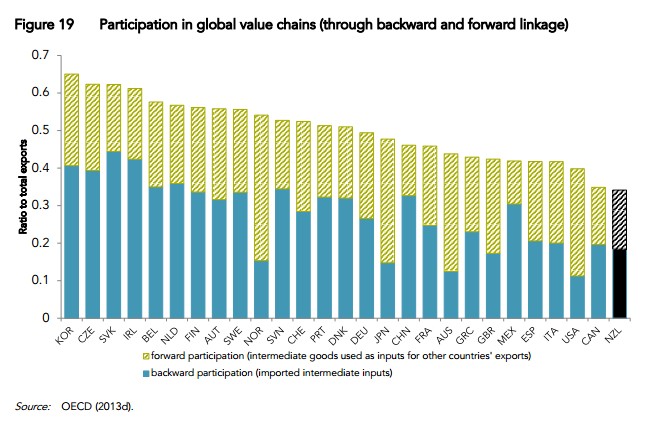
You might recall that the Productivity Commission published a report last month written by three OECD economists, "An International Perspective on the New Zealand Productivity Paradox". One of its conclusions was that we are not as well plugged into global value chains ('GVCs') as we might be: these chains are "a wide range of value creation beginning from the development of a new concept to basic research, product design, supply of core material or components, assembly into final goods, distribution, retail, after service and marketing (including branding). Participating in these segments of a GVC enables firms to capture world demand without having to develop a whole supply chain and full set of underlying capabilities" (p27), which is why they would be so handy for a smaller economy like ours. Currently, we're relatively unconnected to these global supply chains, as the chart below (from p28) shows, so we're missing out.


But as the OECD authors point out, "Participation in GVCs often involves increases in trade and FDI [foreign direct investment], which enables countries – China being a prominent example – to develop industries and narrow the technological gap vis-à-vis the world frontier over a short period of time".

What we ought to be doing, in short, is making it as easy as possible for overseas firms to operate part of these chains in New Zealand (ideally the better paying, upmarket bits). Seen from that perspective, moaning about migrants isn't just xenophobic: it's also blocking the linkages we need to build to become better off.

Saturday, 22 February 2014

The real issue with Hugh Laurie

There's been quite a lot of media coverage about who said what to whom in the supposed stoush between Hugh Laurie and Immigration New Zealand  over a work visa - see, for example, Hugh Laurie's spat with Immigration NZ - and I've been waiting for someone to make the most obvious point of all, and the only serious takeaway from the whole thing, but nobody has. So here it is.

Why on earth does Hugh Laurie have to apply for a work visa in the first place?

Or the Rolling Stones, or the Berlin Philharmonic, or JK Rowling, or Billy Connolly, or the Indian cricket team, or anyone else coming for a concert, or performance, or sports or book tour?

Nobody seriously imagines that Immigration is going to turn down any of these applications: they're a completely futile formality. So why do them?

Presumably (if there's any good policy reason at all) it's because if we let Hugh Laurie in to work, next thing the country will be swamped by itinerant Indian applepickers.

Well, I've got three thoughts about that.

One, I've got no problem with the applepickers arriving, either. And neither do the farmers who'd like to employ them. And I don't see long queues of the New Zealand unemployed waiting at the farm gate for those applepicking jobs.

Two, why hasn't someone had the wit to devise a visa-free process for the Berlin Philharmonics of this world instead of the makework nonsense we currently have?

And three, what sort of image do we want to present to the rest of the world? We're supposed to be on the side of the non-protectionist angels when it comes to free movement of goods and services, money, and people. Why are using this footling process that achieves nothing except the occasional burst of bad PR?

Tuesday, 17 December 2013

Follow the money...

I know I've said it before, but there really are so many business surveys around these days that even dedicated economy-watchers can't keep track of all of them. Inevitably some slip under the radar.

One you might have missed (and I came across it only accidentally while foraging a while ago for something else on the bank's website), is the quarterly ASB Kiwi Dollar Barometer. It's well worth having a look at: it's quite a decent sized survey (390 firms with turnover of at least $1 million) of businesses' exchange rate expectations and their forex hedging plans.

The latest one came out last week. The headline result was that businesses (averaging out both importers’ and exporters’ views) expect the Kiwi dollar to peak against the US$ around the 81 cent mark  in the March ’14 quarter, and to decline to 76.5 cents by the end of next year. Currency forecasting, many would say, is a complete waste of time, and perhaps these businesses' expectations will prove just as wide of the mark as any other forecaster's. But I doubt it.

For one thing, consensus forecasts across wide groups tend to do better than a single guy with his spreadsheet.

And for another - and this, to me, was the really interesting bit - the businesses are putting their money where their mouths are, as this graph shows.


Notice that the percentage of importers planning to hedge has hit a new high: in real time, with real dollars, import businesses are increasingly taking out protection against the Kiwi dollar falling.

You might wonder (as the ASB economists did) why the proportion of exporters planning to hedge also ticked up a bit in this latest survey - if they really believed the Kiwi dollar is going to fall, they'd be planning to do less hedging. The ASB team commented that "It is likely the recent strength in the NZD has seen exporters look to protect themselves against further increases in the NZD, even if their core view is that the currency will ease over the year ahead".

I think this is absolutely right, because I've seen this happen before. Years ago I worked for a forex consultancy business in London, and our customer list looked like a hospital ward: every corporate in Europe that had run into financial grief appeared to be on our books as clients. Why? Because they were already in such a difficult position that the last thing they wanted was to have forex losses on top of everything else.

And that's where Kiwi exporters are right now. They might believe the Kiwi dollar is going to fall - but they can't live with the risk that it might tighten the screws even further on them with another bout of appreciation.

Wednesday, 20 November 2013

Another good book

It's taken me a while to catch up with it - I gather it won awards and was on shortlists of best business books of the year when it was published in 2005 - but I've finally read Pietra Rivoli's The Travels of a T-Shirt in the Global Economy: An economist examines the markets, power and politics of world trade.

It's been worth the wait.

Rivoli, a professor of finance and international business at Georgetown University, has written what she calls "a story about globalization", noting that while "stories are out of style today in business and economic research", they play a bigger and useful role in other disciplines.

On this evidence we could do with more economics stories. This is a good one, tracing Rivoli's T-shirt ("white and printed with a flamboyantly coloured parrot, with the word "Florida" scripted beneath") from the cotton grown on a family cotton farm in Texas, through to the yarnmaking, spinning, cutting and stitching together in China, back to the US for the printing and retailing, and finally to Tanzania and its second-hand clothes ("mitumba") markets.

Along the way you'll learn a lot about economic history and economic development (the cotton mills have often played a lead role in countries' industrialisation and in the original Industrial Revolution) and about the politics of trade policy. As she notes, all the "markets" bar the final second-hand clothing one are heavily distorted by protectionism in buyer countries (especially in the US with its domestic cotton subsidies and its quotas and tariffs) and restrictions on functioning markets in supplier countries ("cotton farmers in West Africa are embedded in a system that exposes and impoverishes them...not only does this steep discounting [i.e. the rip-off price farmers get from the state-owned buying board] impoverish the farmers and enrich the state, but the exclusion from the markets created by the A/B [pricing] system gives the farmers no incentive to improve quality", pp54-5).

She is very good on the politics of protectionism, and how the US cotton industry has been so good at it. "Remarkably", she says (p51), "US government subsidies under the cotton program - approximately $4 billion in 2000 - exceed the entire GNP of a number of the world's poorest cotton-producing countries, as well as the United States' entire USAID budget for the continent of Africa". And she quotes research from the US International Trade Commission: "Using the USITC's most conservative estimates, 2002 textile and apparel quotas cost $174,825 per job saved....The costs of protectionism are not only high in dollar terms, they represent a regressive tax, which falls disproportionately on the lower-income workers that the regime is designed to protect". Indeed, there's a whole chapter ("Perverse Effects and Unintended Consequences of T-Shirt Trade Policy") on the cock-ups and harm done by textile protection.

Rivoli started with an economist's belief in the merits of free trade, and it's not shaken by the end of the journey: "Since completing my travels, I have come to believe in a moral case for trade that is even more compelling to me than the economic case" (p214). But she's also sympathetic to any activist working to improve working conditions at the bottom of the world textile manufacturing heap, as long as she (the activist) remembers "to appreciate what markets and trade have accomplished for all of the sisters in time who have been liberated by life in a sweatshop, and that she should be careful about dooming anyone to life on the farm" (p215).

This book is balanced, it's readable, it's right. If you're ahead of me and have read it already, great. If not, it's well worth a go.

Thursday, 17 October 2013

Are we as committed to free trade as we think?

The latest print edition of the Economist has an article, 'The gated globe', which makes the case for increased globalisation and in particular for renewed liberalisation of international trade. All good.

Along the way the article mentioned an organisation called Global Trade Alert. I looked them up: their mission in life is "Independent monitoring of policies that affect world trade", and they do a fine job of it. It's a very interesting site.

I wondered, as you do, if I could break out how New Zealand was travelling in terms of liberalising or impeding global trade. And I could, using a box on the left of their home page, where you can 'Search [trade policy] measures by...'. I put 'New Zealand' in the 'Implementing jurisdiction' box, left everything else set to 'Any', and hit 'Search'.

I hoped and expected that we'd come out on the side of the angels. The answer is, we kinda did, sorta.

The search returned 12 results. Sadly, only two of them were liberalising. One was an APEC initiative in 2012 to reduce tariffs on a range of environmental goods (wind turbines, solar heaters and the like). The other was a unilateral initiative in 2011 to make business immigration a little easier.

That left 10 on the protectionist side of the ledger.

Six of them were anti-dumping measures, against Chinese preserved peaches, Chinese wire nails, Italian tomatoes, Malaysian galvanised wire (what's with the wire?), Spanish canned peaches (what's with the peaches?), and Thai plasterboard. Incidentally, there seem to be a few more that Global Trade Alert may have missed: on the 'Imported goods subject to duty' page of the MED website I found peaches, yet again, from Greece and South Africa; diaries, of all things, from China and Malaysia; hog bristle paintbrushes from China; and reinforcing steel bar and coil from Thailand.

The other four measures that Global Trade Alert reported were a mixed bag.

Two of them were GFC-response measures to guarantee the deposits and the wholesale funding of New Zealand financial institutions. Global Trade Alert put them in the bad column because they felt they discriminated in favour of New Zealand entities. That might be formally true, and probably undesirable, but I honestly don't believe there was a skerrick of protectionist intent behind either measure in the circumstances of the GFC, so I'm going to put those to one side.

The last two were a 2009 toughening of immigration law, making it harder for seasonal migrants to get in, and a 2012 amendment to the customs and excise legislation, introducing much higher penalties on importers for making "materially incorrect" entries on their import forms, with the maximum penalty going up from $50 to (wait for it) $10,000.

It's regrettable we've done any of this, but it's especially regrettable that we've made use of these anti-dumping measures. The MED's website says all the right things - its FAQ says "Trade remedy investigations ensure fair competition, and should not be seen as trade restrictions", and "There is a difference between imports that are low-cost and those that are dumped or subsidised. Anti-dumping or countervailing action does not remove a foreign producer's competitive advantage, and is not designed to prevent imports from any given country" - but the reality is that anti-dumping provisions have little underlying logic. They're on the same, generally shaky, ground as 'predatory pricing' cases are in a competition law context.

And even if they might be worthwhile in some situations (and I'd emphasise the 'if' and the 'might'), the regularity with which they are abused, as covert protectionism, outweighs any good they might do. And we should know: we've been on the receiving end of the abuse in the past, notably over kiwifruit exports to the US in the 1990s.

So I'm sorry to see us making regular use of them. I know, there aren't pages and pages of them, it's not the end of the world, these are relatively small niches, and you couldn't argue with a straight face that we are erecting Fortress New Zealand behind a barricade of anti-dumping duties. But even a few of them are in my view a few too many.

You might wonder why I summarised our overall position as 'sorta' on the side of the free trade angels, since we haven't done much on the plus side of the ledger and an assortment of (admittedly modest scale) stuff on the wrong side.

That's because you haven't seen the scale of what other countries have been up to. Australia, for example, features 80 times in the Global Trade Alert database. Only 10 of the mentions are in the liberal column. The other 70 were on the protectionist side, including 34 anti-dumping cases.

So we're not perfect. But we're a great deal less imperfect than a lot of places.

Thursday, 11 July 2013

The uphill struggle for free trade

I was very pleased to read that we've signed a free trade deal with Taiwan. I know that bilateral deals aren't as effective as regional or global multilateral deals, but with global WTO talks on the never-never and the Trans Pacific Partnership still over the horizon somewhere, it's worthwhile bagging what we can get, especially with strong performing economies like Taiwan.

It is rather depressing, though, to see how badly the case for free trade still struggles in the marketplace of public opinion. If you google references over the past month to 'Trans Pacific Partnership', for example, you will find that the coverage is dominated by hostility.

The first page of results today included "The Trans-Pacific Partnership is a global corporate coup that makes corporations more powerful than governments and undermines our national sovereignty", "If the TPP is adopted the door will be open wider for human rights and environmental abuse", and "the TPP is a major power grab by large corporations...the intention of the TPP is to enhance and protect the profits of medical and pharmaceutical corporations without considering the harmful effects their policies will have on human health". Maybe there is indeed something wrong with the negotiating process for the TPP or its agenda, but frankly it wouldn't matter for many people. Every free trade initiative faces an uphill struggle in many people's minds.

There was, for example, an article in the latest May Papers & Proceedings issue of the American Economic Review, "Economic Experts versus Average Americans", which compared the views of the American public with those of a panel of expert economists across a variety of policy issues of the day. Asked whether "On average, citizens of the U.S. have been better off with the North American Free Trade Agreement than they would have been otherwise", only 46.2% of the public agreed, and another 15.4% weren't sure; 38.4% thought NAFTA made things worse. Among the economists, on the other hand,  94.6% thought NAFTA was a good idea, and only 5.4% were unsure. Not a single economist thought NAFTA was a bad plan.

The economist result is not surprising: we all get taught early on in our economics courses about the win/win nature of trade. We know that if the Chinese specialise in T-shirts and we specialise in butter and we trade with each other, there will be more aggregate T-shirts and butter produced than either of us could manage on our own, or - and maybe this is a better way to engage people's minds about it - the same amount of T-shirts and butter, but resources freed up to produce something else as well.

We can even put numbers on it: look, for example, at the analysis the Centre for Economic Policy Research in London has recently carried out on the potential benefits of a trade agreement between the EU and the US (press release here, full report here). A big deal could be worth "an extra €545 [NZ$900] in disposable income each year for a family of four in the EU", and beyond the sizeable benefits to the US and the EU it would also increase GDP in the rest of the world by almost €100 billion [NZ$165 billion]. To put that in context, that's around 75% of our nominal GDP.

Some of the public reaction isn't that surprising either: we know how the political economy of the thing tends to play out. The 99.9% of the population who benefit from cheaper imported T-shirts are a widely dispersed group of individually minor beneficiaries, whereas the 0.1% of the population who are threatened domestic T-shirt manufacturers are a highly vocal, highly motivated pressure group.

That said, you can't help feeling that there is more that us economists could do to fight the good fight in the marketplace of ideas for a policy that raises incomes everywhere, and is probably the single biggest escape route from poverty for the poorest countries amongst the poor.