Showing posts with label monetary policy. Show all posts

Thursday, 29 February 2024

Inflation and the output gap

Yesterday's Monetary Policy Statement from the Reserve Bank said (eg at p ii) that "a sustained decline in capacity pressures in the New Zealand economy is required to ensure that headline inflation returns to the 1 to 3 percent target": the economy needs to move from a hothouse above-capacity state (a 'positive output gap' with people trying to chase after scarce resources, driving up their prices) to a below-full-capacity state (a 'negative output gap', where resources are more available and less in demand).

Here's what the relationship that's being relied on has looked like over the past twenty odd years. It shows how the output gap has affected domestically-generated ('non-tradables') inflation. The numbers come from the underlying data supporting the Statement, which the RBNZ helpfully supplies as a spreadsheet. I've taken the impact of the 2010 GST increase out of the inflation data. I've also advanced the output gap by three quarters, which looks to be a good stab (tested by a couple of quick regressions) at the lag between the hot or cold state of the economy and subsequent heating up or cooling down of inflationary pressures.

It's a reasonably robust relationship (a simple regression had an R squared of 0.54) but it's obviously not infallible. In the mid 2000s for example the economy ran quite hot but non-tradables inflation never picked up, and the years immediately before Covid also saw the economy in reasonably good fettle without provoking the inflation genie. But that said, and especially when there are really large moves (the post GFC slump, the post-Covid fiscal and monetary policy fuelled boom), it holds up pretty well.

Two things struck me when I looked at the chart. One is that the RBNZ is projecting a large move in the output gap by historical standards. Peak to trough, the GFC setback amounted to a 5.8% of GDP swing, from 2.8% above capacity to 3.0% below it. The projected move in coming years is almost as large: a 5.5% swing from 3.9% above full capacity to 1.6% below. Maybe that will indeed happen as monetary policy continues to bite, fiscal policy very likely turns less supportive and strong net immigration swells the available labour supply. I wouldn't say it's an implausibly big or improbable ask to see a turnaround of that order, but getting on top of inflation is reliant on a pretty large change in economic conditions coming to hand.

The other thing that struck me is that if the output gap does indeed evolve as the RB expects, non-tradables inflation might even drop more than projected. My little regression says that if we get down to a negative output gap of -1.6%, non-tradable inflation (with a three quarter lag) would get down to 2.3%, a bit lower than the 3.0% the RBNZ anticipates. Or put it another way: the 3% or so non-tradables inflation the Bank expects is the sort of outcome you'd get if the economy was roughly at a Goldilocks zero output gap, neither too hot nor too cold. If we actually stay below that level (as the Bank thinks), non-tradables inflation could well recede more than currently anticipated.

Thursday, 22 February 2024

The New Zealand Economic Forum - Day 2

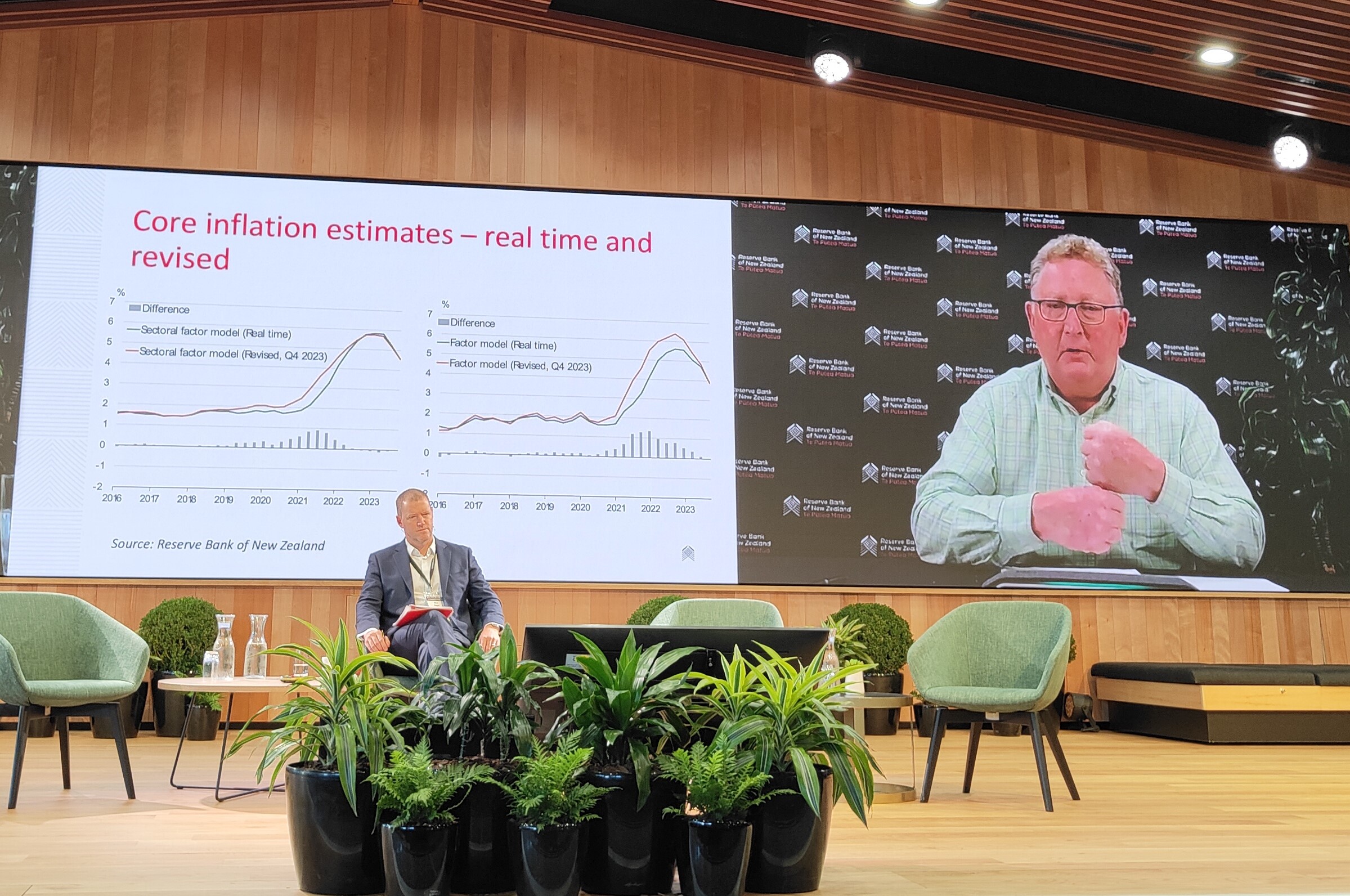
We kicked off Day 2 with a keynote speech, "The monetary policy remit and two percent inflation", by Adrian Orr, governor of the Reserve Bank, delivered online (full text here or watch the video here) after Adrian came down with a late lurgy (a pity, as I'd looked forward to chewing the fat about the forthcoming NRL season with my fellow Warriors tragic).

Adrian Orr with one of his slides, showing that core inflation as it actually transpired over 2020-22 was stronger than the lower real-time estimates available when decisions needed to be made (with Waikato's Prof Matt Bolger as moderator)

Takeaways? Some sympathy for the RBNZ's (and other central banks') challenges over the past few years: Covid, where Adrian reasonably asked, which mistake did you most want to avoid in the high-uncertainty crisis, and the answer was too-tough policy that might aggravate a downturn, hence the almost universal let-it-rip of both fiscal and monetary policy; the Team Transitory/Team Core debate; the interruption to normalisation from the Auckland lockdown; the Ukraine; and a recent rise in household inflation expectations. 

Expectations - which are interlinked with people's trust in the competence of a central bank (what us older folks used to call 'credibility') - look high on the bank's agenda. I noted in the speech that while inflation has come down, "tackling the tail end of these persistent inflation pressures in the domestic economy remains key to achieving 2 percent inflation. Just how persistent these pressures might be depends on how factors, such as capacity pressures and inflation expectations, evolve going forward". Adrian was giving nothing away about the next monetary policy decision (February 28) but if I were in the room I'd be looking at the latest annual non-tradable inflation rate (5.9%) and wondering if those capacity pressures and expectations levels needed a further knock on the head.

Onwards to fiscal policy, first with a keynote from Caralee McLiesh, Secretary to the Treasury, followed by a panel discussion on 'Treasury and the state of the books'.

Caralee's speech doesn't appear to be up on the Treasury website, but you can get the gist of it from the excellent 'Economic and Fiscal Context Slide Pack' which was part of Treasury's Briefing to the Incoming Minister of Finance. A key point was that our fiscal deficit is structural, not cyclical: as Caralee said, it tends to be easy to loosen fiscal policy in a downturn, and a lot harder to wind back the spend in better times, and we've now reached the point where belated policy tightening is needed (we'd got the same message from Nicola Willis the previous day). "Difficult distributional decisions lie ahead": quite.

Treasury Secretary Caralee McLiesh speaking to our rise in net public debt

The 'State of the books' panel - Craig Renney from the CTU, Eric Crampton from the New Zealand Initiative, Sarah Hogan from the New Zealand Institute of Economic Research - may have been intended to have been a battle of "duelling economists", as one person put it, but it turned out to be a lovefest of harmony and mutual understanding which coalesced around the theme of the importance of getting the best value for money from the public spend. 

As Craig said, there's nothing inherently "right-wing" in demanding value for money and nothing inherently "left-wing" in spending the right amount. Sarah pointed to health as one area where we are not getting value for money: Pharmac (she said) may take its lumps from its critics, but on the other hand it is a rare example in the sector when it comes to revealing its prioritisation. Other areas are either not transparent, or may not even prioritise in the first place. Eric would like us to retreat from the post-Covid spending bloat, perhaps to the same share of GDP that the Wellbeing Budget of 2019 represented (core crown spending of 29.1% of GDP, compared to the 33.0% expected for 2023-24 in last year's Budget forecasts): one reason was that people would be less likely to sign up to future rainy day spendups if they see previous ones sitting there unpaid for. And all the panellists were very keen on a really rigorous framework of prioritisation and evaluation: as Craig put it, "Think hard, and then think hard again".

The "duelling economists": Craig Renney, Eric Crampton, Sarah Hogan, with (on left) panel moderator Waikato's Prof Anna Strutt

Then we got a panel on 'Infrastructure: Unclogging the arteries', a topic close to my and I'd guess every other New Zealander's heart, given the increasingly shabby state of virtually all the infrastructure we use, from hospitals, classrooms, and roads to those infamous three waters. I drove down to Hamilton from outside Warkworth. The good news is that Warkworth to the approaches to the Harbour Bridge went fine (thanks to the new Puhoi motorway extension, even if it took forever to build), and Drury to Hamilton was fine (thanks to the new Waikato Expressway, also remarkably protracted). The bad news was that the intervening Harbour Bridge to Drury stretch remains an absolute nightmare, undoing a fair amount of the Puhoi/Waikato benefits, and the throttleneck looks like staying that way for some considerable time. There's a huge deferred bill looming: one speaker mentioned the Infrastructure Commission's estimate that we will need to spend $30 billion a year for the next 30 years.

Alison Andrew, CEO at Transpower, told us that while the current transmission grid is in good shape, (a) most of it was built in the '50s and '60s and is getting to its use-by and (b) there's an opportunity to green the country through electrification, but we will need 22 gigawatts of generation (and associated transmission) compared to today's 10 gigawatts. She didn't say it, but I personally wondered why the Commerce Commission regulates Transpower in 4-5 year bites, rather than over a longer-term horizon. Chris Joblin, CEO at Tainui Group Holdings, said it wasn't so much unclogging the arteries that's needed, but more like a double or triple bypass after being on the fags since the '70s: we just haven't being looking after our infrastructural health. And when we do bestir ourselves,  the consenting takes forever: he mentioned that it took 17 years to get Tainui's inland port at Ruakura (just beside Waikato University, as it happens) up and running. Among the issues: we look for perfection, which causes procrastination, and we load too many objectives onto projects, blowing out the costs and causing further rethinks. And Nick Leggett, CEO at Infrastructure New Zealand, agreed that we need to get our project management process right: we can occasionally rise to the occasion but mostly we're bad at it.

In passing, if the planning and project mismanagement omnishambles gets your goat, too, you'll like Daryl McLauchlan's piece for Democracy Project, 'Unjarndycing the State'. And if you'd like a piece on how we might do better, here's one I prepared earlier for Acuity magazine, 'Getting results'.

Life's too short, so I'll just pass briefly over the final two sessions. 'Climate & Weather: So what happens if we don't curb emissions?': answer, bad stuff,  and for some of the same reasons that our infrastructure record is so poor. As Sir Brian Roche said, we make a virtue of recovery from disasters, but we don't provide for preparedness in the first place. If 'value for money' was a recurring theme of the Forum, 'dynamic inefficiency', not investing enough to keep the show on the road, ran it a close second.

And in 'Fintech Futures: The end of cash?', no, cash is not dead, with the RBNZ's Karen Silk reminding us of why we still use it (full and final settlement, in privacy, plus benefits when, say post-Gabrielle, the ATMs and EFTPOS go down). And on the fintech side, we've had some successful financial innovation - we heard from Brooke Roberts, co-CEO of one of the successes, Sharesies - and while Brooke hoped that we will eventually have a global fintech come out of New Zealand, it's generally not as easy to get things up and running as it is in, say, Australia. Shane Marsh, cofounder of DOSH, also wondered about us falling behind. In my mind, I've always thought of New Zealand as a digitally advanced place - we were using EFTPOS for everything when our friends and rellies in Ireland, the UK or the US were still writing cheques - but the world's moved on, and we haven't. In Shane's view, our payments landscape is now well behind the rest of the world and even behind some of the 'developing' world .

Matt Bolger, Pro Vice-Chancellor of the Waikato Management School, sent us on our way with an uplifting message. While it's tempting to think that today's rate of change is unprecedented, Matt said we shouldn't get so up ourselves: how do we compare, really, with the generations who went through the Great War, the Depression, fascism and communism, and World War Two? And despite our current inability to plan properly for tomorrow's challenges, maybe he's right that we shouldn't get overwhelmed, and we should stay optimistic. It would be nice to think that New Zealand Economic Forum 2025 will be able to document that we're getting more of a grip on the issues that face us.

Wednesday, 21 February 2024

The New Zealand Economic Forum - Day 1

The University of Waikato's New Zealand Economic Forum 2024, on the theme of 'A briefing to the incoming government', kicked off in Hamilton last Thursday with a speech by Finance Minister Nicola Willis (below).

Nothing headline-making, but solid stuff: I liked the aim to lift our growth rate by removing go-slow regulation, the plan to have fast one-stop consenting for major projects, and to have more 'social investment', meaning prioritising social spending on the groups most at risk of being stuck in persistent disadvantage. In Q&A, someone asked about investment plans: there's apparently going to be a coordinated 30 year pipeline of projects, and about bleeding time. There are decision-making models maintained in the public sector that let you assemble optimal investment portfolios, and they badly need to be deployed, however belatedly, to make our infrastructure spend all that it can be. Chatting to another attendee afterwards, he wondered if the benefits and costs you need to feed into those models were reliable enough to avoid garbage in, garbage out results, but anything's got to be better than the lack of coordination we've had up to now.

The next two topics - agriculture and health - weren't my thing, but they had their moments. In agriculture, I'd never heard of AgriZeroNZ before: "A partnership between the New Zealand government and major agribusiness companies, we're helping farmers reduce emissions while maintaining profitability and productivity". Good stuff. In health, I heard a lot of sense from Professor Des Gorman. He said that we don't have a 'health' system, we have a disease and injury management system, paid for on annual levels of activity, which is self-evidently not ideal. He argued for a better 'tight, tight, loose' system focused on value for money: it would be tight in defining the health outcomes you'd like to see, tight in measuring what providers actually achieve, but loose or agnostic about what sort of providers you use. For those who would cry 'privatisation' of the public health system, his answer is that the system is largely private already, notably including your local GP practice. And for those worried about those dreadful private providers making a profit, in a competitive value-for-money system the answer is, "They're delivering more for less. What bit don't you like?".

After lunch we had a choice of 'Demographics are history' or 'Running tax differently', and my inner nerd chose tax. Graham Scott (gamely filling in for the unavoidable late withdrawal of Max Rashbrooke, also contactable here) reminded us that tax has its own comparative advantage - it has things it can and cannot do - and threatening to load it with multiple policy aims risked taking us back to the bad old days when we had a mad patchwork of specific sales taxes and other distortions and complexities. PwC's Sandy Lau was mostly happy with things as they are, though wondered if we need capital gains taxes, if only to reduce our currently disproportionate reliance on personal income tax. And Victoria's Professor Lisa Marriott's main point was over enforcement: she felt genuinely ratbag behaviour wasn't being sufficiently prosecuted by the IRD. Not only were people getting away with malfeasance, tax compliant businesses were being put at a competitive disadvantage relative to the scofflaws.

The session on 'Social investment: What difference will it make', led to a strong consensus that (a) there is a large group of people who suffer from persistent disadvantage (b) current social policy isn't cutting the mustard (c) by finding out what these people most need we can get better much better results especially if we focus on value for money from what we do and (d) we should regard what we do as an investment in people rather than as a cost. As Merepeka Raukawa-Tait put it, the time for wasted spending is over. Subsequent speakers pointed to a dramatically successful example that Maria English gave us, where providing tailored housing to a particular person saved nearly all of the very expensive 100 nights a year they'd previously been spending in a hospital bed. The session made complete sense to me, and I was quietly bemused how the winds have changed since Bill English (Maria's dad) championed this very approach, and got roundly rubbished for it.

My initial reaction to 'Trade: Dealing with a divided world' left me worrying: there's been an end of the "golden weather" of increasingly free and rules-based trade. Now there's fragmentation, rules flouting, disempowerment of the World Trade Organisation, protectionism, and 'security' concerns (real and paranoid). It very much felt like the trade front of Cold War II. MFAT's Vangelis Vitalis replied to my downbeat tweet that "I hope the conclusion left you feeling  more positive, i.e. we have a plan, agency, new options & advantages in key markets and are determined to protect and defend our hard won benefits through FTAs", and that we are showing "Policy entrepreneurship in international trade policy". He'd mentioned, for example, us successfully taking Canada on about their dairy trade protectionism. All fair comment, and it's good to know we're fighting our corner, but it's still a trickier wicket to bat on than it was before.

And the day wrapped with a session chaired by Steven Joyce on 'Monetary policy: Controlling what we can control'. Grant Spenser, ex deputy governor at the Reserve Bank, reminded us that the RBNZ, when it last reviewed how it had been going, found nine things it could work on, and wondered how they were getting on with them: he also noted that there appeared to be quite a blowout in operational spending and in headcount over the past six years. He also wanted to see more of a challenging culture at the Monetary Policy Committee from the independent members. I totally agreed: Australia's moved in that direction recently as well, with a boost in expertise and a requirement that independent members put their view into the public domain at least once a year. Bryce Wilkinson revisited some of the territory he'd covered in his publication co-authored with Graeme Wheeler, 'How central bank mistakes after 2019 led to inflation',  reminding us that monetary policy everywhere was relied on as being more of an exact science than it actually was, and that central banks made very poor inflation forecasts, even though that was their day job. Bryce said the global financial markets had also missed what was developing. And Henry Russell found himself in something of the spotlight given that the ANZ Bank had just made a big off-consensus call that the RBNZ would hike rates again (two moves of 0.25%), its reasoning being that the RBNZ had indicated back in November that it had little tolerance for any upside inflation risks, but they looked like they were getting some.

The monetary policy panel: Henry Russell (ANZ Bank), Bryce Wilkinson (Capital Economics / The New Zealand Initiative), Grant Spencer (ex RBNZ, Victoria University), Steven Joyce at the lectern

There was a really interesting discussion after the speakers' opening remarks, including around the ANZ forecast of hikes to come. Bryce thought that interest rates were now where they out to be on a Taylor Rule basis, and also that money supply growth had slowed down to very little growth at all (the latest 'broad money' measure, for example, is up only 3.6% on a year ago), both of which argued against hikes. Grant felt that with inflation already down quite a bit, maybe it would be better to hold and stay at current rates for a bit longer to see what happens. Henry, however, said that arguably a global disinflation supporting tailwind has blown out, that domestic inflation is still not good and might surprise on the upside again, and that while the pricing indicators in the ANZ business survey have stabilised, it was an open question whether they had stabilised at a level consistent with the RBNZ's inflation target. Policy issues raised but unresolved for another day: whether unconventional monetary policies (like quantitative easing) had been worth it; how monetary policy should respond to supply shocks; and whether the RBNZ ought to be both the setter of monetary policy and the financial prudential authority. Evidence from overseas is mixed, and against the canonical practice of economists having an answer to everything, I can't say I've got any clear opinion, either.

Thursday, 21 December 2023

The clock ran out

This week's 'mini Budget' was certainly down the minier end of mini, and understandably so. While I sympathise with a bias for action, and there was also a political commitment to be honoured, by the time the coalition was settled and portfolios allocated, there just wasn't enough time left on the clock to pull everything together and produce an up to date and internally consistent mini-thingie and its accompanying Half-Year Economic and Fiscal Update (HYEFU). As the HYEFU notes (p9) its forecasts were put to bed on November 6, but after that it lists a slew of events (notably the new government and its policies, and some important data releases including that weaker than expected September quarter GDP number) that haven't been able to be fully factored in. We'll have to wait for the Budget Economic and Fiscal Update (BEFU) next year for a complete and up to date view.

That said, there were a couple of interesting bits of analysis in the HYEFU. One important issue is whether the economy is still at or above capacity - if it is, there might still be lurking inflation risks emanating from domestically traded but supply constrained goods and services, if it isn't, then we might start looking ahead to eventual RBNZ easing. Here's the HYEFU take: it's reasonably encouraging from an inflation-pressure perspective. On its 'output gap' calculations, Treasury reckons we'll be going from 1% above capacity in June '23 to roughly at-capacity (-0.1% below potential output) in June '24 and to clearly below (-1.0%) potential output by June '25.

That all depends, though, on whether you can get a good handle on potential output - the maximum level of GDP growth we could manage on a sustainable basis - and I don't envy the Treasury analysts their task ("There is considerable uncertainty surrounding the degree of excess demand in the economy" - HYEFU p14). One big uncertainty is how much of the recent immigration-superpowered increase in labour supply feeds into what GDP it will produce. Another is likely productivity growth, which recently has been all over the place, as the graph below shows, and it would be a brave person who claimed to know where it was going next. You'd think there might be a chance that post-Covid business practices (working from home, greater flexibility, less command and control), might be about to deliver some kind of productivity payoff, but then again maybe not: after all, over the 13 years in the graph, we've only managed to eke out a 0.3% a year productivity gain, and only a small part of it came in the most recent few years.

Finally, for me one of the most important bits in any HYEFU or BEFU is the degree to which the fiscal policy stance is stimulatory or contractionary, and whether the stance matches with the state of the business cycle (a 'pro-cyclical' stance, making booms even boomier and downturns even gloomier, being the trap to avoid). Here's the latest stab at the 'fiscal impulse', the degree to which underlying fiscal policy is looser or tighter than the year before.

To me, and accepting that some of the spend was in response to North Island weather events, the fiscal policy stance for the 2023-24 year was inappropriately procyclical. In June '23 the unemployment rate was only 3.6%: the economy didn't need a fiscal boost. And it also put fiscal policy at odds with the tightening stance of monetary policy, which had started to apply the brakes from late 2021 and pressed harder and harder through 2022 and into this year. Monetary policy needs mates, as they say, but it ended up dancing alone.

Looking ahead, the economic outlook is not that flash: over June '23 to June '25, HYEFU expects GDP growth at a relatively slow 1.5% a year pace, and unemployment to rise from 3.6% to 5.2%. That'll be a tricky environment to be thinking about taking 2.4% of GDP out of aggregate demand (the estimate of the fiscal impulse for 2024-25). The new government will need to be careful not to turn a slowdown into something worse.

Thursday, 31 August 2023

Coordinating in the dark

While laid up at home with a very belated case of Covid - we're okay, thanks for asking - I thought I'd use the downtime to read the IMF's latest report on New Zealand. I'm tempted to add the traditional "so you don't have to". While you don't expect an airport novel, even economists' eyes will glaze over when they find pieties like "The OCR [official cash rate] path should be calibrated to developments in the economy, including external shocks and fiscal and other policy responses". Well, duh.

Cheap shots aside, you can't argue with the big macro conclusion - we've overheated, and fiscal and monetary policy need to brake the economy: "With exemplary management of the pandemic, New Zealand recovered faster than most other advanced economies. This supported activity and, together with generous fiscal and monetary support, resulted in strong investment and consumption. But this came at the cost of overheating against capacity constraints exacerbated by restrictions on labor movement due to border closures, and disruptions in global supply chains". 

You could argue that the RBNZ has done its bit, but that Treasury hasn't. As the graph below shows, we have a largeish positive (i.e. stimulatory) fiscal impulse in the current 2023-24 fiscal year, when if everything was nicely coordinated fiscal policy would also be tightening. Given the Auckland floods and Gabrielle I'm happy enough to cut some (but only some) slack in the circumstances and trust (hope?) that the fiscal largesse will unwind in coming years. It's also true, as Oscar Parkyn, New Zealand's alternate director at the IMF, points out in an accompanying statement, that "While the fiscal impulse is estimated to be positive in the current fiscal year, the authorities [i.e. the New Zealand government] note that near-term fiscal impulse forecasts are highly uncertain", and maybe there won't have been an unhelpful 1.8% of GDP boost to an already overstretched economy when the final beans are counted. All that said, some of the discretionary measures in the 2023 Budget, or other programmes that could have been put on the back burner, really ought to have been deferred till a more cyclically opportune time


The Executive Board assessment in the report - "Directors underscored the importance of careful calibration of the fiscal and monetary policy mix to rebalance the economy and help address long-term structural needs" - is surely right. And I'm not convinced we have a good institutional mechanism to make that happen and to expose the consequences of fiscal and monetary policy not pulling together. If Joe and Joan Public had been told that you can have your Budget goodies, but your mortgage is now going to 6% rather than 5%, how impressed would they have been?

Elsewhere in the report, the Executive Board said that "Compiling a monthly inflation index would enhance the effectiveness of monetary policy", and it crops up in various places: in the staff report (para 19), "During the consultation, the RBNZ flagged the need to improve data and real-time information to aid monetary policy decisions and highlighted the lack of monthly consumer price data as an important gap. The lack of a monthly CPI series makes New Zealand an outlier among advanced economies and is holding back a timelier formulation and assessment of monetary policy. A review of the financial resources of the RBNZ is ongoing" and (para 20, in the government's response), "Stats NZ is examining the possibility of publishing more price data on a monthly basis to enable more timely monitoring of inflation developments but noted that a monthly CPI series would require additional resources".

Sadly, we have form here. When Covid hit, we discovered we didn't have timely enough data on how the economy was tracking, and we started on a mad scramble in the middle of a crisis to develop some ('Getting real', 'Getting even more real'). Two years later along comes the worse outbreak of inflation in 30 years, and do we have the statistics to help us best cope with the latest challenge? No we don't. In our current and deeply strange ordering of statistical priorities, the Stats database can tell us what we spend monthly on imports of 'Preparations of vegetables, fruit, nuts or other parts of plants' from Bulgaria*, but it can't tell us our own country's monthly inflation rate.

Just over a year ago the Aussie Bureau of Statistics got with the plot and started its 'Monthly CPI indicator'. We saw its value yesterday when the latest number (4.9% for July) came in below the expected 5.2% - useful new info all round, with reactions across numerous markets. Here? We're still twiddling our thumbs.

*$46,015 in May

Wednesday, 26 May 2021

The Bank and the markets are on the same page

First thing you notice about today's Monetary Policy Statement?

Well, maybe the second thing, after the wholly expected news that the official cash rate or OCR will be staying where it is for quite a while yet, as (for example) all 13 folks surveyed on the Finder OCR preview page had anticipated.

The possibility of an OCR cut is now remote. The February Statement had said, "The Committee agreed that it remains prepared to provide additional monetary stimulus if necessary and noted that the operational work to enable the OCR to be taken negative if required is now completed". The April Review had said, "The Committee agreed that it was prepared to lower the OCR if required". And in this one? Any cut to the OCR has been taken out the back and quietly buried. Which makes complete sense: the futures market has already moved on and has been signalling no further cuts for a while now.

We're back to the good old days when the Bank published a projection for the OCR, rather than the notional "unconstrained OCR" construct it had been running with in recent Statements. And here it is.

As the Bank says (p17), "This projection is conditional, in that it communicates the policy path required to meet our monetary policy objectives subject to the economic outlook and the assumed impacts of other monetary policy tools", and it is not "forward guidance", or the Bank's formally tipping its hand about likely future moves, and if the outlook changes the projected OCR path will, too. But all that said, it's the best take we've currently got on what the Bank is likely to do next. It also agrees with what the markets were expecting, which was an OCR hike of 0.25% around the middle of next year and another one by the end of 2022..

On the Really Big Question that is bothering central banks right now - are current signs of inflationary pressure a signal of permanently higher inflation down the track, or will they go away as (eg) Covid effects wither away? - the Bank has come down largely on the temporary side: 

"The Committee discussed the risk that these one-off upward price pressures may promote a rise in more general inflation and inflation expectations. However, the Committee agreed that these risks to medium term inflation were mitigated by ongoing global spare capacity and well anchored inflation expectations" (p3), and

"we expect the broader impact on consumer price inflation to be moderate and temporary. Our projection assumes that goods supply-chain bottlenecks begin to ease in late 2021, and dissipate gradually over 2022. There are already tentative signs that the strong global demand for goods is abating, as easing of public health restrictions abroad is lifting demand for services such as eating out and travel. In addition, we expect labour shortages will lessen as border restrictions ease and more workers are able to come into New Zealand" (p28)

though if the Bank's wrong it will have to do something about it, or as it put it (p19), "there is some risk that the change in prices is more persistent and leads to ongoing inflationary pressure. Consistent with the [Monetary Policy] Remit, the MPC [Monetary Policy Committee] would be expected to respond to ongoing inflationary pressure if it were perceived as being inconsistent with the inflation target".

One bit of good news in the Statement is that while we are not in completely calm waters yet, some of the extreme risks around the economic outlook have dissipated: "Confidence in the outlook is rising as the more extreme negative health scenarios wane given the vaccination progress globally. We remain cautious however, given ongoing virus-related restrictions in activity, the sectoral unevenness of economic recovery, and the weak level of business investment" (p2). 

On Covid, the Bank is operating on the basis that "New Zealand is assumed to remain at Alert Level 1 or a lower level of restrictions over the projection ... Border restrictions are expected to begin to ease more broadly from the beginning of 2022. The majority of New Zealand’s adult population is assumed to be fully vaccinated by the end of 2021" (p34).

Wednesday, 24 February 2021

An OCR cut isn't dead after all

Every economist polled before today's Monetary Policy Statement (eg here and here) said there'd be no change to the Official Cash Rate (OCR). Quite a few (including me) thought it's unlikely that any further cuts are on the table (and that the option of going to a negative OCR might even be taken off the table by the Reserve Bank); that the next move will be up (likely preceded by winding back some of the unconventional monetary policy tools); but that it's still necessarily a longish way away. Personally I was also wondering what weight the Bank would place on the December higher than expected inflation rate and the very much lower than expected unemployment rate.

The OCR did indeed stay at 0.25%. Taking it to zero or into negative territory has not, however, taken off the table: quite the contrary. The Statement said (p3) that it's now operationally do-able ("the operational work to enable the OCR to be taken negative if required is now completed") and the minutes of the latest policy meeting said (p6) that "The Committee agreed that it was prepared to lower the OCR to provide additional stimulus if required". There was even a section on pp26-7 headed "A zero or negative OCR would provide additional monetary stimulus, if required" and went into how it might work out in practice.

Adrian Orr was asked at the media conference about the pre-MPS expectation that a lower OCR might be sidelined: he said the bank prefers to maintain a full suite of options against whatever might befall down the track. Fair enough: personally I was starting to wonder whether a lower OCR catalyst might be the need to defuse any unwanted appreciation in the Kiwi dollar. 

The Bank is rightly being cautious on reading too much into the December numbers: "How long the recent recovery in inflation and employment can be sustained is highly uncertain ... Our baseline scenario for the economy, while starting from a stronger position than assumed in November, is subdued. Significant monetary stimulus remains necessary to confidently and sustainably meet our inflation and employment objectives" (p7). 

So there will be "a prolonged period of time to pass before these [inflation and employment] conditions are met" (p6) and "Meeting these requirements will necessitate considerable time and patience" (p3). How long? The Bank publishes a measure called the "unconstrained OCR"* which has a go at measuring the overall degree of stimulus: its latest one (p41, reproduced below) shows the existing level of stimulus increasing just a tad during the rest of this year, but gradually becoming less stimulatory (though still strongly supportive) through 2022 and into 2023. When will monetary policy be back at "neutral"? If (as Figure 6.4 on p50 suggests), a "neutral" OCR is something like 2%, chances are that we won't see one till 2024 or beyond.

There's usually some interesting one-off stuff in each Statement. There's a box (pp19-21) on current conditions in the Māori economy, and this new visualisation (p14) of conditions in the labour market, which does a nice job of bringing together the various ways you might look at the market to figure out how close you are to maximum sustainable employment. 


*In the May 2020 Statement, p11, it had said that "the Reserve Bank used a projection of the OCR to highlight the level of monetary stimulus needed to achieve our inflation and employment objectives. A fall in the OCR projection relative to the previous Statement meant that more policy stimulus was needed. We have had to modify this practice given the Monetary Policy Committee’s forward guidance on the OCR out to early next year and the use of alternative monetary policy instruments. We have opted to publish an unconstrained OCR ... This demonstrates the broad level stimulus needed to achieve the Reserve Bank’s monetary policy objectives, much like the OCR projection demonstrated in the past"

Thursday, 12 November 2020

The Bank's other stuff

Yesterday's Monetary Policy Statement went entirely as expected - no change to the Official Cash Rate (still 0.25%), no change to the Large Scale Asset Purchasing Programme (still capped at $100 billion), and the introduction of the signalled Funding for Lending Programme, intended to provide a new source of cheap funding to lenders (three year funding at the OCR rate). 

If used fully, the new FLP would amount to $28 billion. In Australia, the equivalent Term Funding Facility, which has been going since April, has a capacity of some A$200 billion, or about NZ$212 billion. Divide by 7 as a rough pro rata rule of thumb and the Aussie TFF would be a NZ$30 billion or so programme here, so the good news is that we've introduced a similar-sized stimulus.

There is a line of thinking that providing extra funding for lending might be the proverbial 'pushing on a string' if, in still unsettled Covid conditions, borrowers aren't much minded to take on more debt or banks aren't much minded to take on more risk, and it's true that (as of early November) the Aussie one has seen only A$83 billion taken up, or some 40% of the total available. But as the RBNZ said in the Statement, the actual take-up may not matter so much if the new FLP gets the cost of borrowing down, or as the Bank put it (p21)

The key success metric of the FLP will be whether it results in declines in funding costs, and encourages recent declines in these costs to be passed through to lower household and business borrowing costs. We could see a scenario where FLP funds are only drawn down in small amounts, but its availability encourages a broad decline in interest rates. We would consider this scenario successful, even though actual use of the FLP would seem minimal.

There's always interesting stuff in the body of the Statement and this time round I was especially interested in what the RBNZ had found as it went around the business traps, and in its comments on house prices.

"Many businesses", the Statement said (p18), "expressed concern about finding required staff. Some firms noted that re-deploying staff from one industry to another can be difficult, particularly for skilled jobs. Many firms rely on hiring skilled workers from abroad, which they have been unable to do because of the border closure". 

Granted, the large numbers at risk of losing their jobs in the most affected sectors - the Statement reckoned that pre-Covid international tourism and education made up 6% of GDP - won't always be a good fit for the vacancies available elsewhere, and labour market policy is always going to struggle to assist the transition. "Active" labour market policies (like these successful ones) try to ease the process, but you do wonder whether we've got enough of them. And the reported dependence on overseas skills again makes you wonder how well our labour market is working to match up the demand for skills with the supply of them.

House prices have grabbed everyone's attention, not least because the latest resurgence wasn't supposed to happen in a world where (supposedly) shell-shocked households were hunkering down, not trading up the house. It got a fair bit of attention at the media conference at the Bank after the Statement (tune in around the 29:25 mark, and stay with the rest of the video). But the Bank was quite right to say that it's not its ever-lower interest rates that are the big moving part in the house price increases. As it - completely correctly - said in the Statement (p28):

High house prices in New Zealand largely reflect structural and regulatory issues in New Zealand’s housing market. In particular, land use restrictions, such as urban planning rules, limit the land available for housing and how intensively it can be used. These land use restrictions impede the ability of the market to increase the supply of houses when demand for houses increases. As a result, house prices tend to increase more than otherwise in response to higher housing demand. Other supply-side issues include infrastructure  planning, the building consent process, and the cost of building.

You can berate the Bank all you like, and launch market studies into the building materials trade till you're blue in the face. They're all in the twopenny halfpenny place. Nothing's going to happen to high house prices until the supply side of the market starts to work a lot, lot better.

Wednesday, 12 August 2020

It helps, but we'll need more than this

No surprises in today's Monetary Policy Statement from the Reserve Bank. The official cash rate (OCR) was kept at 0.25% - as every one of us surveyed in the Finder forecaster survey had expected - and the size of the Bank's Large Scale Asset Purchase (LSAP) programme was increased to $100 billion. The point of the LSAP is to keep longer-term interest rates down by buying bonds: me, I'd be tempted to go the Aussie route where they've explicitly said what rate they're aiming for (0.25% for the Aussie three-year government bond). The RBNZ governor got asked at the press conference if the RBNZ was minded to some explicit bond yield targeting: it isn't ruled out, but it's not being ruled in, either. Can't see it hurting, as it would add to the information available on where the RBNZ is headed over time, its 'forward guidance' in the jargon.

Speaking of which, I'm not really sure anymore why the RB is keeping the OCR at 0.25%. Yes, it seems to want to have its forward guidance seen as rock solid, and it had said back in March that the OCR would be on hold "for at least the next 12 months". There may also have been some element of giving the banks a heads up about a timetable for getting their systems in order to handle a negative OCR. But in the wider scheme of things I'm inclined to think the extra support from a 0.25% cut now, especially if it helped weaken the NZ$, trumps the forward guidance credibility. And there is  not a lot of credibility downside risk anyway, given the recent turn of events and a new community outbreak. When the facts change, etc.

It's also worth pointing out that some of the Bank's other policy options would also get more bang per buck if the OCR were lower. As the Statement said, "Because the NZGB [New Zealand Government Bond] curve is already relatively flat around the current level of the OCR, a lower OCR would likely increase the effectiveness of LSAPs by lowering short-term interest rates and allowing LSAPs to flatten the yield curve at a lower level" (p19) and "A term lending programme may be increasingly useful for supporting the pass-through of monetary stimulus if the OCR were reduced" (p20).

But in any event further policy support, if only by way of a bigger LSAP at this stage, is absolutely the right thing to do, and would have been even without the latest Covid outbreak. And it's helpful that its previous easing is also quietly bearing fruit: as the Statement pointed out, "At least 50 percent of mortgages are due to be re-priced in the next 12 months" (p18), which will make quite a difference to a lot of households. 

At the same time you can't help feeling that monetary policy is well into diminishing returns territory. As cropped up in the press conference, marginal changes to interest rates aren't going to make much difference if, in deeply uncertain times, borrowers won't borrow and lenders won't lend. So the heavy lifting from here is going to have to be done by fiscal policy, and earlier plans to put the revolver back in the holster now look behind the curve.

Fiscal policy has been hugely important up to now: the Statement rightly pointed out that "The Wage Subsidy has temporarily supported more than 71 percent of New Zealand businesses and 1.7 million workers, helping employers to retain staff. As a result, the [Covid] impacts on employment to date have been small despite the unprecedented reduction in economic activity" (p25). The reality is that it's going to have to do a lot more again: "Fiscal stimulus is likely to be more significant and more front-loaded than we assumed in the May Statement" (p18). 

At this point, though, we don't have a great feel for what's likely to happen on the fiscal front, or as the Statement phrased it, "The exact timing, composition, and magnitude of government spending remains uncertain" (p10). August 20's Pre-Election Economic and Fiscal Update is going to be one of the most important policy statements of recent times. And I very much hope it doesn't fall into the election campaign's depressing "I can out-austere you" heffalump trap.

Finally a wonkish point that only an economist will warm to, but it's important all the same. One of the things you need to know when you're trying to figure out how monetary policy is working is what interest rates people actually pay or receive (duh, but bear with me). The Statement noted, however, that "Detailed data on business lending rates is limited. The Reserve Bank has begun collecting information on actual new lending rates faced by firms, which will enable better monitoring of monetary policy transmission to businesses in the future" (p18)

Better late than never, and well done the Bank for getting on with it, but it's yet another Covid-revealed instance of our statistical infrastructure letting us down. On the other side of the election, the next Prime Minister could usefully appoint herself Minister for Statistics, and find out why have we been so bad over long periods of time at collecting the fuller set of data that policymakers - and the rest of us - need. It's a gap that's all the more bizarre when the world is awash in data that can be turned into useful official info, as Stats, the RB and Treasury recently showed when they came up with the New Zealand Activity Indicator

In campaign season, the pols are prepared to make all sorts of commitments: how about committing to a fully First World set of statistics?

Wednesday, 13 May 2020

More support in difficult times

Highlights for me of today's Monetary Policy Statement:

  • The official cash rate will likely be held at 0.25% "until early 2021" (p4). An eventual negative OCR isn't totally off the table, however: "If further stimulus is deemed necessary, additional options include ... setting a negative OCR" (p19)
  • The bank aims to keep longer-term interest rates low by expanding its programme of bond buying -  the limit on its "large scale asset purchases", or LSAP,  will be nearly doubled to $60 billion. What caused what, and how much, isn't clear but net net, between the LSAP and everything else going on, longer term yields have moved significantly lower, and appropriately so, as shown below (from p18)


  • The job of getting inflation to 2% or so is even harder now: "the economic impacts of the COVID-19 outbreak will reduce inflation significantly ...  Overall, CPI inflation is likely to be much lower by the end of this year, possibly below the 1 to 3 percent target range" (p8)
  • It would help if the exchange rate was a good deal lower, but paradoxically we're looking relatively good by international standards, so people aren't actually that keen on selling it: "New Zealand remains in a relatively positive position given its relatively low number of COVID-19 cases, the relatively moderate declines in its export prices so far, and its strong fiscal position" (p7)
  • The bank's expecting a big fiscal boost of around $30 billion on top of the $20 billion or so already committed (p8), most of which is the wage subsidy ($12 billion) and tax relief ($5.9 billion)
  • The RBNZ is getting restive about lower wholesale interest rates not flowing through to retail level: "We expect to see retail interest rates decline further as lower wholesale borrowing costs are passed through to retail customers. It remains in the best long-term interests of the banking sector to promptly maximise the effectiveness of our LSAP programme (p2). Not enough has happened up to now - "So far, we have not observed the pass through of wholesale interest rate reductions to retail interest rates to the extent we might expect in normal times" (p19) - and there have been reasons for that - "This likely reflects a number of factors, including strong competition for deposits as market funding conditions deteriorated" (p19) - but we need to move on: "As the economy comes out of lockdown, we expect a lift in lending market activity and increased competition from banks to put downward pressure on lending rates" (p19). The bank has made it easier for banks to fund at (cheaper) wholesale rates than from depositors, and as a result "We expect our recent monetary policy easing to pass through more fully to bank funding costs and lending rates in the near future, and will be closely monitoring movements in retail interest rates and bank margins" (p23)
  • The economic outlook is very difficult. No-one can do better in current conditions than sketch out some possible scenarios: here are the bank's (p10).You'll note that its baseline is relatively optimistic, and things could go worse. Even on the baseline view, it will be late 2021 or early 2022 before we're back to where we were pre-covid. The immediate outlook is for a 2.4% fall in GDP in the March quarter and a 21.8% fall in GDP in the June quarter, followed by a 23.8% rebound in the September quarter. The cumulative effect of those three is a 5.5% decline, which will take some time to claw back.


One thing that's occurred to me (and occurred to Bernard Hickey of Newsroom in the post-Statement media conference, too) is that I wonder why we don't do what the Reserve Bank of Australia does, and simply announce a target level for one or more long term interest rates: in the RBA's case, an 0.25% target for three-year Australian government bonds. The Bank of Japan has had a long-standing 0% target for the 10 year Japanese government bond. Adrian Orr's response was, as I understood it, to the general effect that the RBNZ didn't have enough control over the market to steer towards something precise. I dunno: at the end of the day, we're not especially interested in whether the LSAP programme is $60 billion or $40 billion or $100 billion. What we actually want is the outcome of at worst stable bond yields (despite the expected flood of new issuance) and ideally lower again. Why not cut out the focus on the middle-man process and cut to the chase of the desired outcome?

Friday, 8 May 2020

Go big

Next week we get the double header of a Monetary Policy statement (on Wednesday) and the Budget (on Thursday). Simple message for all involved: go for it, and go as big as you can.

If you haven't appreciated it already, I've had a look at how the impact of covid compares with previous setbacks. Here's the history of New Zealand's GDP growth back to 1980, and I've included for comparison the growth rates for the overall world economy and for the US. Data by the way come from the very useful (and free) World Economic Outlook database maintained by the IMF.


There's been nothing remotely like this in most people's working lifetime. While point forecasts in current circumstances are of only limited use, for what it's worth the IMF thinks that New Zealand's GDP will drop by 7.2% this year, even worse than the 5.9% they expect in the US, which has been as politically dysfunctional on covid as you'd have expected. The GFC is a tiny blip by comparison.

The good news - if you can call it that - is that the IMF is in the 'sharp V-shaped recovery' camp. But if I were Adrian Orr or Grant Robertson, I don't think I'd bet the economy on that assumption. At the Bank, I wouldn't be bothered about walking back from March's statement that "The Official Cash Rate (OCR) is 0.25 percent, reduced from 1.0 percent, and will remain at this level for at least the next 12 months". That was then: this is now. And at the Treasury, they recently showed us some scenarios based on $20 billion and $40 billion fiscal support programmes. The $20 billion programme was based on GDP dropping this year by 4.5%: the $40 billion responded to GDP potentially dropping 8% this year. If the IMF is indeed right, we need to be down the $40 billion end.

Friday, 27 March 2020

Lessons for later

There will be lots of economic policy lessons from covid-19. One of them, I hope, will be about the coordination of fiscal and monetary policy.

Before the virus, there were many people saying that monetary policy had already been loosened so much that it left central banks too little room for further support if the proverbial encountered the wind redistribution device. And they were right.

Have a look at this simple and I'd say uncontroversial macroeconomic policy schema. There are four states of the world, too high/low inflation crossed with too high/low unemployment. Some folks might prefer an 'output gap' to 'unemployment' but same diff.

What's 'too high' or 'too low' inflation? Judgement call, but there's enough of a consensus these days around 'materially above/below 2%' as a good enough rule of thumb. And 'too high' or 'too low' unemployment? Unemployment is unwelcome at any substantial level, but for these purposes let's call it 'materially above/below the level that would get inflation accelerating' (the 'NAIRU' in the trade). Nobody has a very tight grasp on that level, but (according to Figure 5.3 down the back of the RBNZ's most recent Monetary Policy Statement in February), it's somewhere in the 4% to 4.75% area. So let's say 'clearly above 4.75%/clearly below 4.0%'.


In principle, in two states of the world (the green boxes) fiscal and monetary policy ought to have been pulling together. In the top right quadrant, anything the RBNZ did to boost inflation would likely do the real economy some good, and ditto for fiscal policy helping to increase inflationary pressures.

Did any of that happen? No. In practice the official cash rate got all the way down to 1.0% before fiscal policy belatedly came to the party by way of the $12 billion infrastructure spending plan in the December 11 Half-Year Economic and Fiscal Update. Here's the stance of fiscal policy, from that HYEFU.


During the whole of the 2012 through to 2017 period fiscal policy was actually contractionary - not expansionary, as it should have been, since unemployment was too high through all that period as this chart from the RBNZ shows (again from February's Statement).


I've painted things rather black and white, and there are some nuances being left out. One is that I can see some of what contractionary policy was trying to achieve which, in part, was to restock the ammo after the splurge on anti-GFC and post-earthquake support. And another is that whether the OCR was 5% or 3% or 1% at the onset of the covid-19 out breakout has become somewhat moot, since monetary policy would have seen the OCR cut to its present 0.25% and unconventional monetary tactics deployed either way. And I'm conscious that we're far from the worst in the world at this: the eurozone, for example, pushed monetary policy even further than we did (into negative interest rate territory and into tactics like quantitative easing) and were even more feeble on the fiscal front.

All that said, there has to be a better way. Pushing one setting of policy to Full Steam Ahead and leaving the other on Mild Astern makes no sense in periods when they should be coordinated (like most of the past decade). When we get out of this, we need No 1 The Terrace and No 2 The Terrace to get their act together.

Wednesday, 11 December 2019

Give that man a DB

Everybody from blind Freddy upwards has been telling this government, and previous ones, to get on with fixing New Zealand's gross infrastructural deficiencies.

"We should pull finger and get the hell on with it while the going is still pretty good", I wrote just over three years ago. "Roll out the infrastructure we need, and pull finger about it while you're at it", I said over two years ago. And apart from an unfortunate predilection for 'pulling finger', I was right, as was everyone else who has been banging on about it.

So all credit to Grant Robertson, who at today's Half Yearly Economic and Fiscal Update ('HYEFU') has done precisely that: an extra $12 billion into infrastructure. It was, from an economic perspective, completely correct: we need the choke points fixed, borrowing costs are at historical lows, and monetary policy has been driven into ever more grotesque distortions because fiscal policy wasn't carrying its share of the inflation-boosting load. Show me someone who disagrees with this boost, and I've a better than average chance of showing you a nutter.

To be clear, I'd say well done to whoever held the portfolio: I try to be non-partisan, and I'll give credit where it's due. In this case the economics said, go for it, and he did. Robertson also ran a bit of a political risk: "you can trust us with the public purse" was an electoral asset, and he's been prepared to face the "you promised a fiscal surplus and you blew it" flak (you'll have seen it's already flying) for the greater good. Good call.

There are practicalities that might intrude. With this spend-up, there is are risks that any old vanity project will get a green light. There are probably capacity constraints, meaning good intentions won't translate into diggers on sites, and hence and otherwise you'd want to see some thought given to (say) apprenticeships in the engineering and construction trades. There could be other constraints: it's a wild guess, and probably totally unrelated to whatever might be the Commerce Commission's next market study, but I wonder what are your chances of buying construction materials at a reasonable price, if  you were minded to buy a lot more of them? And the infrastructure spend-up is going to make overall expenditure control trickier: "you could find $12 billion for roads, but you can't find money for [insert allegedly deserving cause here]". For all that, it's still a good plan.

The other interesting thing from today's HYEFU was the update on whether fiscal policy is likely to boost or brake the economy. Yes, I know I go on about this, but for good reason. Most of the fiscal coverage is from a vested interest point of view - will my pretties get their share of the lollies - and the overall national interest doesn't get enough of a look in. But we all need to know whether on balance, overall, the government is on an austerity tack or whether it's adding to the national spend-up.

The answer to that question - and when I say 'answer', I have to confess it's the best we've got, rather than an outright humdinger of a clearcut answer - is given by Treasury's estimates of the 'fiscal impulse'. Here they are. Bars above the line say that fiscal policy is supportive, below the line it's contractionary. The blue bar is the best one to look at.


Treasury's commentary (p16 here) says that
Compared to Budget Update [last May], the fiscal impulse in 2019/20 and 2020/21 is now more positive (0.9% and 0.3% respectively, up from 0.0% and -0.2% previously). The change in the 2019/20 impulse largely reflects operating spending shifting from 2018/19 to 2019/20. The change in the 2020/21 impulse reflects increased capital spending.
I don't blame you if you're wondering what's being said here. Unpacked, there's good news and bad news.

The good news is that fiscal policy is going to be more helpful over the next year or two than originally planned, which, given that the current preponderance of risks in the global economy is tilted to the downside, is a good precautionary move, as well as taking the heat off the Reserve Bank and starting to chip at our infrastructural problems.

The bad news is that $12 billion of extra infrastructure spend, which you'd think would make quite an impact, will take forever to kick in. Here's the profile (from p13 here).


Some of this is inherent in the nature of infrastructure spending: you can't go out tomorrow and start hacking away at Transmission Gully or a second Auckland Harbour crossing. Some of it is down to unnecessarily complex and slow planning processes. Some of it is down to governments not being ready (from a cyclical management point of view) with the proverbial 'shovel ready' projects or (from a longer term investment perspective) not having a coherent portfolio of projects thought through well ahead of time.

But however you parse it, you can announce $12 billion today, but only $3.7 billion is actually going to be spent over the next three and a half years. So while Treasury talks about increased capital spending contributing to a fiscal boost in 2020/21, the effect is quite small because infrastructure is harder to get moving than a teenager with an attitude.

I'm not the first to say this, but there is a ever stronger case building for a non-partisan agreement on a core programme of infrastructure spending. We shouldn't be in a position where overdue investment happens only when cyclically opportune; we shouldn't be in a position where one government's 'holiday highway' is the next government's 'road of national significance'; we shouldn't be reacting, after the event, to stresses that have become evident because we haven't had the wit to preempt them. And on the supply side, we won't have the range of contractors we'd like to have to build the projects we need, unless they get the comfort of a pre-announced schedule of potential contracts. We risk being hostage to the big few who can ride out the dry years.

But enough of the quibbles. Did fiscal policy step up to the plate? Yes. Did we get more real about infrastructure? Yes. Does that man deserve a DB? Yes.

Thursday, 21 November 2019

Small mystery solved

Here is the table from the latest Monetary Policy Statement that shows the Reserve Bank's projection for the official cash rate (the OCR).


There's something odd. If you look at the projection for March '20 through to June '21, you see that the OCR is projected to be 0.9% for six quarters in a row. But how can that be? The RBNZ won't be setting an 0.9% OCR: it might set 0.75%, it might set 1.0%, but it won't be setting 0.9%.

If you're a monetary policy tragic, maybe you already know the answer. But I didn't. So I asked the RBNZ what was going on. And the very helpful Chris McDonald, manager of forecasting at the Bank, enlightened me.

The projection is actually what the Bank thinks, via its modelling, is what the OCR needs to be to achieve 2% inflation. The Monetary Policy Committee will make its own tactical OCR call at each policy decision point, and you'd imagine it wouldn't be a million miles away from the level the Bank's models say is the right level, but the projected path isn't actually a stab today at what those decisions will be.

I gather I'm not the first to wonder what that 'projection' meant. Future tables may well include some footnoted explanation.

Wednesday, 13 November 2019

Good call

We've just had the Reserve Bank Monetary Policy Statement. In the pre-MPS poll that Daniel Dunkley ran for the Good Returns website I'd reckoned that it was a 50:50 call, but on balance (and in the minority who lucked into making a correct forecast) I leaned towards leaving the OCR at 1%. It's the right decision.

I'd been worried that another cut would risk the same counterproductive effect on consumer and business confidence that seems to have followed the Reserve Bank of Australia's latest cut to their cash rate - "if the RBA thinks things are bad, I'd better panic too" - and there were other factors suggesting doing nothing. Local business activity seemed to have bottomed out in the latest ANZ business survey; it could be a good idea to leave some monetary policy ammo in the locker rather than creeping ever closer to zero interest rates; and in any event in current global geopolitical conditions it might pay to wait and see how things unfold.

Plus domestic non-tradables inflation had gone over 3% in the September CPI (as shown below in blue, with the 2010 GST hike taken out): I like to look at it ex housing and housing utilities (in red), but either way it looks as if local inflation is already heading towards where the Bank would like it to go, and has been for two years. So sit on your hands, I thought, made sense for the Bank.


In responding to the survey I forgot to add that the RBNZ itself thought, at its August MPS, that inflation would get back to 2% by late 2021 with the OCR effectively unchanged. The forecast OCR track in August's MPS isn't easy to interpret - there are, for example, three successive quarters where the OCR is shown as 0.9%, and if you can explain the OCR track that gives rise to that pattern you're smarter than I am - but essentially the RBNZ thought we looked to be headed for 2% inflation last time without doing anything much extra.

Since then, two other things have occurred to me. One is that I wonder whether the distortions involved in driving inflation up from its current 1.5% to the target 2.0% are worth it. And the other is whether easing monetary policy further (and in Oz they now appear to be contemplating unconventional tactics as well - 'Reserve Bank gets the money printers ready') would be effective: what if we ventured even further into unknown territory and we still couldn't get a 2% inflation outcome? What would be the point?

On the distortions, I'm leaning towards the view that there is precious little effective difference between a 1.5% and a 2% inflation outcome: both are low enough not to distort economic decisions, but both are high enough to allow that little bit of lubrication that allows relative price changes to take place without some prices having to be cut in absolute terms. I wouldn't therefore invest a lot of effort in pushing 1.5% to 2%, and I note that the Monetary Policy Committee's 'remit' says "a focus on keeping future inflation near the 2 percent mid-point" not "the focus" (my emphasis).

So there's little upside benefit from straining harder for 2%, but there are costs. Current settings are already undermining, for example, much of the rationale for retail investors to invest in term deposits, and market commentary suggests that much of the recent sharemarket price gains reflect Mr and Mrs Bloggs taking money out of the bank and plonking it in dividend-paying equities. I can't say I'm hugely enthused about the incentives on the other side of the ledger, either, for corporate treasurers to tank up on artificially cheap debt.

There has to be some risk of inflating asset or debt bubbles. On Standard & Poor's calculations, the S&P / NZX 50 index at the end of October was trading at 24.8 times expected earnings. That's even more expensive than the U.S. market. Looking at the MPC's remit again, it says at 2(b)(i) that "the MPC shall ... have regard to the efficiency and soundness of the financial system": have any members started asking questions about the allocative efficiency consequences of where we are?

Even if that's a hard question to answer, I think it's pretty clear that whatever the distortionary costs are, they're likely more than deploying fiscal policy would involve. There's plenty of efficiency-improving infrastructural investment (including building the human capital skills of the unemployed and underemployed) that could push on our output gap and generate the desired inflationary pressure.

And can we even be sure, given the state of the rest of the world, that there is any sensible setting for local monetary policy that would actually deliver the 2% target? By sensible I mean a setting that does not have the exchange rate a long way away from purchasing power parity, or interest rates at very high or very low levels in real terms. The assumption has been that all we have to do is push the official cash rate to some non-absurd position on the dial, and 2% inflation will follow in due course. As the old DB ads might say, is that right?

The reason I ask that question is that I think there is some risk of forgetting the fact that we only have a limited control of our own monetary policy destiny. As Friedman's 'trinity' put it, you can have two, and only two, out of the following three: control of your own interest rates, control of your own exchange rate, and control of cross-border money flows. We've opted for our own interest rates, and free capital flows: the exchange rate which we can't control will be whatever it will be. What guarantee is there that the autonomous exchange rate will settle at a level compatible with 2% local inflation? None at all.

Chuck in the fact that we have only partial control of our own interest rates in the first place - we're effectively squeezed into the territory constrained by the zero lower bound and other countries' currently ultra-easy monetary policy settings - and it may well be that our limited room for interest rate manoeuvre (combined with that free-ranging exchange rate) isn't compatible with a 2% outcome. There's room to be sceptical about pushing ever harder on a piece of string.

Thursday, 13 December 2018

Our financial cycles

Two economists at the University of Auckland, Caitlin Davies and Prasanna Gai, have come up with a really useful bit of practical macroeconomics. They've devised a Financial Cycle measure for New Zealand - an indicator of the overall tightness or looseness of financial conditions. Their paper, 'The New Zealand financial cycle 1968–2017', is available here in the online version of New Zealand Economic Papers.

Financial conditions indices (FCIs) are an established thing overseas. They were always relevant - changes in financial conditions have played a lead part in many business cycles, and even when not the lead have been important channels for propagating non-financial shocks - but have naturally become of greater interest since the GFC. As Davies and Gai say (p1), "Recent [academic] work ... suggests that strong credit growth and house price booms are good predictors of crisis and significantly shape macroeconomic outturns".

In the States, for example, there are a herd of them. The chart below shows five FCIs - three produced by various regional Federal Reserve Banks (Chicago, Kansas City, St Louis), two by the private sector (Bloomberg, Goldman Sachs) - plus a market-derived measure, the VIX, which is the volatility investors expect from holding the S&P500 index and which can be backed out of the prices for S&P500 options. They've all been normalised to be comparable, as described here by the St Louis Fed. Higher values for these indices mean tighter conditions.


You can see, for example, how financial conditions (ex the VIX) had been tightening ahead of the GFC, and then hit all-time highs for financial distress and unavailability of credit through the GFC itself. And if you subscribe to Austrian or Minsky style theories of business cycles, you'd argue that the pronounced period of unusually easy monetary conditions you can see in 2004-2006 sowed the seeds for the over-exuberant risk-taking that fuelled the eventual GFC bust.

Highly useful and informative things, these FCIs. And now we've got one of our own. To get it, Davies and Gai went the principal components route - take a bunch of finance and credit indicators, and see if there's a common influencing component in the background - and found that yes, there was. It combines six variables into an overall index: real credit, credit to GDP, credit to the M3 measure of money supply, real house prices, real share prices, and housebuilding to GDP.

Here's what the results look like, in raw form: for this New Zealand index, you read it the other way round to the US ones, in that higher values show easier financial conditions. The authors say that "Our measure of the New Zealand financial cycle appears to be broadly consistent with the main economic developments during the period", and I agree. You can see, for example, the surge in credit availability in the mid 1980s following banking deregulation, and the subsequent bust after the 1987 sharemarket crash. You can also see our experience of the GFC.


The authors usefully superimposed their financial index results on the business cycles identified by Viv Hall and John McDermott. The FCI for this comparison has been expressed in smoothed cyclical terms showing whether it is rising or falling (there's econometrics behind this we don't need to explore here), but same diff. Here's how they compare.


"Of the six contractionary episodes during the past fifty years, five occur less than three years after a peak in the financial cycle", the authors say (p8), and while I wouldn't immediately leap to cause and effect (and they don't either), it's a suggestive pattern.

The authors modestly say (p14) that their work "should be regarded as a tentative first-step in constructing a set of stylised facts on the financial cycle in New Zealand", but it's more than that. We had a rather large gap in documenting our recent macro history, and they've filled it. They've also created something that could easily be kept up to date, and serve as a real-time indicator of trouble brewing. As they mention, it's of obvious relevance to macroprudential policy: you might want to keep a weather eye out for where the FCI is before, for example, tightening or loosening LVRs. Indeed, you'd wonder why the RBNZ hadn't developed an FCI of their own by now.

And you can see extensions to it. This FCI is based on whatever quarterly series were available all the way back to 1968, and for a paper looking at the grand sweep of history, that's fine and unavoidable. But you can easily imagine an FCI using data that became available only more recently:I think it's highly likely, for example, that moves in corporate credit spreads, unavailable back to 1968 but available for more recent years, would feature strongly. And I think it's plausible that you could get to a monthly FCI: the Americans certainly have, and the Fed of Chicago has even gone as far as producing a weekly one (conditions are currently on the easy side of normal).

In any event this is a great start: I hope there's someone out there - the RB? a bank? the University itself? - who'll take up the baton and turn this into an ongoing up-to-date macro indicator.