Showing posts with label infrastructure. Show all posts

Thursday, 20 June 2024

Something will have to give

This week's online seminar from Treasury had its chief economics adviser Dominick Stephens recapping the economic and fiscal outlook as laid out in the Budget Economic and Fiscal Update (the 'BEFU').

It drew a big crowd - I counted close to 330 online, and 20 or 30 or so in person - and was a well-laid-out reprise of Treasury's thinking heading into the Budget. I could have done with an update on how data since the BEFU had or had not changed Treasury's thinking. I'd guess, given things like the really poor BusinessNZ/BNZ Performance of Services index for May which had appeared just before Dominick got to his feet, that there's now a bit more downside risk to the Budget forecasts for real activity.

What struck me most, though, were some of Dominick's concluding graphs, reproduced below. The first two come from He Tirohanga Mokopuna 2021 (The Treasury’s combined Statement on the Long-term Fiscal Position and Long-term Insights Briefing): a new Statement is due this year and likely will show the same broad picture. As the Statement said, back in 2021, 

"the gap between expenditure and revenue will grow significantly as a result of demographic change and historical trends, in the absence of any offsetting action by governments. This will cause net debt to increase rapidly as a share of GDP by 2060 ... Changing tax rates or restricting expenditure growth can help close the growing gap between revenue and expenditure. However, analysis in this Statement shows that one policy change by itself is unlikely to stabilise debt over the long run. This means that future governments will likely need to draw on multiple levers and consider trade-offs across different policy options in responding to our fiscal challenges".


Dominick also showed this chart, which illustrates one of the demographic drivers: as people age, they drift into the brackets that attract most government spending support. 

My opinion (just to make clear that it wasn't Dominick saying it) is that it's becoming obvious that at least some of the elements of the government's current fiscal strategy - especially the longer-term commitment to keep spending around 30% of GDP - are going to have to give way. And it's not just the demographics and the climate transition impacts that will eventually force public spending higher: it's also the large bill that's going to fall due to keep the country's infrastructure in good operative nick.

I've been struck in recent days by how many examples there are of investment spending falling short of what's needed. According to this report from Radio New Zealand,  the public health IT system has "more than 6000 apps; 1000 servers, almost half of which were so old they were "out-of-support"; a quarter of databases out-of-support and half on "extended" support; 1000 devices over a decade old". From this report in the Herald, we know that the Cook Strait ferries are approaching terminal clappedoutedness. It's been widely reported (for example here by 1News) that the aging Air Force plane supposed to take the Prime Minister to Japan broke down. And in Auckland the shiny new North Shore hospital has been sitting largely idle because the funds haven't been raised to pay for its operation (as reported for example here).

You'll notice the common theme, writ even larger again in sectors like the dilapidated Three Waters and the potholed roads: failure by successive governments, not just this one, to invest enough to keep capital equipment in good, reliable, up to date order. It's a classic example all round of Stephen Covey's adage that when you classify things that need to be done by whether they're urgent or not, and by whether they're important or not, it's the important but non-urgent stuff, like maintenance, that tends to get neglected.

The current fiscal strategy may limp on for a wee while yet: more equipment may be left to get even more obsolete, the waiting lists for medical procedures may be allowed to blow out even longer, the schools' teaching performance and physical premises can become even shabbier. But it's unsustainable. 

Thursday, 30 May 2024

Budget 2024: tough choices deferred

There’s a big bunch of Budget documents handed out to the serried ranks of analysts packed into the pre-Budget ‘lock-up’ in Parliament’s Banqueting Hall, and the place I always like to start unpacking them is the economic forecasts: are they reasonable, or (in particular) are they flattering the prospects for the fiscal accounts? I’ve shown the main forecasts below, and they look more or less reasonable. I reckon the immediate economic outlook could be a bit weaker than allowed for – consumer spending, in particular, could turn out weaker (while there was a lot else also going on, Smith & McCaughey closing was just another indicator of households pulling back from spending), and we’ll have to wait and see whether the expected improvements in corporate profitability and national productivity growth materialise as anticipated. I have my reservations about the predicted track for the fiscal deficit (the ‘OBEGAL’ in the chart), as discussed later in this post, but as far as the economic forecasts go, the overall picture of difficult conditions now, ho-hum conditions in 2024-25, and rather better times beyond that, looks a commonsensical enough take.

A lot of attention will no doubt be given to the headline OBEGAL balance and in particular to the fact that it will not be back in surplus until the 2027-28 June year, a year later than previously anticipated. I don’t think this is a big issue, even if it continues an unhelpful recent tradition of pushing the “we’ll be in surplus” year out by a year, every year. I’m not sure an over-aggressive return to surplus would have made much sense in a weakish economic environment, and even at this slower-pace return to surplus we would end up with net government debt still at relatively low levels by the standard of other developed economies.

And in any event the fiscal balance, while it’s relevant to eventually stabilising government debt and later starting to pay it back, isn’t the best guide to one of the more important aspects of the Budget, namely whether it boosts or brakes the economy, and whether that boosting or braking helps or hinders the Reserve Bank’s job, which is also simultaneously trying to steer the near-term course of the economy. That’s better captured by the ‘fiscal impulse’ (shown below), and the good news is that the Treasury and the Reserve Bank are no longer so obviously at loggerheads. The previous government’s 1.7% boost to GDP from fiscal policy in 2023-24, which clearly complicated the Bank’s job, has been followed by a more or less neutral stance in the current June 2024-25 year, and by fiscal tightening in the years beyond that. The Reserve Bank’s job is now a bit easier. There is a wrinkle – the Reserve Bank may well have been expecting an outright tightening of fiscal policy over the coming year as opposed to the broad neutrality that’s now on the books – but I’ll settle for the two of them no longer being at odds.

The improved coordination of fiscal and monetary policy is a distinct plus in this Budget, as is the reversal of the stealth tax ‘bracket creep’ of recent years when income tax thresholds were not raised in line with inflation. As Nicola Willis pointed out in her Budget speech, “The median full-time wage and salary earner now earns $73,000 a year and is in the one of the highest tax brackets. A minimum wage worker can face a marginal tax rate of 30 per cent”. That needed fixing, and has been to a degree, though I would (perhaps unrealistically given the limited room for fiscal giveaways) have liked to see a commitment to keep on adjusting the thresholds in the future.

But there are also issues that bother me.

One is that there has clearly not been enough money allocated to keep government services going at their current levels or pay for new programmes. The Budget Economic and Fiscal Update (the ‘BEFU’) says (p37) that “the Government has $0.9 billion average per annum available to fund all new initiatives and other cost pressures at Budget 2025  … It is difficult to estimate how much of the Budget 2025 operating allowance will be needed to meet future cost pressures. However, in recent times a large portion of the funding allocated at Budgets has been used to meet cost pressures faced by existing services”. In other words, just paying the higher wage bills will likely eat up all (or more than all) of what’s budgeted.

And beyond 2025 it’s also likely there won’t be enough money to keep everything running unless something else gives. To be fair, the Budget fesses up: “The high-level analysis indicates that the future budget allowances are unlikely to be sufficient to cover future cost pressures on existing services. This means any shortfall and spending on new initiatives will need to be offset by expenditure savings, reprioritisation or revenue raising policy changes for each of the next three Budgets for the Government to manage within the signalled budget allowances. This will involve difficult choices and trade-offs for the Government which are likely to become harder over time”. The Fiscal Strategy Report says (p4) that “Managing within $2.4 billion [operating] allowances will therefore be challenging”: “challenging”, I’d suggest, is a euphemism for “impossible” (especially if you look at the long list of ‘Specific Fiscal Risks’, ‘Committed or Announced Intent that may have Fiscal Implications’ and ‘Time-limited Funding’ from p65 in the BEFU, and which will very likely put even further pressure on the public purse). Maybe there will indeed be enough savings or extra revenue found somewhere to make everything add up, but I for one wouldn’t be surprised to see the OBEGAL turn out worse than currently forecast, continuing the pattern of kicking the fiscal issues can down the road a bit further.

Another is the infrastructure spend. Yes, the Budget speech said that “In 2024, the Government is overseeing a record level of capital investment to deliver the infrastructure on which New Zealand’s growth depends. More than $68 billion is forecast to be spent on infrastructure by the Crown, Crown entities and KiwiRail over the next five years”. That’s great, and to be fair (just looking at transport) in recent years we’ve seen things like the Waikato Expressway, the extension of the Northern Motorway to Warkworth, and easier access to the airport via the Waterview tunnel which have eased previous bottleneck nightmares. But while $13.6 billion a year in new stuff is all good, you have to remember that depreciation (the cost of keeping the existing stuff going) is a sizeable $8.0-8.5 billion a year (see Note 10 to the government’s Forecast Financial Statements): the net addition of infrastructure is a rather less impressive $5.0-5.5 billion a year. I very much doubt if that’s enough given the existing infrastructure deficit and likely new commitments (eg funding the electrification of cars).

And finally, one of the biggest issues for successive government of all stripes has been the quality of outcomes from every public dollar spent: you only have to look at falling educational standards, or the unavailability of medical specialist advice within reasonable timeframes. The Budget is singing the right song – in the Budget speech, “the Government has a clear expectation that public agencies must strengthen their focus on delivering results. We have set clear targets to improve results in health, education, law and order, employment, housing and the environment, and we are focused on delivering them” – but I struggled to see the initiatives or new ways of working that would make the aspiration more credible.

Thursday, 28 March 2024

Hemmed in

Yesterday's Budget Policy Statement, the BPS, as expected, showed that the government's fiscal options are heavily hemmed in. As Jenée Tibshraeny put it in the Herald, "even if economic growth hadn’t slowed as much as it has, it was always going to be difficult for the coalition Government to cut taxes, reduce public sector spending, ramp up the delivery of infrastructure and get the books back to surplus by 2026-27" (her earlier piece in reaction to last December's Half-Yearly Economic and Fiscal Update or HYEFU is worth a look, too).

There's also another factor in play. It's right for the BPS to say that "Tight fiscal policy in the near term will also support monetary policy to bring inflation within target, and maintain it there", but you wouldn't want to push your luck over-aggressively tightening fiscal policy when monetary policy has also tightened substantially. A combo of monetary and fiscal over-ease got us into too-high inflation territory, but we don't want to make the opposite mistake and have the combo of over-braking on both fronts. It's another reason why deferring the planned surplus a bit further into the future makes cyclical management sense.

Fiscal policy faces tough trade-offs, and they may even be a tad more hemmed-in again than the BPS expects. Treasury, in the placeholder forecast update it issued to go with the BPS, has already heavily revised down its estimate of GDP growth in the year to June '24, from 1.5% in the HYEFU to 0.1% now, but there's still downside risk to that estimate. Treasury said that "We expect pressure on household budgets from the erosion in real wages over the past few years, and the decline in household wealth from past falls in house prices, to contribute to declines in real consumption spending until the second half of 2024. On a per capita basis, consumer spending has fallen rapidly, and this scenario envisages that continuing over 2024". 

There's clearly a retail recession of some severity underway, and it could get worse. It's not just the real wage erosion and wealth effects that Treasury mentioned, it's also the hit from monetary policy (the peak pain of mortgage repricing hasn't quite been hit yet), the latest rise in petrol prices, and the imminent bill shock from next year's rates demands. Some ratepayers will be lucky to get away with a high-single-digit percentage, and a lot more will be looking down the barrel of a double digit increase somewhere in the teens. Walk around any shopping strip these days, and you'll find more store windows have gone dark: the chocolatier near us in Warkworth closed this month, and the jeweller flagged it away towards the end of last year. The outlook for the GST take on discretionary consumer spending is going to be distinctly soggy.

There's also downside risk to tax revenues from businesses and the self-employed. Treasury's already well aware of weaker than expected tax inflows: in the financial statement for the first seven months of the year, Treasury noted that "Corporate tax revenue and net other individuals’ tax revenue were $0.5 billion and $0.3 billion below forecast, driven by lower terminal tax revenue for corporate tax and reduced assessed and estimated taxable profits". On Stats NZ's figures, business operating profits in the December quarter were only 0.5% up on a year later, whereas provisional tax paid (as I understand the system) is based on the assumption that profits will have risen by 5%. Overpayment versus the actual outcome triggers tax refunds. There are tax boffins within Treasury who live and breathe this stuff, and maybe they're already onto the scale of it, but I do wonder if they're downbeat enough.

More positively, there was quite a lot to like about how the government intends to go about resolving the trade-offs they face. In particular I liked the look of "Improving public services by shifting spending to higher-value areas and focusing on results": there was a strong theme at this year's Waikato Economics Forum (as I reported here and here) that current programmes are not delivering the value they should, and that better designed, innovative and cost-effective 'social investment' initiatives need to get more support. And while, personally, I wouldn't be putting the highest priority on tax cuts, I can see the merit of one proposal, namely reversing the stealth tax of the past decade that happened as a result of not indexing tax rate thresholds for inflation.

If I was to push one priority over others in this forthcoming scrum, it would be infrastructure. Yes, it's clearly a fact that everyone can't have what they would ideally want from fiscal policy, given our starting point and the economic outlook, and no doubt us infrastructure enthusiasts will take our lumps, too. And I understand that we have currently limited capacity (what with low unemployment and other constraints) to make a big immediate splurge on fixing our infrastructure deficit. 

But there has to be a more serious attempt to fix our infrastructure than we've managed so far. As this report by Sense Partners for the Infrastructure Commission showed, we're already $110 billion odd short of what we need, and if we're not careful that could blow out to some $230 billion (in today's money) over the next thirty years. And quite apart from the new stuff that's needed, we're not even spending enough to keep the existing stuff in good working nick: this report by the Infrastructure Commission found that "renewal spending is below depreciation for state highways, local roads, water supply, wastewater and stormwater infrastructure, and gas distribution infrastructure".

The BPS talked about "Developing a long-term, sustainable pipeline of infrastructure investments"; it said that the government "will top up the multi-year capital allowance (MYCA) by up to $7 billion, with the final number to be confirmed in the Budget"; debt will be used inter alia "to fund high quality investments that provide benefits to New Zealand over time, including those that increase the productive capacity of the economy"; and the government will be "unlocking new funding and financing models to catalyse private investment". That's all good on paper: I just hope that between now and the Budget on May 30, when the decisions on competing claims get thrashed out, we don't do what we've always done, and kick the infrastructure can even further down the increasingly potholed road.

Thursday, 22 February 2024

The New Zealand Economic Forum - Day 2

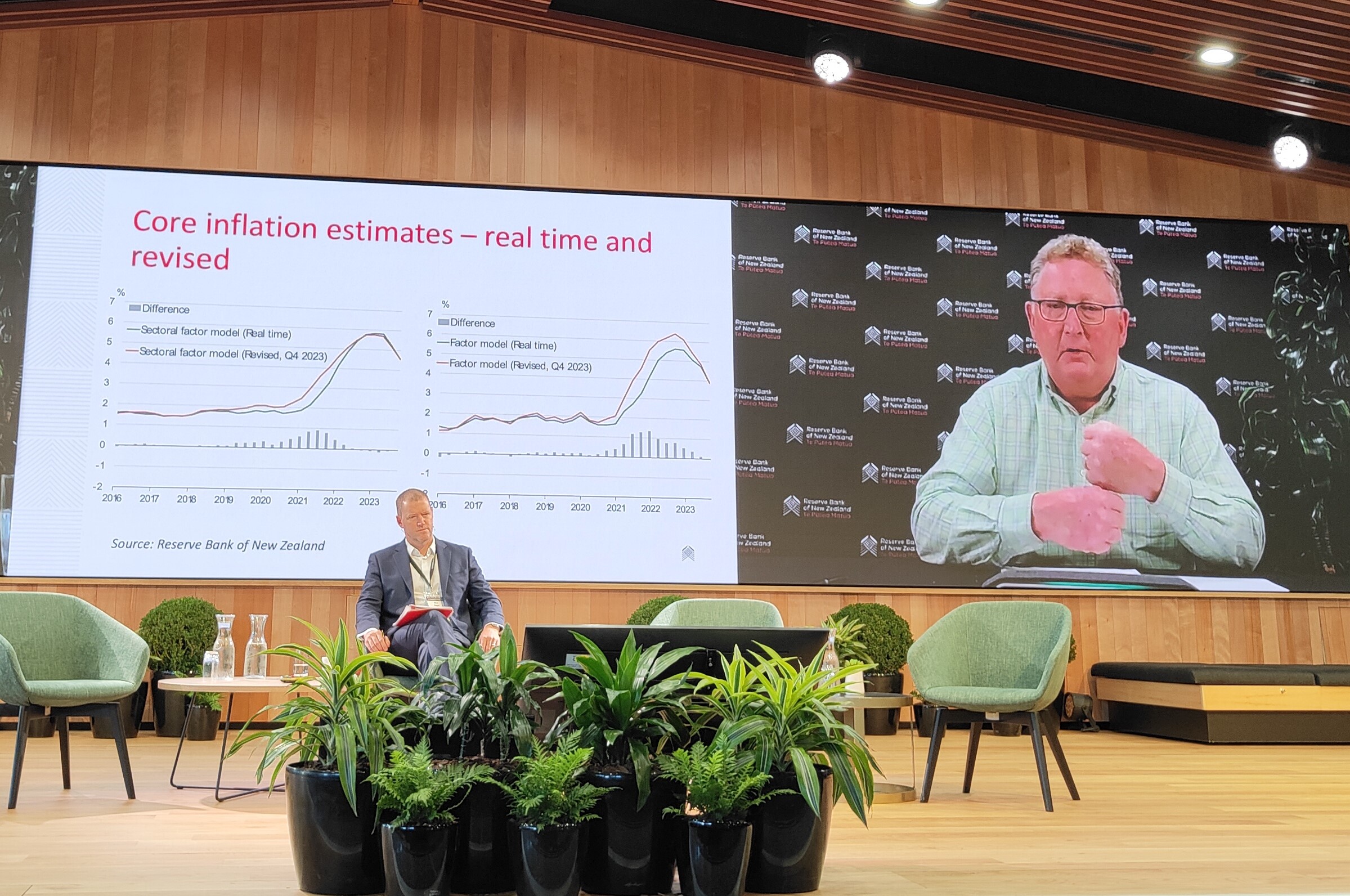
We kicked off Day 2 with a keynote speech, "The monetary policy remit and two percent inflation", by Adrian Orr, governor of the Reserve Bank, delivered online (full text here or watch the video here) after Adrian came down with a late lurgy (a pity, as I'd looked forward to chewing the fat about the forthcoming NRL season with my fellow Warriors tragic).

Adrian Orr with one of his slides, showing that core inflation as it actually transpired over 2020-22 was stronger than the lower real-time estimates available when decisions needed to be made (with Waikato's Prof Matt Bolger as moderator)

Takeaways? Some sympathy for the RBNZ's (and other central banks') challenges over the past few years: Covid, where Adrian reasonably asked, which mistake did you most want to avoid in the high-uncertainty crisis, and the answer was too-tough policy that might aggravate a downturn, hence the almost universal let-it-rip of both fiscal and monetary policy; the Team Transitory/Team Core debate; the interruption to normalisation from the Auckland lockdown; the Ukraine; and a recent rise in household inflation expectations. 

Expectations - which are interlinked with people's trust in the competence of a central bank (what us older folks used to call 'credibility') - look high on the bank's agenda. I noted in the speech that while inflation has come down, "tackling the tail end of these persistent inflation pressures in the domestic economy remains key to achieving 2 percent inflation. Just how persistent these pressures might be depends on how factors, such as capacity pressures and inflation expectations, evolve going forward". Adrian was giving nothing away about the next monetary policy decision (February 28) but if I were in the room I'd be looking at the latest annual non-tradable inflation rate (5.9%) and wondering if those capacity pressures and expectations levels needed a further knock on the head.

Onwards to fiscal policy, first with a keynote from Caralee McLiesh, Secretary to the Treasury, followed by a panel discussion on 'Treasury and the state of the books'.

Caralee's speech doesn't appear to be up on the Treasury website, but you can get the gist of it from the excellent 'Economic and Fiscal Context Slide Pack' which was part of Treasury's Briefing to the Incoming Minister of Finance. A key point was that our fiscal deficit is structural, not cyclical: as Caralee said, it tends to be easy to loosen fiscal policy in a downturn, and a lot harder to wind back the spend in better times, and we've now reached the point where belated policy tightening is needed (we'd got the same message from Nicola Willis the previous day). "Difficult distributional decisions lie ahead": quite.

Treasury Secretary Caralee McLiesh speaking to our rise in net public debt

The 'State of the books' panel - Craig Renney from the CTU, Eric Crampton from the New Zealand Initiative, Sarah Hogan from the New Zealand Institute of Economic Research - may have been intended to have been a battle of "duelling economists", as one person put it, but it turned out to be a lovefest of harmony and mutual understanding which coalesced around the theme of the importance of getting the best value for money from the public spend. 

As Craig said, there's nothing inherently "right-wing" in demanding value for money and nothing inherently "left-wing" in spending the right amount. Sarah pointed to health as one area where we are not getting value for money: Pharmac (she said) may take its lumps from its critics, but on the other hand it is a rare example in the sector when it comes to revealing its prioritisation. Other areas are either not transparent, or may not even prioritise in the first place. Eric would like us to retreat from the post-Covid spending bloat, perhaps to the same share of GDP that the Wellbeing Budget of 2019 represented (core crown spending of 29.1% of GDP, compared to the 33.0% expected for 2023-24 in last year's Budget forecasts): one reason was that people would be less likely to sign up to future rainy day spendups if they see previous ones sitting there unpaid for. And all the panellists were very keen on a really rigorous framework of prioritisation and evaluation: as Craig put it, "Think hard, and then think hard again".

The "duelling economists": Craig Renney, Eric Crampton, Sarah Hogan, with (on left) panel moderator Waikato's Prof Anna Strutt

Then we got a panel on 'Infrastructure: Unclogging the arteries', a topic close to my and I'd guess every other New Zealander's heart, given the increasingly shabby state of virtually all the infrastructure we use, from hospitals, classrooms, and roads to those infamous three waters. I drove down to Hamilton from outside Warkworth. The good news is that Warkworth to the approaches to the Harbour Bridge went fine (thanks to the new Puhoi motorway extension, even if it took forever to build), and Drury to Hamilton was fine (thanks to the new Waikato Expressway, also remarkably protracted). The bad news was that the intervening Harbour Bridge to Drury stretch remains an absolute nightmare, undoing a fair amount of the Puhoi/Waikato benefits, and the throttleneck looks like staying that way for some considerable time. There's a huge deferred bill looming: one speaker mentioned the Infrastructure Commission's estimate that we will need to spend $30 billion a year for the next 30 years.

Alison Andrew, CEO at Transpower, told us that while the current transmission grid is in good shape, (a) most of it was built in the '50s and '60s and is getting to its use-by and (b) there's an opportunity to green the country through electrification, but we will need 22 gigawatts of generation (and associated transmission) compared to today's 10 gigawatts. She didn't say it, but I personally wondered why the Commerce Commission regulates Transpower in 4-5 year bites, rather than over a longer-term horizon. Chris Joblin, CEO at Tainui Group Holdings, said it wasn't so much unclogging the arteries that's needed, but more like a double or triple bypass after being on the fags since the '70s: we just haven't being looking after our infrastructural health. And when we do bestir ourselves,  the consenting takes forever: he mentioned that it took 17 years to get Tainui's inland port at Ruakura (just beside Waikato University, as it happens) up and running. Among the issues: we look for perfection, which causes procrastination, and we load too many objectives onto projects, blowing out the costs and causing further rethinks. And Nick Leggett, CEO at Infrastructure New Zealand, agreed that we need to get our project management process right: we can occasionally rise to the occasion but mostly we're bad at it.

In passing, if the planning and project mismanagement omnishambles gets your goat, too, you'll like Daryl McLauchlan's piece for Democracy Project, 'Unjarndycing the State'. And if you'd like a piece on how we might do better, here's one I prepared earlier for Acuity magazine, 'Getting results'.

Life's too short, so I'll just pass briefly over the final two sessions. 'Climate & Weather: So what happens if we don't curb emissions?': answer, bad stuff,  and for some of the same reasons that our infrastructure record is so poor. As Sir Brian Roche said, we make a virtue of recovery from disasters, but we don't provide for preparedness in the first place. If 'value for money' was a recurring theme of the Forum, 'dynamic inefficiency', not investing enough to keep the show on the road, ran it a close second.

And in 'Fintech Futures: The end of cash?', no, cash is not dead, with the RBNZ's Karen Silk reminding us of why we still use it (full and final settlement, in privacy, plus benefits when, say post-Gabrielle, the ATMs and EFTPOS go down). And on the fintech side, we've had some successful financial innovation - we heard from Brooke Roberts, co-CEO of one of the successes, Sharesies - and while Brooke hoped that we will eventually have a global fintech come out of New Zealand, it's generally not as easy to get things up and running as it is in, say, Australia. Shane Marsh, cofounder of DOSH, also wondered about us falling behind. In my mind, I've always thought of New Zealand as a digitally advanced place - we were using EFTPOS for everything when our friends and rellies in Ireland, the UK or the US were still writing cheques - but the world's moved on, and we haven't. In Shane's view, our payments landscape is now well behind the rest of the world and even behind some of the 'developing' world .

Matt Bolger, Pro Vice-Chancellor of the Waikato Management School, sent us on our way with an uplifting message. While it's tempting to think that today's rate of change is unprecedented, Matt said we shouldn't get so up ourselves: how do we compare, really, with the generations who went through the Great War, the Depression, fascism and communism, and World War Two? And despite our current inability to plan properly for tomorrow's challenges, maybe he's right that we shouldn't get overwhelmed, and we should stay optimistic. It would be nice to think that New Zealand Economic Forum 2025 will be able to document that we're getting more of a grip on the issues that face us.

Monday, 28 June 2021

So far so good. What next for fiscal policy?

If the Plague had indeed broken out big time last week in Wellington, it would have taken out a high proportion of the country's economists.

No, don't be like that, and put that champagne back in the fridge - fingers crossed, our Sydney visitors don't appear to have spread the pandemic here. But if they had, there was a combo of the Treasury / Reserve Bank workshop on fiscal and monetary policy in the wake of Covid (Tuesday), and the annual shindig of the New Zealand Association of Economists (Wednesday and Thursday, though Thursday got cancelled when Level 2 was brought in). Just about everyone with an interest in macro policy and economic research were all in the same lecture halls at Vic - a very short virus-exposed walk from Rydges Hotel, one of the 'locations of interest'.

Tuesday's workshop (full programme here) kicked off with a keynote, 'New challenges for macroeconomic stabilisation policy: The role of fiscal policy', from Treasury Secretary Caralee McLiesh. What I took away was that we've done well through Covid: as she said (p3) "Overall these [supportive monetary and fiscal policy] interventions, alongside a health response that successfully eliminated COVID-19 in New Zealand, have been effective in supporting the New Zealand economy, which has outperformed our forecasts since the beginning of the pandemic". By international standards we've ended up in a good place, and pushed the fiscal lever hard to get there, as these graphs from her speech show.


Fiscal policy fired up quickly (even if a begrudging part of me wants to add "for once"), and got the support out in literally hours, in some cases, to applicants for wage subsidies. And there's been a corresponding re-assessment of how well fiscal policy can help stabilise an economy against cyclical shocks, with our wage subsidies and the Australians' and Americans' cheques-in-the-mail approaches all clearly effective, and in a timely way.

The supposed pre-Covid consensus that monetary policy was the best cycle stabilisation tool and that fiscal policy would be too lumbering to do any good, has been rather overstated. It was never that clearcut: monetary policy, after all, famously operates through long and variable lags, so isn't necessarily the quick fix some folks touted, and fiscal policy isn't always on a 'turn the first sod in twenty years' Transmission-Gully-style timetable. But in any event the new consensus is that they can both be deployed to good effect early in the piece.

Some commentators see a new, bigger role for fiscal policy as potential over-reach. Michael Reddell in his blog piece on the workshop, 'Fiscal policy in the wake of Covid', felt that "When a half-baked loaf is finished cooking it can be a fine thing, but this loaf seems to need a lot more work before New Zealanders should be rushing to embrace a much more active role for fiscal policy or a lot more public debt". The NZ Initiative's Eric Crampton in 'Govt making the case for higher levels of debt for longer' said that "If the core of the public sector is happy with higher debt levels, despite clear failures in ensuring that funded projects pass any reasonable cost-benefit assessment, greater prudence is needed in how that debt is issued". 

The exact scale and scope of future fiscal activism is still in sum very much up in the air, though if McLiesh is right, and we are indeed headed into a world of permanently lower interest rates, then I hope one outcome is that we pull finger and get on with the overdue infrastructure we need and which have now become significantly cheaper to finance. Which I've been saying for at least the last five years ('A once in a generation opportunity'). 

In  any event you don't have to just sit there and take what's dealt to you in the fullness of time. Treasury is reviewing our macroeconomic frameworks, and you'll get your chance to put in your tuppence worth. There's an e-mail address at the site if you want to get involved.

Wednesday, 23 September 2020

Keep up the stimulus

Last week I was making the point that one of the key things to look for in the Pre-Election Economic and Fiscal Update or PREFU was whether fiscal policy was going to be supportive or contractionary over the next wee while, and to what extent, and whether the proposed fiscal stance matched up with the likely state of the economy. 

You might have thought that Ministers of Finance need no special advice on aligning fiscal policy with the cyclical needs of the economy. Surely (you might have thought) they let it rip when times are bad, and wind it back when times are good: obvs, to use the technical macroeconomic term.

And if so you'd be in for an unpleasant surprise, at least if you were a citizen of the US or the EU. Overnight we had this presentation from the OECD on their latest economic outlook. It included this graph, where the blue bars are the same measure of the stance of fiscal policy I used in looking at least week's PREFU, except that the OECD shows bars above the line as fiscal tightening and bars below as loosening (our Treasury does the opposite, it's arbitrary, either works). The yellow triangles are a measure of how poorly each regional economy is faring. The grey shaded area is the GFC.

In both the US and the EU you'll see the local fiscal response was bang on: decent sized fiscal stimulus. And in both regions you'll see that it was taken away much too soon. There are all sorts of reasons why the GFC was a doozy, but premature fiscal braking was one of the larger moving parts. Inevitably politics played a large part, including a Republican Congress wanting to unwind anything President Obama initiated.

The OECD says, rightly, that eventually everybody's fiscal house will have to be put back in order, and done the right way, but as of today "Undertaking fiscal consolidation measures now would be premature". I suspect in our case the eventual retrenchment won't be able to get started  before 2023.

The other big messages are that the world economic outlook, on the OECD's latest base scenario, is a bit better than it was when the OECD took its last stab at a guess back in June ...

... but before rushing out into the street to celebrate, bear in  mind that the range of uncertainty around the base scenario is still very wide, as it is here at home.


Finally, the OECD points out (on p10 of the Outlook) that
With long-term interest rates close to zero in many advanced economies, the social rate of return on public investment is likely to exceed the financing costs for many projects. Investment is particularly needed in areas that have large positive externalities for the rest of the economy and where under-investment might otherwise occur due to market failures, including in health care, education, and digital and environmental infrastructure.

Here in Auckland the Bridge has been out, aggravating the already inadequate transport infrastructure, the water supply is iffy, and housing land remains stratospherically expensive: I passed a sub-division the other day, admittedly with largish sections in a nice rural area, where section prices are "from $985,000". When are we going to start fixing it, if not now?

Wednesday, 11 December 2019

Give that man a DB

Everybody from blind Freddy upwards has been telling this government, and previous ones, to get on with fixing New Zealand's gross infrastructural deficiencies.

"We should pull finger and get the hell on with it while the going is still pretty good", I wrote just over three years ago. "Roll out the infrastructure we need, and pull finger about it while you're at it", I said over two years ago. And apart from an unfortunate predilection for 'pulling finger', I was right, as was everyone else who has been banging on about it.

So all credit to Grant Robertson, who at today's Half Yearly Economic and Fiscal Update ('HYEFU') has done precisely that: an extra $12 billion into infrastructure. It was, from an economic perspective, completely correct: we need the choke points fixed, borrowing costs are at historical lows, and monetary policy has been driven into ever more grotesque distortions because fiscal policy wasn't carrying its share of the inflation-boosting load. Show me someone who disagrees with this boost, and I've a better than average chance of showing you a nutter.

To be clear, I'd say well done to whoever held the portfolio: I try to be non-partisan, and I'll give credit where it's due. In this case the economics said, go for it, and he did. Robertson also ran a bit of a political risk: "you can trust us with the public purse" was an electoral asset, and he's been prepared to face the "you promised a fiscal surplus and you blew it" flak (you'll have seen it's already flying) for the greater good. Good call.

There are practicalities that might intrude. With this spend-up, there is are risks that any old vanity project will get a green light. There are probably capacity constraints, meaning good intentions won't translate into diggers on sites, and hence and otherwise you'd want to see some thought given to (say) apprenticeships in the engineering and construction trades. There could be other constraints: it's a wild guess, and probably totally unrelated to whatever might be the Commerce Commission's next market study, but I wonder what are your chances of buying construction materials at a reasonable price, if  you were minded to buy a lot more of them? And the infrastructure spend-up is going to make overall expenditure control trickier: "you could find $12 billion for roads, but you can't find money for [insert allegedly deserving cause here]". For all that, it's still a good plan.

The other interesting thing from today's HYEFU was the update on whether fiscal policy is likely to boost or brake the economy. Yes, I know I go on about this, but for good reason. Most of the fiscal coverage is from a vested interest point of view - will my pretties get their share of the lollies - and the overall national interest doesn't get enough of a look in. But we all need to know whether on balance, overall, the government is on an austerity tack or whether it's adding to the national spend-up.

The answer to that question - and when I say 'answer', I have to confess it's the best we've got, rather than an outright humdinger of a clearcut answer - is given by Treasury's estimates of the 'fiscal impulse'. Here they are. Bars above the line say that fiscal policy is supportive, below the line it's contractionary. The blue bar is the best one to look at.


Treasury's commentary (p16 here) says that
Compared to Budget Update [last May], the fiscal impulse in 2019/20 and 2020/21 is now more positive (0.9% and 0.3% respectively, up from 0.0% and -0.2% previously). The change in the 2019/20 impulse largely reflects operating spending shifting from 2018/19 to 2019/20. The change in the 2020/21 impulse reflects increased capital spending.
I don't blame you if you're wondering what's being said here. Unpacked, there's good news and bad news.

The good news is that fiscal policy is going to be more helpful over the next year or two than originally planned, which, given that the current preponderance of risks in the global economy is tilted to the downside, is a good precautionary move, as well as taking the heat off the Reserve Bank and starting to chip at our infrastructural problems.

The bad news is that $12 billion of extra infrastructure spend, which you'd think would make quite an impact, will take forever to kick in. Here's the profile (from p13 here).


Some of this is inherent in the nature of infrastructure spending: you can't go out tomorrow and start hacking away at Transmission Gully or a second Auckland Harbour crossing. Some of it is down to unnecessarily complex and slow planning processes. Some of it is down to governments not being ready (from a cyclical management point of view) with the proverbial 'shovel ready' projects or (from a longer term investment perspective) not having a coherent portfolio of projects thought through well ahead of time.

But however you parse it, you can announce $12 billion today, but only $3.7 billion is actually going to be spent over the next three and a half years. So while Treasury talks about increased capital spending contributing to a fiscal boost in 2020/21, the effect is quite small because infrastructure is harder to get moving than a teenager with an attitude.

I'm not the first to say this, but there is a ever stronger case building for a non-partisan agreement on a core programme of infrastructure spending. We shouldn't be in a position where overdue investment happens only when cyclically opportune; we shouldn't be in a position where one government's 'holiday highway' is the next government's 'road of national significance'; we shouldn't be reacting, after the event, to stresses that have become evident because we haven't had the wit to preempt them. And on the supply side, we won't have the range of contractors we'd like to have to build the projects we need, unless they get the comfort of a pre-announced schedule of potential contracts. We risk being hostage to the big few who can ride out the dry years.

But enough of the quibbles. Did fiscal policy step up to the plate? Yes. Did we get more real about infrastructure? Yes. Does that man deserve a DB? Yes.

Friday, 3 August 2018

Doom and gloom? Yes and no

As any number of recent headlines will tell you, there's a bunfight going on about a slump in business confidence and a rise in unemployment. There's the usual partisan point-scoring going on about the size of it, who caused it, and what comes next.

What's really happening?

Let's deal to the unemployment rate first, up from 4.4% in March to 4.5% in June. Should anyone be worried about that?

No, for at least three reasons. One, the statistic comes from a survey, which has sampling error. If I've read Infoshare right, and I've been known to get it wrong, the sampling error for the unemployment rate is 0.3%, which means there's a 95% chance the true unemployment rate is between 4.2% and 4.8%. A 0.1% rise may not even have happened. And second, even if it did, the economy is not an automaton, and you expect to find "noise", random fluctuations even in the middle of a longer-term trend. And third, and most important, the unemployment rate rose for a rather comforting reason: the participation rate went up.

The logic is that the participation rate goes up in good times. People aren't stupid, and can judge what's happening in the jobs market. Discouraged people lurk outside the labour force when they reckon there are few jobs to chase. They delurk when they think it's all on. Sure, there'll be the odd person who's forced by bad stuff - the mortgage getting out of hand, a redundancy in the family - to go hunting for a job, but overwhelmingly the evidence is that the participation rate going up is a signal of the labour market running in job seekers' favour.

Put that together with the all-time record employment rates for women and Maori and a strengthening in wage increases, and the marginal rise in the unemployment rate is neither here nor there. If you get a press release from a pollie banging on about it, mentally subtract a little from your previous estimate of their credibility. Negative numbers are allowed.

The business confidence slump is not so easily dismissed.

For a start, it's beyond any question of sampling error or random wiggles. It's large, and evident over several readings. There's a lot of focus on the ANZ Bank's latest and particularly glum survey, but it goes back further than that. The NZIER's June Quarterly Survey of Business Opinion showed more unhappy campers, too. It's true that you should focus on the 'activity' measures in these surveys rather than the 'confidence' ones, but the activity numbers are also in rapid retreat.

As the latest ANZ survey said, "Firms’ perceptions of their own prospects are a better gauge of economic outcomes, but the news wasn’t upbeat here either: it dropped 5 points to a net 4% expecting an improvement. This is the lowest reading since May 2009 and well below the long-term average of +27". There have also been growth slowdowns captured in the latest BNZ / BusinessNZ surveys of manufacturing and services.

Here's one graph that I think helps explain what's going on. On the trusted principle that in a market economy an analyst should follow the money, here's what businesses have been telling the ANZ survey what they think the outlook is for their profitability.


There's clearly (to my eye) a political component. The sharp drop in expected profitability after we got the new Coalition government might have been rational - "this lot aren't business friendly" - but likely also had some sort of political protest mixed in. But businesses appeared to have got over themselves by March or April of this year - only for expected profitability to drop to even lower levels than immediately after the election. So my guess it's no longer a "should have been National" two fingers, but a signal of something more real.

A good deal of it, I suspect, is pressures on wages and other costs (notably energy) which haven't been able to be passed on. As many others have commented, the rise in the minimum wage, from already high levels by international standards as a percentage of average earnings, and with more to come, is putting sectors like retailing under intense pressure. Retailing has large numbers of minimum wage workers, and bricks and mortar shops have little or no ability to pass the costs on when e-commerce is already stealing their lunch. I was walking around Newmarket today for the first time in a while, and while the area was generally busy, I was startled to see how many retail vacancies there are.

Nor are many businesses enthused about the cost - real or imagined - of having to go back thirty years and sign up again for collective agreements. And I suspect they, like everyone else, are wondering about the sort of generalised wage pressures that look like leaking from the public sector. Any public sector union worth its salt has sized up this government as an easy mark. And they're right: the chance of a Coalition Finance Minister actually getting to the finishing line forecast in this year's Budget is half of five eighths. As I said at the time, "The likelihood of the New Zealand political process actually leaving $7.3 billion unspent on the table is extremely low".

I'm not even there myself. With the infrastructure - where it exists at all - creaking all around us, I'd be using that money, too, especially as we've got not only cash in the government cheque account but also the opportunity to borrow at once-in-a-generation low interest rates and make a substantial and lasting difference.

Inaction on that front may be part of business malaise too, especially when contrasted with the readiness to spend on lower quality ideas (think boondoggle regional lollyscrambles). I was somewhat dismayed, reading MBIE's latest national construction pipeline report (summary here, full thing here) that "Infrastructure is forecast to remain relatively unchanged, increasing marginally to $7.3b in 2023" (p1 of the summary) and that (p4) " Infrastructure activity is lower than previously forecast". And although the summary also notes (p4) that " Pacifecon’s research data suggests that there is a high value of infrastructure construction scheduled to be initiated over the next six years", it always seems to be light rail tomorrow but traffic jams today.

The previous government, by the way, was just as bad as getting the facilities built that would enable all of us to get on with our lives more productively. The longer it goes on, the more likely we're going to hit capacity and productivity constraints that stop the economy growing at the rates we'd like. Whatever else may or may not be needed to be done (or undone) by the current government to move us forward from where we are now, a larger and earlier infrastructure spend has to be part of the answer.

Bottom line, some of the beat-up over the slowdown (actual or imminent) in the economy is exaggerated. But some of it is realistic, especially if you put some weight, as you've got to in this late stage of the post GFC global recovery, on the external environment hitting a bump. Recent surveys of global fund managers, for example, show that they are worried about the impact of trade wars on world economic activity, and with a buffoon pressing the protectionist policy buttons, they're right to be biting their nails. So the ANZ's take looks realistic: "with businesses in a funk, it’s fair to say that the road ahead is looking less assured, and risks of a stall have increased".

Friday, 27 October 2017

And never the twain shall meet*

According to the text of the Labour/Greens confidence and supply agreement, "Auckland’s East-West motorway link will not proceed as currently proposed".

I'm not surprised, though before I was asked to look at the East-West Link, I'd have had a different reaction. Auckland's been so short of infrastructure investment, and transport investment in particular, that I would have welcomed anything at all that helped, even if it wasn't especially efficient. Two billion dollars, the ballpark cost of the Link, however poorly spent, had to be some sort of advance on half of five eighths of the proverbial alternative.

And then the Campaign for Better Transport asked me to have a look at how the New Zealand Transport Agency had signed off on the Link. A Board of Inquiry had been set up to decide whether to approve the Link: would I be interested in putting in an expert view? I would. I did.

I was rather surprised when I had a look at the benefit/cost ratios for each of the six options that the NZTA had shortlisted for the Link. The option chosen was far from being the best on a benefit/cost basis. Compared to the chosen one, there was an alternative that would have achieved slightly more benefits, but for only 60% of the cost. And there was another one that was less ambitious - only half of the benefits - but was very cheap indeed, at only a quarter of the cost. The preferred option was, bluntly, inefficient.

But mankind does not live by cost/benefit ratios alone, and the NZTA, sensibly, also put all six options through a 'multi criteria analysis' wringer, prodding them from every possible perspective, including Maori, historical, and environmental.

Again the preferred option didn't stand out. That cheap and cheerful one - half the benefits but very cheap to do - scrubbed up well (again). And even if you played around with the weightings, as I did, I couldn't get the NZTA's preferred option to come out on top. Even when I gave double weighting to transport outcomes, which after all might be what the NZTA was prioritising, there were better ways of doing the Link than the NZTA's golden-haired choice.

As happens in these sorts of proceedings there's a "hot tub" where the economists get together to say what they can agree on and what they can't. On this occasion there were five of us: in the post-tub joint statement we put in to the Inquiry, four of us agreed that "The [NZTA's] application [to build the Link] and subsequent evidence does not establish...How Option F [the NZTA's preference] was arrived at as the preferred option and, in particular, how the Option reconciled with the NZ Transport Agency's own system for prioritising Projects". The NZTA's economist disagreed.

In sum, I couldn't make much sense of the NZTA's justification for ploughing ahead with their preferred option, and said so when I fronted up to the Inquiry. If you're seriously short of better things to do, the transcript is here. I come onto the stage at page 4897 (!) and the most relevant bits are on pages 4907-10 where I have trouble with the NZTA's thinking behind its choice and finish up by rhetorically asking the NZTA, "with all that lovely information, why did you do F?"

Lots of other people have been having trouble with the decision, too. Cameron Pitches of the Campaign for Better Transport has had a go at 'The Economics of the East West Link' with part two here, and the Greater Auckland site has a string of posts, with highlights being the latest 'Where to now for the East West Link?' and the earlier 'Rethinking the East-West Link'The Spinoff's  Simon Wilson has also been on the case, with 'The most expensive road in New Zealand history is coming to Auckland. Why?' and '‘I have not quantified the benefits’: the astonishing truth about NZ’s most expensive road ever'.

Bottom line: my guess would be that you could deal to a lot of the Onehunga/Penrose congestion with a slimmed-down version of the Link, and still have a billion dollars left over. That's a rather irresistible bit of economic - and political - calculus.

What happens to the Inquiry itself? Far as I know, it's still due to deliver its final decision by December 22, and I hope it's let do it. The board seemed to me to be a very sharp collection of folks, and I'd like to hear what they made of it all, even if swathes of it may have become moot.

There's also a point of law they had to consider that could be important for future regulatory proceedings. Was the board constrained to examining only what the NZTA put in front of it, or could it enquire into the NZTA's thought processes when it came up with the scheme?

As the chair of the Inquiry said (p4909, para 35)
it seems to be  reasonably clear law that we as a Board can't sit down and start scratching our heads and drawing alternative lines over bits of paper and saying, "Well, this option might have been better than that option" etc. We really have to judge on the merits what's been served up to us.
But on the other hand as one of his colleagues said (p4913, para 15)
I think you're quite right that we have to be satisfied that there was a robust process of evaluation of the alternatives.
In practice it may not make a huge difference. Submitters could (and did) propose that the NZTA's preferred option should have been redirected around this town centre, or slimmed down along that stretch, or mitigated a different way, and would have effectively smuggled the NZTA's discarded options back into the proceedings irrespective of whether the Board itself did not want to revisit the NZTA's original decision.

But it's still an important point. My preference lies down the end of tyre-kicking that "robust process of evaluation of the alternatives". If, by analogy, some group appeared before the Commerce Commission for authorisation of an otherwise anti-competitive arrangement that nonetheless has a net public benefit, I would expect Commissioners to ask, very early in the piece, did you consider other or better or less intrusive ways of doing this? What did you find? Why did you go with this one? And if they weren't satisfied, I'd expect them to say, go back to the drawing board.

If Boards of Inquiry find they don't have these powers under the Resource Management Act process, then maybe we should fix the Act so that they do.

*OK, pretty corny, but if you don't recognise it it's a bit of Rudyard Kipling: "Oh, East is East, and West is West, and never the twain shall meet"

Friday, 20 October 2017

Looking for ideas?

So we've got a new government, and lots of people have been wishing things on them.

And so am I.

Here's one that's well up my list: roll out the infrastructure we need, and pull finger about it while you're at it.

The outgoing government, for all the good stuff it did in some areas, was desperately slow at getting long overdue infrastructure built: 30 year timeframes before we would even start building airport and North Shore links in Auckland were just absurd. And as I've said before and the OECD has said as well this is a once in a generation opportunity to fill our boots with unusually cheap funding to pay for it.

But you don't have to take just my word for it. Here's the IMF's wording in this month's update to its flagship World Economic Outlook (p28, Chapter 1):
Investment in physical infrastructure: Empirical evidence from advanced economies suggests that, if done right, infrastructure investment brings both short- and long-term benefits: an increase in public investment of 1 percent of GDP can raise the level of output by 1½ percent over the medium term...After three decades of almost continuous decline, public investment in infrastructure and the stock of public capital as a share of output are near historic lows in advanced economies. Many countries could take advantage of the favorable funding environment [see? see?] to improve the quality of the existing infrastructure stock and implement new projects (see Chapter 3 of the October 2014 WEO). Countries with deficits in infrastructure include Australia, Canada, Germany, the United Kingdom, and the United States [and us, as I pointed out for example here]. Priorities vary but, in most cases, include upgrading surface transportation and improving infrastructure technologies (in high-speed rail, ports, telecommunications, broadband), as well as green investments.
Fire up the JCBs.

Friday, 22 September 2017

Who pays?

On Tuesday evening Harshal Chitale, senior economist in Auckland's Chief Economist Unit, spoke at the latest LEANZ seminar on 'Funding Auckland’s greenfield infrastructure: 'Efficiency, incentives, risk and fairness'. Tell you what - the chair for the evening, Richard Meade, didn't have to do much to encourage debate: this was one fired up audience. In a  nice way: our infrastructure deficit, especially in Auckland, is one of the hottest current issues for the economy, and gets at least a best supporting role nomination in the national slow productivity debate. Plus Harshal's talk raised knotty back-pocket and equity issues on who pays for what.

Harshal's paper will go up on the Auckland Council website in the near future* - probably here - and I should add (as he said) that the talk reflected Harshal's views and not necessarily those of the Council.

The key points I took away (and from here it's as much me as Harshal talking) were that there's a massive $20 billion infrastructural bill coming up to service greenfield development, of which the Council's share for the likes of water, waste, local roads and community spaces is some $13 billion (NZTA road funding pays for a lot of the rest). But Auckland Council's own ability to pay for this greenfield infrastructure is severely constrained. Putting the bill on the rates faces a political commitment not to raise rates more than 2.5% a year. Borrowing faces a credit rating limit: debt beyond some 270% of revenue (and it's currently 255%-ish) jeopardises the Council's AA/Aa credit ratings.

The political constraint may reflect electoral reality: my suggestion that rates should be a fixed proportion (0.25% a year?) of the market value of a house, which has the pleasant property that those who've benefited most from the housing shortage will pay most to relieve it, was not met with universal delight. So we're lumbered with inadequate rates revenue: if the Council's costs are mostly wages (I'd guess they are), 2.5% rates increases will struggle to keep capex spending constant in real terms let alone boost it. And we're lumbered with the debt ceiling, too, as the ratings agencies are unlikely to buy the argument (though it's correct) that the spend today will boost the debt servicing tomorrow, plus it's not silly for the Council to stay a highly rated borrower.

So Harshal's talk looked at what other options there might be - the big ones being developer 'contributions', targeted rates, and off-balance-sheet vehicles - and how they stack up on various criteria including efficiency, having the beneficiaries pay their full whack, and incentivising development rather than land banking. Of that lot, targeted rates maybe scrubbed up best, but it's not an easy area. Apportioning the benefits created and costs incurred, for example, is not straightforward. If new Suburb A gets developed alongside existing Suburb B, for example, it may make it feasible for a new bus route to service both A and B. Who is credited with the benefit? Who ought to pay? And who actually pays in the end: will developers simply pass on all 'their' costs to the housebuyer? And are finely calibrated but expensive and complex attributions any better at the end of the day than cheap and cheerful approximations?

Personally I was left with the impression that local resourcing won't cut it, and some central government funding may be required beyond the Housing Infrastructure Fund (announced here, updated here), which while helpful doesn't get past the debt ceiling problem, since it counts against councils' debt. Relatively limited-scope entities like territorial authorities may not be well equipped to handle step-change demands like these. And Auckland's issues are an outcome in substantial part of the country's national immigration policy (a policy which I don't have an issue with, just to be clear).

Here, and everywhere else where we're short of infrastructure, the government ought to use its considerable leeway to borrow internationally on once in a lifetime cheap terms. Take a look at the chart below: at a wild guess, would you say this looks a good time to tank up? And not just on an interest rate basis, either: we could ease the capital repayments, too, by borrowing for a longer maturity. Last week Austria, a country rated similarly to us (AA+/Aa1 with S&P/Moody's, while we're AA/Aaa), issued 100-year debt. We're getting a bit better at getting longer stuff away than we used to be, but our longest current maturity is 23 years (the September 2040 issue).


Which, by the way, is also what the latest (June) OECD report on the New Zealand economy said:
The government is aiming to reduce net core Crown debt as a share of GDP from 24% in 2016-17 to 10-15% by 2025 to help cope with future periodic global shocks and natural disasters. Nevertheless, it should be possible to finance some high-priority tax reductions or expenditure increases without compromising its fiscal strategy.
So full marks to Harshal for a thoughtful presentation, to Richard for organising, and especially to David Walker of PriceWaterhouseCoopers who generously provided the venue and hosted the drinks and nibbles. Keep an eye out for future meetings: if you've got an interest in the intersection of law and economics, there's bound to be something that'll interest you.

*Update - Harshal's paper was indeed published online, on September 27

Friday, 26 May 2017

The real increase in infrastructure

The government made a decent effort in the Budget to boost the spend on infrastructure, as it showed in this graph, taken from the 'Capital at a Glance' document handed out yesterday as part of the Budget material.


But if you thought that we will have an extra $32.5 billion worth of shiny new infrastructure in four years' time, think again.

All these numbers ignore depreciation. But, as we all know, road surfaces get worn, bridges develop cracks, classrooms get leaks, equipment wears out. How much of the budgeted $32.5 billion is actually going to get us new stuff, and how much is going to maintain, repair or replace existing stuff? Repairs and maintenance are of course a good and necessary thing, and nobody's begrudging that spend, but how much of the infrastructure is going on maintenance of the stuff we've already got, and how much on genuinely new additional stuff?

The answer is, at least a good half of the announced spend is keeping the existing stuff in good nick, and only around half, at most, is for new stuff.

Here's the calculation, which I've taken from Note 15 to the Forecast Financial Statements on page 107 of the Budget Economic and Fiscal Update (the 'BEFU').


You'll see that the table says that the government is planning to add $28.8 billion to the stock of infrastructure. This is less than the $32.5 billion in the graph, because the numbers in Note 15 don't include some $4 billion of new spending that hasn't been allocated to anything specific yet. But even if you add that $4 billion to the $28.8 billion in the table, you get a gross addition of $32.8 billion, and on the (generous) assumption that there is no depreciation at all on all this extra $4 billion, the answer comes out, gross addition $32.8 billion, depreciation $18.4 billion, net addition $14.4 billion. Maintaining existing stuff 56%, adding new stuff 44%.

All these numbers involve some forecasting, and the forecast events may or may not happen, and they also involve some judgement calls about what assets are worth. Valuation can be a bit of an art sometimes, though having looked at how these assets are valued and depreciated (which you can read for yourself in the 'Accounting policies' bit of the BEFU's 'Additional information' document, pages 43-6) the methodologies look reasonable enough to me. All that said, let's round things off massively to allow for the uncertainties: very roughly, of every $2 that's going to be spent on infrastructure over the next four years, $1 will go on new stuff and $1 will keep the old stuff going.

To recap. There's nothing wrong with counting maintenance in the total spend: there are too many countries which roll out new facilities and don't maintain them properly, so it's good that we allow for it. And it's good that we're upping the total spend. It's rather late in the day, and there is still a huge infrastructure deficit, built up under a succession of governments, to tackle - as I've noted before, there are Third World countries making a better fist of building links to their airports than we've been able to manage - but we are at last getting more serious about it. 

That's all good. But next time you see a big spend-up announced, calm down, and remember to take $4.5 to $5.0 billion a year off the headline number, to get some feel for the extra stuff we're actually getting.

Thursday, 25 May 2017

Budget 2017 - the big picture

What's the very, very first thing you should look for in any Budget? It's not the headline surplus or deficit, no, nor the spend-ups, nor the tax breaks, nor the gimmicks (does anyone ever track the effectiveness of this year's grant scheme or last year's incentive?).

It's whether the Budget boosts or brakes the economy. And how would you know? By digging out the 'fiscal impulse'. Which isn't the easiest thing to find: it's never in the big Budget bumph, but is relegated with the horoscopes and crossword to an 'additional information' document (this year's is here). And that's partly because Treasury are a bit embarrassed by it: the calculations involved can be on the arbitrary side, and you wouldn't want to bet anything valuable on the accuracy of the outcome.

But for all its flakiness, it's the only thing we've got. What it does, is strip out all the cyclical stuff from last year's Budget and this year's. It could be, for example, that last year's Budget showed a surplus solely because the economy was doing well and the GST take was pouring in, and this year's surplus is even bigger because the economy is doing even stronger still (not a million miles removed from what's actually happened). Both surpluses, and the increase from the first to the second, may have sweet eff all to do with careful stewardship of the nation's finances, and may not tell you anything about the overall impact of the Budget.

So what you do, is you strip out the fortuitous cyclical stuff from both Budgets, taking out (for example) the happenstance of higher GST in good times or lower GST in bad times. You might have to take out one-offs like earthquakes as well, to get a proper feel for the real 'normal times' state of the government's books. And when you've done that, then you compare the true, 'underlying', 'structural', 'cyclically adjusted', outcome - call it what you will - in the two Budgets. If, for example, last year's Budget had a true deficit of 1% of GDP, and this year's has a true surplus of 1%, that's a turnaround of 2% of GDP, which by fiscal standards would be a reasonably significant tightening of fiscal policy - a clear brake on the economy (last year injecting some money into the economy, this year taking some out). And conversely a larger true deficit, or a smaller true surplus, would be a boost.

We know, too, that Ministers of Finance ought to do the right counter-cyclical thing - in good times (like now), fiscal policy doesn't need to be, and shouldn't be, a stimulus to the economy. In bad times, it does, and should. So, how'd Joyce go? Here's the fiscal impulse.


The good news is that he didn't go for a pro-cyclical splurge in election year. Overall, the stance of fiscal policy won't be making much of a difference, either way, to our current business cycle. There is a mildly pro-cyclical fiscal stance for 2018 and 2019 (acknowledging, again, the ropiness of these kinds of calculations), and the heavy lifting of getting government debt down has been pushed out to 2020 and 2021 and beyond.

That said, I for one don't mind too much if we take a while to get net government debt below the target 20% (which on current forecasts will be in the June 2021 year) if instead we spend up large on our severely deficient infrastructure. The Budget speech said that "Through this new capital spend [$11 billion] and existing commitments the Government and its key infrastructure agencies will invest a total of $32.5 billion over the next four years in new infrastructure". It may sound odd to say that $32.5 billion is only a start, but that's the reality: the infrastructure deficit has been allowed to balloon to a level that is now difficult to grapple with, even in $32.5 billion chunks. And even these higher levels of spending will result in indefensibly slow improvement (30 year timeframes for rail to Auckland's North Shore come to mind).

What else?

The tax thresholds. Yes, of course they should have been adjusted upwards, good job they were. And it's good to see the bulk of the increase concentrated on raising the lowest threshold (where the 10.5% rate applies) from $14,000 to $22,000. Leaving them unadjusted had been an insidious and regressive way to raise the tax take: people barely into middle-class incomes, paying the top marginal tax rate, along with the millionaires? Give us a break.

Mr Joyce did not, however, take a principled approach and commit to keep on adjusting them every year. While (I guess) he thinks that's clever politics - keeping a lolly up his sleeve for future years' scrambles - it's not good, either as economics or politics. The economics is obvious: we'll soon have teachers and police constables back paying the millionaires' tax rate. Politically, it would have been smarter to commit to indexing the thresholds, gaining all the moral high ground, and watch the opposition parties squirm if they didn't match it. And if you really want to inherit the technocratic, managerial mantle of Bill English, a valuable political asset built up over many years, you do the fiscally right thing, even if it costs you the option of a cheap political stunt every year.

Lowering the target for net government debt to 10% to 15% of GDP by 2025 is fine by me. If there's anything we've learned over the past decade, it's that you need to leave a lot more 'fiscal space' or 'fiscal leeway' than you might have thought in pre-GFC days. You don't want to go into whatever the next unpleasant surprise may be carrying significant amounts of debt (as countries like France may discover) and even countries like Ireland, which appeared to be in a decent net debt starting point, found that, in fact, it wasn't enough to cope with the implosion of their banking system.

Finally, the economic forecasts. At first squizz they look reasonable enough - perhaps a tad on the optimistic side - but there's an interesting wrinkle in the details, where housing construction is expected to barely grow in the year to June '18 (+0.3%) and then perk up a lot (up 8.7% in the year to June '19, and another 8.8% in the following year). As the forecast document says, "There is considerable uncertainty associated with the judgement that this slow-down will be temporary", and that a building boom in the Auckland market is on the horizon. I really hope there is. But then I look at our capacity constraints, and our planning delays, and I wonder.

Friday, 24 March 2017

Take advice? Moi?

Most years - they skipped 2016 - the OECD comes out with one of its Going For Growth reports. They're a big thing for the OECD: its Director General says that "Going for Growth is the OECD’s flagship publication on structural policies. Its purpose is to help policymakers set reform agendas for the wellbeing of their citizens and to achieve strong, sustainable, balanced and inclusive growth".

Don't know why they bother, frankly, if New Zealand's reactions are typical. We give the reports close to zero coverage in the media, and our governments sleepwalk on, taking too little heed of the OECD's advice. From time to time we do some patchwork or catch-up improvements, but rarely if ever deal to the issues properly. All of the recommendations in the 2013 version, for example, were still there in the 2015 one (if you want to see previous years, they're here).

And that's a real shame, because if you're in New Zealand's position, where we seem to be doing quite a lot of good things but getting little payoff by way of faster productivity growth, you'd think that we would be lapping up informed ideas on how to get more traction.

So, what are they saying we should do?

The OECD's got two approaches. One is a "what everyone should do" piece, which you can read here, and the other is a country-specific piece, which for New Zealand is here.

At the "everyone" level, the OECD has a long shopping list, some of which don't apply a lot to us, because - while we've still things left undone - we did a pretty good reform job in the Eighties and Nineties. But some do, and I was especially interested in their recommendations on infrastructure. As I've mentioned before, we're currently chronically unable to roll out enough infrastructure in good time: the OECD says that

The most direct contribution of policy to growth of the whole-economy capital stock comes from public investment and recent empirical work suggests a large positive effect on productivity. Solving infrastructure bottlenecks, such as those in transport, can also contribute to stronger labour utilisation, through enhanced labour mobility, and to better environment protection, through lower carbon emissions. Considering the post-crisis fall of government investment as a share of GDP...and the current macroeconomic context, enhancing core public capital, and in particular the capacity and regulation of infrastructure, is a priority for both member and non-member countries.

Everything we do (and we're not alone in this) is a dollar short and at least a decade late, and I have a strong suspicion that it's one of the bigger reasons for our relatively poor productivity performance by international standards (have a look here). With financing costs at historically low levels, we ought to be getting on with it in any event, but it would be nice to think that the OECD's advice will give a further rark up to the government's Budget plans on the infrastructure spend.

For New Zealand, the shopping list is:

  • Reduce barriers to FDI [foreign direct investment] and trade and to competition in network sectors
  • Improve housing policies [a new one added since the 2015 report, and no surprise given what's happened to house prices]
  • Reduce educational underachievement among specific groups
  • Improve health sector efficiency and outcomes among specific groups
  • Raise effectiveness of R&D support

There are detailed policy recommendations under each of the headings. On housing, for example, the report says by way of preface that "Reducing the scope for vested interests to thwart land rezoning and development that is in the public interest would result in greater agglomeration economies and housing affordability, which would disproportionately benefit lower-income households", and it says we should

Implement the Productivity Commission’s recommendations on improving urban planning, including: adopting different regulatory approaches for the natural and built environments; making clearer government’s priorities concerning land use regulation and infrastructure provision; making the planning system more responsive in providing key infrastructure; adopting a more restrained approach to land regulation; strengthening local and central government emphasis on rigorous analysis of policy options and planning proposals; implementing pricing to reduce urban road congestion; and diversifying urban infrastructure funding sources.

That's a pretty good summary of the choke points - each of us might emphasise one rather than another, but they're all there - and of what to do to relieve them, and the same goes for their other detailed recommendations.

But our track record on responding quickly and fully is, sadly, poor. Oscar Wilde said he could resist anything except temptation: New Zealand governments can take anything except advice.

Postscript (March 24): Michael Reddell has also written about this latest Going for Growth report in his post, 'What does the OECD really have to offer us?'. As his title suggests, he's less enthused about the OECD's ideas. And that's okay: opinions make markets.