Showing posts with label New Zealand Economic Forum. Show all posts

Thursday, 30 May 2024

Budget 2024: tough choices deferred

There’s a big bunch of Budget documents handed out to the serried ranks of analysts packed into the pre-Budget ‘lock-up’ in Parliament’s Banqueting Hall, and the place I always like to start unpacking them is the economic forecasts: are they reasonable, or (in particular) are they flattering the prospects for the fiscal accounts? I’ve shown the main forecasts below, and they look more or less reasonable. I reckon the immediate economic outlook could be a bit weaker than allowed for – consumer spending, in particular, could turn out weaker (while there was a lot else also going on, Smith & McCaughey closing was just another indicator of households pulling back from spending), and we’ll have to wait and see whether the expected improvements in corporate profitability and national productivity growth materialise as anticipated. I have my reservations about the predicted track for the fiscal deficit (the ‘OBEGAL’ in the chart), as discussed later in this post, but as far as the economic forecasts go, the overall picture of difficult conditions now, ho-hum conditions in 2024-25, and rather better times beyond that, looks a commonsensical enough take.

A lot of attention will no doubt be given to the headline OBEGAL balance and in particular to the fact that it will not be back in surplus until the 2027-28 June year, a year later than previously anticipated. I don’t think this is a big issue, even if it continues an unhelpful recent tradition of pushing the “we’ll be in surplus” year out by a year, every year. I’m not sure an over-aggressive return to surplus would have made much sense in a weakish economic environment, and even at this slower-pace return to surplus we would end up with net government debt still at relatively low levels by the standard of other developed economies.

And in any event the fiscal balance, while it’s relevant to eventually stabilising government debt and later starting to pay it back, isn’t the best guide to one of the more important aspects of the Budget, namely whether it boosts or brakes the economy, and whether that boosting or braking helps or hinders the Reserve Bank’s job, which is also simultaneously trying to steer the near-term course of the economy. That’s better captured by the ‘fiscal impulse’ (shown below), and the good news is that the Treasury and the Reserve Bank are no longer so obviously at loggerheads. The previous government’s 1.7% boost to GDP from fiscal policy in 2023-24, which clearly complicated the Bank’s job, has been followed by a more or less neutral stance in the current June 2024-25 year, and by fiscal tightening in the years beyond that. The Reserve Bank’s job is now a bit easier. There is a wrinkle – the Reserve Bank may well have been expecting an outright tightening of fiscal policy over the coming year as opposed to the broad neutrality that’s now on the books – but I’ll settle for the two of them no longer being at odds.

The improved coordination of fiscal and monetary policy is a distinct plus in this Budget, as is the reversal of the stealth tax ‘bracket creep’ of recent years when income tax thresholds were not raised in line with inflation. As Nicola Willis pointed out in her Budget speech, “The median full-time wage and salary earner now earns $73,000 a year and is in the one of the highest tax brackets. A minimum wage worker can face a marginal tax rate of 30 per cent”. That needed fixing, and has been to a degree, though I would (perhaps unrealistically given the limited room for fiscal giveaways) have liked to see a commitment to keep on adjusting the thresholds in the future.

But there are also issues that bother me.

One is that there has clearly not been enough money allocated to keep government services going at their current levels or pay for new programmes. The Budget Economic and Fiscal Update (the ‘BEFU’) says (p37) that “the Government has $0.9 billion average per annum available to fund all new initiatives and other cost pressures at Budget 2025  … It is difficult to estimate how much of the Budget 2025 operating allowance will be needed to meet future cost pressures. However, in recent times a large portion of the funding allocated at Budgets has been used to meet cost pressures faced by existing services”. In other words, just paying the higher wage bills will likely eat up all (or more than all) of what’s budgeted.

And beyond 2025 it’s also likely there won’t be enough money to keep everything running unless something else gives. To be fair, the Budget fesses up: “The high-level analysis indicates that the future budget allowances are unlikely to be sufficient to cover future cost pressures on existing services. This means any shortfall and spending on new initiatives will need to be offset by expenditure savings, reprioritisation or revenue raising policy changes for each of the next three Budgets for the Government to manage within the signalled budget allowances. This will involve difficult choices and trade-offs for the Government which are likely to become harder over time”. The Fiscal Strategy Report says (p4) that “Managing within $2.4 billion [operating] allowances will therefore be challenging”: “challenging”, I’d suggest, is a euphemism for “impossible” (especially if you look at the long list of ‘Specific Fiscal Risks’, ‘Committed or Announced Intent that may have Fiscal Implications’ and ‘Time-limited Funding’ from p65 in the BEFU, and which will very likely put even further pressure on the public purse). Maybe there will indeed be enough savings or extra revenue found somewhere to make everything add up, but I for one wouldn’t be surprised to see the OBEGAL turn out worse than currently forecast, continuing the pattern of kicking the fiscal issues can down the road a bit further.

Another is the infrastructure spend. Yes, the Budget speech said that “In 2024, the Government is overseeing a record level of capital investment to deliver the infrastructure on which New Zealand’s growth depends. More than $68 billion is forecast to be spent on infrastructure by the Crown, Crown entities and KiwiRail over the next five years”. That’s great, and to be fair (just looking at transport) in recent years we’ve seen things like the Waikato Expressway, the extension of the Northern Motorway to Warkworth, and easier access to the airport via the Waterview tunnel which have eased previous bottleneck nightmares. But while $13.6 billion a year in new stuff is all good, you have to remember that depreciation (the cost of keeping the existing stuff going) is a sizeable $8.0-8.5 billion a year (see Note 10 to the government’s Forecast Financial Statements): the net addition of infrastructure is a rather less impressive $5.0-5.5 billion a year. I very much doubt if that’s enough given the existing infrastructure deficit and likely new commitments (eg funding the electrification of cars).

And finally, one of the biggest issues for successive government of all stripes has been the quality of outcomes from every public dollar spent: you only have to look at falling educational standards, or the unavailability of medical specialist advice within reasonable timeframes. The Budget is singing the right song – in the Budget speech, “the Government has a clear expectation that public agencies must strengthen their focus on delivering results. We have set clear targets to improve results in health, education, law and order, employment, housing and the environment, and we are focused on delivering them” – but I struggled to see the initiatives or new ways of working that would make the aspiration more credible.

Thursday, 22 February 2024

The New Zealand Economic Forum - Day 2

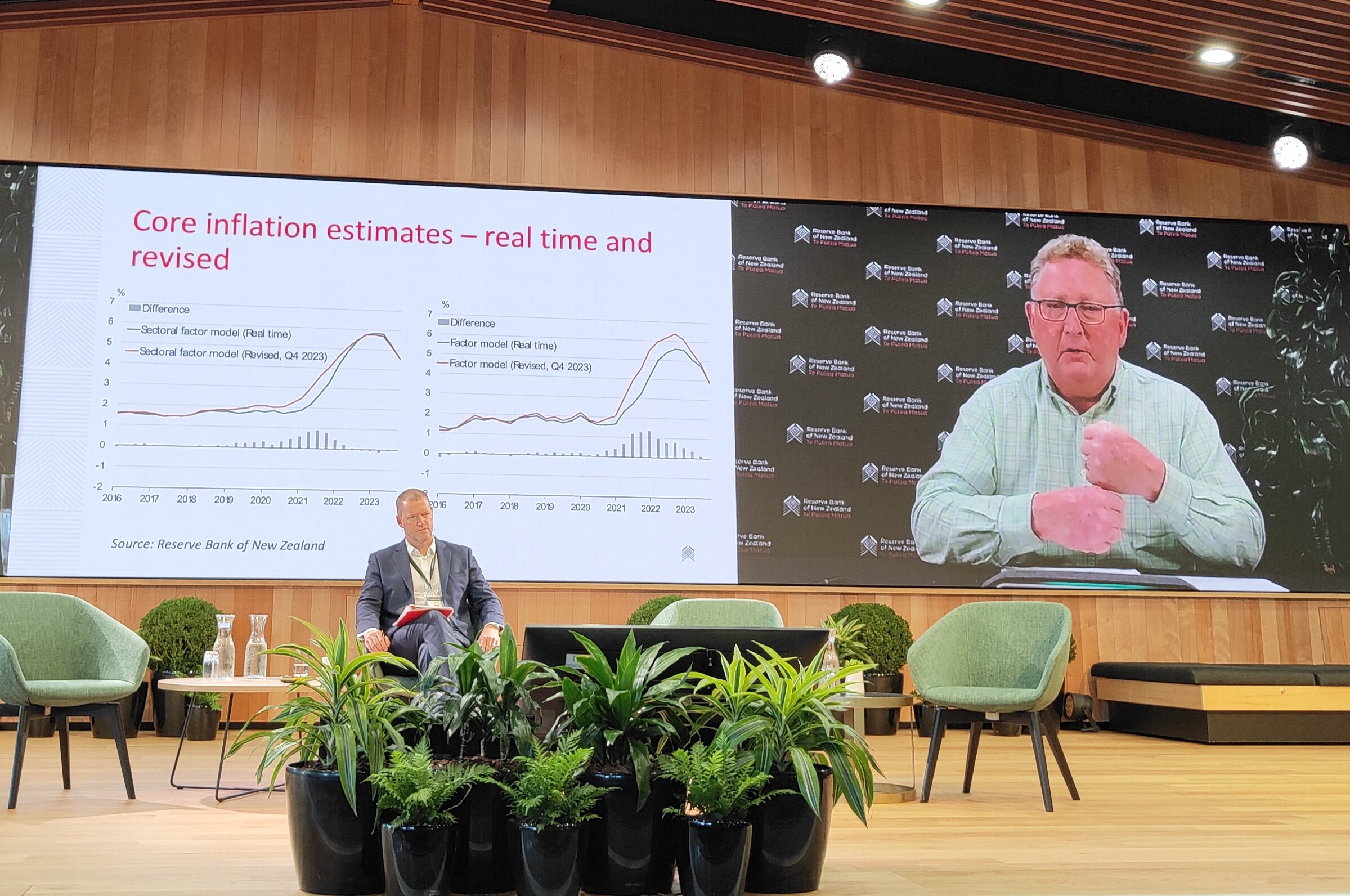
We kicked off Day 2 with a keynote speech, "The monetary policy remit and two percent inflation", by Adrian Orr, governor of the Reserve Bank, delivered online (full text here or watch the video here) after Adrian came down with a late lurgy (a pity, as I'd looked forward to chewing the fat about the forthcoming NRL season with my fellow Warriors tragic).

Adrian Orr with one of his slides, showing that core inflation as it actually transpired over 2020-22 was stronger than the lower real-time estimates available when decisions needed to be made (with Waikato's Prof Matt Bolger as moderator)

Takeaways? Some sympathy for the RBNZ's (and other central banks') challenges over the past few years: Covid, where Adrian reasonably asked, which mistake did you most want to avoid in the high-uncertainty crisis, and the answer was too-tough policy that might aggravate a downturn, hence the almost universal let-it-rip of both fiscal and monetary policy; the Team Transitory/Team Core debate; the interruption to normalisation from the Auckland lockdown; the Ukraine; and a recent rise in household inflation expectations. 

Expectations - which are interlinked with people's trust in the competence of a central bank (what us older folks used to call 'credibility') - look high on the bank's agenda. I noted in the speech that while inflation has come down, "tackling the tail end of these persistent inflation pressures in the domestic economy remains key to achieving 2 percent inflation. Just how persistent these pressures might be depends on how factors, such as capacity pressures and inflation expectations, evolve going forward". Adrian was giving nothing away about the next monetary policy decision (February 28) but if I were in the room I'd be looking at the latest annual non-tradable inflation rate (5.9%) and wondering if those capacity pressures and expectations levels needed a further knock on the head.

Onwards to fiscal policy, first with a keynote from Caralee McLiesh, Secretary to the Treasury, followed by a panel discussion on 'Treasury and the state of the books'.

Caralee's speech doesn't appear to be up on the Treasury website, but you can get the gist of it from the excellent 'Economic and Fiscal Context Slide Pack' which was part of Treasury's Briefing to the Incoming Minister of Finance. A key point was that our fiscal deficit is structural, not cyclical: as Caralee said, it tends to be easy to loosen fiscal policy in a downturn, and a lot harder to wind back the spend in better times, and we've now reached the point where belated policy tightening is needed (we'd got the same message from Nicola Willis the previous day). "Difficult distributional decisions lie ahead": quite.

Treasury Secretary Caralee McLiesh speaking to our rise in net public debt

The 'State of the books' panel - Craig Renney from the CTU, Eric Crampton from the New Zealand Initiative, Sarah Hogan from the New Zealand Institute of Economic Research - may have been intended to have been a battle of "duelling economists", as one person put it, but it turned out to be a lovefest of harmony and mutual understanding which coalesced around the theme of the importance of getting the best value for money from the public spend. 

As Craig said, there's nothing inherently "right-wing" in demanding value for money and nothing inherently "left-wing" in spending the right amount. Sarah pointed to health as one area where we are not getting value for money: Pharmac (she said) may take its lumps from its critics, but on the other hand it is a rare example in the sector when it comes to revealing its prioritisation. Other areas are either not transparent, or may not even prioritise in the first place. Eric would like us to retreat from the post-Covid spending bloat, perhaps to the same share of GDP that the Wellbeing Budget of 2019 represented (core crown spending of 29.1% of GDP, compared to the 33.0% expected for 2023-24 in last year's Budget forecasts): one reason was that people would be less likely to sign up to future rainy day spendups if they see previous ones sitting there unpaid for. And all the panellists were very keen on a really rigorous framework of prioritisation and evaluation: as Craig put it, "Think hard, and then think hard again".

The "duelling economists": Craig Renney, Eric Crampton, Sarah Hogan, with (on left) panel moderator Waikato's Prof Anna Strutt

Then we got a panel on 'Infrastructure: Unclogging the arteries', a topic close to my and I'd guess every other New Zealander's heart, given the increasingly shabby state of virtually all the infrastructure we use, from hospitals, classrooms, and roads to those infamous three waters. I drove down to Hamilton from outside Warkworth. The good news is that Warkworth to the approaches to the Harbour Bridge went fine (thanks to the new Puhoi motorway extension, even if it took forever to build), and Drury to Hamilton was fine (thanks to the new Waikato Expressway, also remarkably protracted). The bad news was that the intervening Harbour Bridge to Drury stretch remains an absolute nightmare, undoing a fair amount of the Puhoi/Waikato benefits, and the throttleneck looks like staying that way for some considerable time. There's a huge deferred bill looming: one speaker mentioned the Infrastructure Commission's estimate that we will need to spend $30 billion a year for the next 30 years.

Alison Andrew, CEO at Transpower, told us that while the current transmission grid is in good shape, (a) most of it was built in the '50s and '60s and is getting to its use-by and (b) there's an opportunity to green the country through electrification, but we will need 22 gigawatts of generation (and associated transmission) compared to today's 10 gigawatts. She didn't say it, but I personally wondered why the Commerce Commission regulates Transpower in 4-5 year bites, rather than over a longer-term horizon. Chris Joblin, CEO at Tainui Group Holdings, said it wasn't so much unclogging the arteries that's needed, but more like a double or triple bypass after being on the fags since the '70s: we just haven't being looking after our infrastructural health. And when we do bestir ourselves,  the consenting takes forever: he mentioned that it took 17 years to get Tainui's inland port at Ruakura (just beside Waikato University, as it happens) up and running. Among the issues: we look for perfection, which causes procrastination, and we load too many objectives onto projects, blowing out the costs and causing further rethinks. And Nick Leggett, CEO at Infrastructure New Zealand, agreed that we need to get our project management process right: we can occasionally rise to the occasion but mostly we're bad at it.

In passing, if the planning and project mismanagement omnishambles gets your goat, too, you'll like Daryl McLauchlan's piece for Democracy Project, 'Unjarndycing the State'. And if you'd like a piece on how we might do better, here's one I prepared earlier for Acuity magazine, 'Getting results'.

Life's too short, so I'll just pass briefly over the final two sessions. 'Climate & Weather: So what happens if we don't curb emissions?': answer, bad stuff,  and for some of the same reasons that our infrastructure record is so poor. As Sir Brian Roche said, we make a virtue of recovery from disasters, but we don't provide for preparedness in the first place. If 'value for money' was a recurring theme of the Forum, 'dynamic inefficiency', not investing enough to keep the show on the road, ran it a close second.

And in 'Fintech Futures: The end of cash?', no, cash is not dead, with the RBNZ's Karen Silk reminding us of why we still use it (full and final settlement, in privacy, plus benefits when, say post-Gabrielle, the ATMs and EFTPOS go down). And on the fintech side, we've had some successful financial innovation - we heard from Brooke Roberts, co-CEO of one of the successes, Sharesies - and while Brooke hoped that we will eventually have a global fintech come out of New Zealand, it's generally not as easy to get things up and running as it is in, say, Australia. Shane Marsh, cofounder of DOSH, also wondered about us falling behind. In my mind, I've always thought of New Zealand as a digitally advanced place - we were using EFTPOS for everything when our friends and rellies in Ireland, the UK or the US were still writing cheques - but the world's moved on, and we haven't. In Shane's view, our payments landscape is now well behind the rest of the world and even behind some of the 'developing' world .

Matt Bolger, Pro Vice-Chancellor of the Waikato Management School, sent us on our way with an uplifting message. While it's tempting to think that today's rate of change is unprecedented, Matt said we shouldn't get so up ourselves: how do we compare, really, with the generations who went through the Great War, the Depression, fascism and communism, and World War Two? And despite our current inability to plan properly for tomorrow's challenges, maybe he's right that we shouldn't get overwhelmed, and we should stay optimistic. It would be nice to think that New Zealand Economic Forum 2025 will be able to document that we're getting more of a grip on the issues that face us.

Wednesday, 21 February 2024

The New Zealand Economic Forum - Day 1

The University of Waikato's New Zealand Economic Forum 2024, on the theme of 'A briefing to the incoming government', kicked off in Hamilton last Thursday with a speech by Finance Minister Nicola Willis (below).

Nothing headline-making, but solid stuff: I liked the aim to lift our growth rate by removing go-slow regulation, the plan to have fast one-stop consenting for major projects, and to have more 'social investment', meaning prioritising social spending on the groups most at risk of being stuck in persistent disadvantage. In Q&A, someone asked about investment plans: there's apparently going to be a coordinated 30 year pipeline of projects, and about bleeding time. There are decision-making models maintained in the public sector that let you assemble optimal investment portfolios, and they badly need to be deployed, however belatedly, to make our infrastructure spend all that it can be. Chatting to another attendee afterwards, he wondered if the benefits and costs you need to feed into those models were reliable enough to avoid garbage in, garbage out results, but anything's got to be better than the lack of coordination we've had up to now.

The next two topics - agriculture and health - weren't my thing, but they had their moments. In agriculture, I'd never heard of AgriZeroNZ before: "A partnership between the New Zealand government and major agribusiness companies, we're helping farmers reduce emissions while maintaining profitability and productivity". Good stuff. In health, I heard a lot of sense from Professor Des Gorman. He said that we don't have a 'health' system, we have a disease and injury management system, paid for on annual levels of activity, which is self-evidently not ideal. He argued for a better 'tight, tight, loose' system focused on value for money: it would be tight in defining the health outcomes you'd like to see, tight in measuring what providers actually achieve, but loose or agnostic about what sort of providers you use. For those who would cry 'privatisation' of the public health system, his answer is that the system is largely private already, notably including your local GP practice. And for those worried about those dreadful private providers making a profit, in a competitive value-for-money system the answer is, "They're delivering more for less. What bit don't you like?".

After lunch we had a choice of 'Demographics are history' or 'Running tax differently', and my inner nerd chose tax. Graham Scott (gamely filling in for the unavoidable late withdrawal of Max Rashbrooke, also contactable here) reminded us that tax has its own comparative advantage - it has things it can and cannot do - and threatening to load it with multiple policy aims risked taking us back to the bad old days when we had a mad patchwork of specific sales taxes and other distortions and complexities. PwC's Sandy Lau was mostly happy with things as they are, though wondered if we need capital gains taxes, if only to reduce our currently disproportionate reliance on personal income tax. And Victoria's Professor Lisa Marriott's main point was over enforcement: she felt genuinely ratbag behaviour wasn't being sufficiently prosecuted by the IRD. Not only were people getting away with malfeasance, tax compliant businesses were being put at a competitive disadvantage relative to the scofflaws.

The session on 'Social investment: What difference will it make', led to a strong consensus that (a) there is a large group of people who suffer from persistent disadvantage (b) current social policy isn't cutting the mustard (c) by finding out what these people most need we can get better much better results especially if we focus on value for money from what we do and (d) we should regard what we do as an investment in people rather than as a cost. As Merepeka Raukawa-Tait put it, the time for wasted spending is over. Subsequent speakers pointed to a dramatically successful example that Maria English gave us, where providing tailored housing to a particular person saved nearly all of the very expensive 100 nights a year they'd previously been spending in a hospital bed. The session made complete sense to me, and I was quietly bemused how the winds have changed since Bill English (Maria's dad) championed this very approach, and got roundly rubbished for it.

My initial reaction to 'Trade: Dealing with a divided world' left me worrying: there's been an end of the "golden weather" of increasingly free and rules-based trade. Now there's fragmentation, rules flouting, disempowerment of the World Trade Organisation, protectionism, and 'security' concerns (real and paranoid). It very much felt like the trade front of Cold War II. MFAT's Vangelis Vitalis replied to my downbeat tweet that "I hope the conclusion left you feeling  more positive, i.e. we have a plan, agency, new options & advantages in key markets and are determined to protect and defend our hard won benefits through FTAs", and that we are showing "Policy entrepreneurship in international trade policy". He'd mentioned, for example, us successfully taking Canada on about their dairy trade protectionism. All fair comment, and it's good to know we're fighting our corner, but it's still a trickier wicket to bat on than it was before.

And the day wrapped with a session chaired by Steven Joyce on 'Monetary policy: Controlling what we can control'. Grant Spenser, ex deputy governor at the Reserve Bank, reminded us that the RBNZ, when it last reviewed how it had been going, found nine things it could work on, and wondered how they were getting on with them: he also noted that there appeared to be quite a blowout in operational spending and in headcount over the past six years. He also wanted to see more of a challenging culture at the Monetary Policy Committee from the independent members. I totally agreed: Australia's moved in that direction recently as well, with a boost in expertise and a requirement that independent members put their view into the public domain at least once a year. Bryce Wilkinson revisited some of the territory he'd covered in his publication co-authored with Graeme Wheeler, 'How central bank mistakes after 2019 led to inflation',  reminding us that monetary policy everywhere was relied on as being more of an exact science than it actually was, and that central banks made very poor inflation forecasts, even though that was their day job. Bryce said the global financial markets had also missed what was developing. And Henry Russell found himself in something of the spotlight given that the ANZ Bank had just made a big off-consensus call that the RBNZ would hike rates again (two moves of 0.25%), its reasoning being that the RBNZ had indicated back in November that it had little tolerance for any upside inflation risks, but they looked like they were getting some.

The monetary policy panel: Henry Russell (ANZ Bank), Bryce Wilkinson (Capital Economics / The New Zealand Initiative), Grant Spencer (ex RBNZ, Victoria University), Steven Joyce at the lectern

There was a really interesting discussion after the speakers' opening remarks, including around the ANZ forecast of hikes to come. Bryce thought that interest rates were now where they out to be on a Taylor Rule basis, and also that money supply growth had slowed down to very little growth at all (the latest 'broad money' measure, for example, is up only 3.6% on a year ago), both of which argued against hikes. Grant felt that with inflation already down quite a bit, maybe it would be better to hold and stay at current rates for a bit longer to see what happens. Henry, however, said that arguably a global disinflation supporting tailwind has blown out, that domestic inflation is still not good and might surprise on the upside again, and that while the pricing indicators in the ANZ business survey have stabilised, it was an open question whether they had stabilised at a level consistent with the RBNZ's inflation target. Policy issues raised but unresolved for another day: whether unconventional monetary policies (like quantitative easing) had been worth it; how monetary policy should respond to supply shocks; and whether the RBNZ ought to be both the setter of monetary policy and the financial prudential authority. Evidence from overseas is mixed, and against the canonical practice of economists having an answer to everything, I can't say I've got any clear opinion, either.