Showing posts with label technology. Show all posts

Thursday, 22 February 2024

The New Zealand Economic Forum - Day 2

We kicked off Day 2 with a keynote speech, "The monetary policy remit and two percent inflation", by Adrian Orr, governor of the Reserve Bank, delivered online (full text here or watch the video here) after Adrian came down with a late lurgy (a pity, as I'd looked forward to chewing the fat about the forthcoming NRL season with my fellow Warriors tragic).
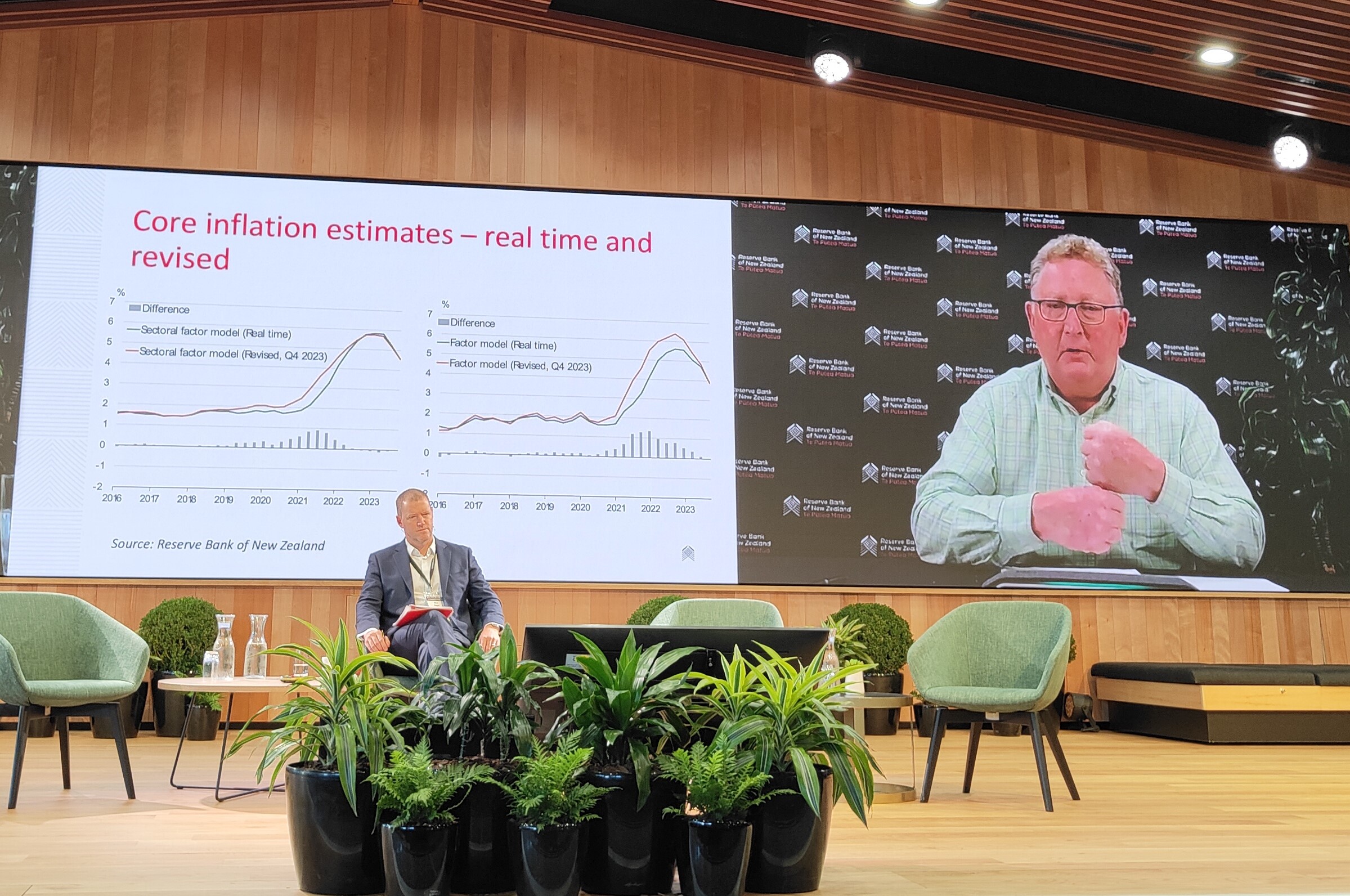
Adrian Orr with one of his slides, showing that core inflation as it actually transpired over 2020-22 was stronger than the lower real-time estimates available when decisions needed to be made (with Waikato's Prof Matt Bolger as moderator)

Takeaways? Some sympathy for the RBNZ's (and other central banks') challenges over the past few years: Covid, where Adrian reasonably asked, which mistake did you most want to avoid in the high-uncertainty crisis, and the answer was too-tough policy that might aggravate a downturn, hence the almost universal let-it-rip of both fiscal and monetary policy; the Team Transitory/Team Core debate; the interruption to normalisation from the Auckland lockdown; the Ukraine; and a recent rise in household inflation expectations. 

Expectations - which are interlinked with people's trust in the competence of a central bank (what us older folks used to call 'credibility') - look high on the bank's agenda. I noted in the speech that while inflation has come down, "tackling the tail end of these persistent inflation pressures in the domestic economy remains key to achieving 2 percent inflation. Just how persistent these pressures might be depends on how factors, such as capacity pressures and inflation expectations, evolve going forward". Adrian was giving nothing away about the next monetary policy decision (February 28) but if I were in the room I'd be looking at the latest annual non-tradable inflation rate (5.9%) and wondering if those capacity pressures and expectations levels needed a further knock on the head.

Onwards to fiscal policy, first with a keynote from Caralee McLiesh, Secretary to the Treasury, followed by a panel discussion on 'Treasury and the state of the books'.

Caralee's speech doesn't appear to be up on the Treasury website, but you can get the gist of it from the excellent 'Economic and Fiscal Context Slide Pack' which was part of Treasury's Briefing to the Incoming Minister of Finance. A key point was that our fiscal deficit is structural, not cyclical: as Caralee said, it tends to be easy to loosen fiscal policy in a downturn, and a lot harder to wind back the spend in better times, and we've now reached the point where belated policy tightening is needed (we'd got the same message from Nicola Willis the previous day). "Difficult distributional decisions lie ahead": quite.

Treasury Secretary Caralee McLiesh speaking to our rise in net public debt

The 'State of the books' panel - Craig Renney from the CTU, Eric Crampton from the New Zealand Initiative, Sarah Hogan from the New Zealand Institute of Economic Research - may have been intended to have been a battle of "duelling economists", as one person put it, but it turned out to be a lovefest of harmony and mutual understanding which coalesced around the theme of the importance of getting the best value for money from the public spend. 

As Craig said, there's nothing inherently "right-wing" in demanding value for money and nothing inherently "left-wing" in spending the right amount. Sarah pointed to health as one area where we are not getting value for money: Pharmac (she said) may take its lumps from its critics, but on the other hand it is a rare example in the sector when it comes to revealing its prioritisation. Other areas are either not transparent, or may not even prioritise in the first place. Eric would like us to retreat from the post-Covid spending bloat, perhaps to the same share of GDP that the Wellbeing Budget of 2019 represented (core crown spending of 29.1% of GDP, compared to the 33.0% expected for 2023-24 in last year's Budget forecasts): one reason was that people would be less likely to sign up to future rainy day spendups if they see previous ones sitting there unpaid for. And all the panellists were very keen on a really rigorous framework of prioritisation and evaluation: as Craig put it, "Think hard, and then think hard again".

The "duelling economists": Craig Renney, Eric Crampton, Sarah Hogan, with (on left) panel moderator Waikato's Prof Anna Strutt

Then we got a panel on 'Infrastructure: Unclogging the arteries', a topic close to my and I'd guess every other New Zealander's heart, given the increasingly shabby state of virtually all the infrastructure we use, from hospitals, classrooms, and roads to those infamous three waters. I drove down to Hamilton from outside Warkworth. The good news is that Warkworth to the approaches to the Harbour Bridge went fine (thanks to the new Puhoi motorway extension, even if it took forever to build), and Drury to Hamilton was fine (thanks to the new Waikato Expressway, also remarkably protracted). The bad news was that the intervening Harbour Bridge to Drury stretch remains an absolute nightmare, undoing a fair amount of the Puhoi/Waikato benefits, and the throttleneck looks like staying that way for some considerable time. There's a huge deferred bill looming: one speaker mentioned the Infrastructure Commission's estimate that we will need to spend $30 billion a year for the next 30 years.

Alison Andrew, CEO at Transpower, told us that while the current transmission grid is in good shape, (a) most of it was built in the '50s and '60s and is getting to its use-by and (b) there's an opportunity to green the country through electrification, but we will need 22 gigawatts of generation (and associated transmission) compared to today's 10 gigawatts. She didn't say it, but I personally wondered why the Commerce Commission regulates Transpower in 4-5 year bites, rather than over a longer-term horizon. Chris Joblin, CEO at Tainui Group Holdings, said it wasn't so much unclogging the arteries that's needed, but more like a double or triple bypass after being on the fags since the '70s: we just haven't being looking after our infrastructural health. And when we do bestir ourselves,  the consenting takes forever: he mentioned that it took 17 years to get Tainui's inland port at Ruakura (just beside Waikato University, as it happens) up and running. Among the issues: we look for perfection, which causes procrastination, and we load too many objectives onto projects, blowing out the costs and causing further rethinks. And Nick Leggett, CEO at Infrastructure New Zealand, agreed that we need to get our project management process right: we can occasionally rise to the occasion but mostly we're bad at it.

In passing, if the planning and project mismanagement omnishambles gets your goat, too, you'll like Daryl McLauchlan's piece for Democracy Project, 'Unjarndycing the State'. And if you'd like a piece on how we might do better, here's one I prepared earlier for Acuity magazine, 'Getting results'.

Life's too short, so I'll just pass briefly over the final two sessions. 'Climate & Weather: So what happens if we don't curb emissions?': answer, bad stuff,  and for some of the same reasons that our infrastructure record is so poor. As Sir Brian Roche said, we make a virtue of recovery from disasters, but we don't provide for preparedness in the first place. If 'value for money' was a recurring theme of the Forum, 'dynamic inefficiency', not investing enough to keep the show on the road, ran it a close second.

And in 'Fintech Futures: The end of cash?', no, cash is not dead, with the RBNZ's Karen Silk reminding us of why we still use it (full and final settlement, in privacy, plus benefits when, say post-Gabrielle, the ATMs and EFTPOS go down). And on the fintech side, we've had some successful financial innovation - we heard from Brooke Roberts, co-CEO of one of the successes, Sharesies - and while Brooke hoped that we will eventually have a global fintech come out of New Zealand, it's generally not as easy to get things up and running as it is in, say, Australia. Shane Marsh, cofounder of DOSH, also wondered about us falling behind. In my mind, I've always thought of New Zealand as a digitally advanced place - we were using EFTPOS for everything when our friends and rellies in Ireland, the UK or the US were still writing cheques - but the world's moved on, and we haven't. In Shane's view, our payments landscape is now well behind the rest of the world and even behind some of the 'developing' world .

Matt Bolger, Pro Vice-Chancellor of the Waikato Management School, sent us on our way with an uplifting message. While it's tempting to think that today's rate of change is unprecedented, Matt said we shouldn't get so up ourselves: how do we compare, really, with the generations who went through the Great War, the Depression, fascism and communism, and World War Two? And despite our current inability to plan properly for tomorrow's challenges, maybe he's right that we shouldn't get overwhelmed, and we should stay optimistic. It would be nice to think that New Zealand Economic Forum 2025 will be able to document that we're getting more of a grip on the issues that face us.

Thursday, 17 October 2019

Solutions in search of a problem?

Yesterday evening in Wellington the Law and Economics Association of New Zealand (LEANZ, here's its spiffy new website), put on its latest seminar, 'Regulating Big Tech: Key Findings from the ACCC’s Groundbreaking Digital Platforms Inquiry', presented by Morag Bond, Joint General Manager of the ACCC's Digital Platforms Branch. There'd been an earlier one in Auckland at lunchtime.

Morag (below) did a fine job, in front of a good crowd. That was partly down to the intrinsic appeal of the topic, and partly down to coordination between LEANZ, the New Zealand Association of Economists, and the Competition Law and Policy Institute of New Zealand, each of whom gave the heads up to their memberships. Nice one. And hat tip to Russell McVeagh Wellington, who generously hosted.


Morag's slides aren't up yet, so in the meantime, if you're not already familiar with it, here's the ACCC's page on the inquiry, which includes the press release, an executive summary, and the whole 619-page inquiry itself. If videos are your thing, here's the 37 minute press conference on publication day.

Overall, my feeling remains where it was when this territory was traversed at this year's ComCom conference: quite a lot of smoke, no clear fires. There are, to be sure, some issues that need investigation. One that should indeed bother merger regulators, for example, is the big incumbent platforms buying up fledgling businesses that might have morphed into credible competitors. It is of course (as Morag noted) open to an ACCC or ComCom to make that case now under our existing legislation, but the inquiry said it might help if the law was made more explicit. It recommended that
Section 50(3) of the Competition and Consumer Act 2010 (CCA) be amended to incorporate the following additional merger factors:
(j) the likelihood that the acquisition would result in the removal from the market of a potential competitor;
(k) the nature and significance of assets, including data and technology, being acquired directly or through the body corporate
Maybe that might help to stiffen the odd judge's spine, but the reality is that a rewording doesn't ease the underlying difficulty, which remains highly vulnerable to both Type 1 error (stopping the purchase of a non-challenger) and Type 2 (allowing the purchase of a real threat). You can see how Type 1 errors might happen when every venture capitalist behind a start-up is puffing to new investors that it is The Next Big Thing. And you might well threaten the pipeline of innovation if inventors of useful complementary technology are wrongly prevented from cashing out to the guys with the big chequebooks.

In dynamic industries, as a general principle it's probably best to do as little as needed. It's fine to ping clearly anti-competitive practices ("thou shalt have no browser but My browser") if you come across them, and Morag said the ACCC has five investigations underway. But beyond that, you are dealing with a high-speed industry with strong network effects, where bigness is almost inevitable and the most likely playbook is a Schumpeterian succession of temporarily highly-profitable near-monopolies. It's true, as Morag said, that Facebook is being somewhat disingenuous when it argues that someone might topple Facebook as readily as Facebook toppled MySpace, but that's the longer-term way to bet. If you're my age, you once wrote in WordStar and worked with data in Lotus 1-2-3: where are they now?

Sit back and let it evolve is likely to be a good default competition policy strategy from another perspective. If there are real issues, for example genuine consumer concerns over privacy or data sharing - and in my view it's not yet proven that enough consumers care about the current bargain they've struck -  I wouldn't underestimate the ability of markets to deal to them. Worried about the outfits tracking your every online move? Instal Ghostery: as I write it's telling me there are no trackers following the ACCC site, four tracking ComCom's, and 13 tracking mine. Hah! Worried about the trustworthiness of a site? Instal Web of Trust. And even the incumbents are beginning to realise that it's in their own longer-term interest not to push their luck: have a look, for example, at 'How to Set Your Google Data to Self-Destruct'.

The ACCC inquiry was required in its terms of reference to consider "the impact of platform service providers on the level of choice and quality of news and journalistic content to consumers", and the upshot was that the Australian public allegedly risks losing some worthwhile public interest coverage of (for example) local politics. This is because, as shown below in a chart from the Executive Summary,  online advertising has eaten the old media's classified advertising revenue, which means they can no longer afford proper "local beat" journalists and are forced to recycle cheaper celebrity gossip, clickbait, and grief porn (my words, not Morag's or the inquiry's).


But I wonder if citizen journalism and the rise of "digital natives" - media that have only ever existed online - are a better market-oriented answer than the taxpayer subsidies the ACCC recommended for coverage of local courts and local politics. As Morag mentioned, the barriers to entry for new media have dropped enormously, enabling that "long tail" of small pockets of interest to be accommodated. Even in relatively niche areas, all of us now read expert, informed, committed media, from all ends of the spectra of opinion, that didn't exist a few years back. If local politics matters to people, and it does to some, it's highly likely someone will rise to the challenge unprompted.

Maybe I'm wrong, the North Shore Times will fall over, and the deliberations of the Hibiscus and Bays Local Board will be lost to posterity. I doubt it, but yet again, the better course is to see how it plays out before jumping to 'solutions'.

Tuesday, 18 April 2017

The details of SkyTV/Vodafone

Just before the Easter weekend the Commerce Commission published its written reasons for turning down the SkyTV/Vodafone merger. Like other competition tragics, I read it over the holiday - all 566 paragraphs of it.

Like everything that comes in the Commission's door these days, the Sky/Vodafone fell in that twilight zone where you can make a decent case for both sides. In the event, the Commission said No: the merged entity would be able, and incentivised, to offer Sky Sport based bundles of pay TV and broadband/telco services that other Internet Service Providers (ISPs) and telcos wouldn't be able to match. There would consequently be a real chance of a substantial lessening of competition (SLC) as Sport-less rivals were less able to compete.

Sky/Vodafone was especially problematic because it fell into two of the more difficult areas for regulators to assess - the alleged use of market power in one market to gain advantage in another, and allegedly exclusionary bundling. These are always going to be line ball calls: the ACCC for example stopped the Aussie supermarkets from giving out large petrol discount vouchers ("shopping dockets") to buy petrol from them, because they thought the supermarkets were using their market power in the grocery trade to drive the petrol stations out of the petrol game (I thought the ACCC could be wrong about that).

And anti-competitive bundling is just as tricky, not least because the economics is not settled (you lawyers at the back, stop sniggering). As the abstract from one review article said
While the [economics] literature has demonstrated the possibility that bundling can generate anticompetitive harm, it does not provide a reliable way to gauge whether the potential for harm would outweigh any demonstrable benefits from the practice. As a result, the widespread application of the antitrust laws to bundling by firms can generate significant error costs by erroneously condemning or deterring efficient business practices. In the future, economists should seek to expand their understanding of both the anticompetitive and procompetitive reasons firms engage in bundling.
So given all the inherent uncertainties, I think the Commission came to a reasonable conclusion. And I think it fits well with what regulators should do in fast-moving sectors, which (as I argued here) is take a conservative view (though it is not always obvious whether doing something or not doing something is the conservative course), don't give leg-ups to anything, and generally try to let events unfold, but deal with any anti-competitive rorts that survive the Schumpeterian storms.

What struck me most about the whole thing was, why did Sky and Vodafone go for a clearance ("there is no SLC") rather than an authorisation ("there is an SLC, but there are compensating benefits")?

Maybe they genuinely believed there would be no SLC; maybe they didn't want the relative hassle of an authorisation (typically longer and more expensive, and the associated conference process isn't everyone's cup of tea, either). But having gone that route, they were stone cold dead if the Commission found an SLC (or, strictly speaking, couldn't be satisfied that there wouldn't be an SLC). That can prove a difficult barrier to get over when, as here, it's a dynamic sector where anything might happen, and it only takes one plausible enough ("real chance") scenario where there might be an SLC for the Commission to throw its rider at the fence.

But with an authorisation, you're still alive with the second leg of your argument: there are SLC downsides, but more than compensating benefits. And there were benefits: as the Commission said, for example at [198], "consumers may be better off in the short term as the merged entity offers better bundles (including better prices) and rivals react with their own bundles (and lower prices)", or again at [226], "it is likely that the bundles offered by the merged entity would be lower priced and/or higher quality, with more additional features than those available without the merger, or compared to those available on a standalone basis".

The Commission may still have jibbed at an authorisation, because it clearly worried that any short term consumer benefits would be taken back when the Sky/Vodafone entity had seen off some of its competitors, but it would have been a better route to go. An argument along the lines, "clear short term benefits in the (semi-predictable) near to medium term, but uncertain detriments in the (much less predictable) medium to long term" was a real runner, particularly as the Commission said at [358] that it is "difficult to predict with any certainty what effects might occur in the medium to long term". A bird in the hand today, versus more heavily time-discounted and more uncertain detriments sometime in the future, could have snuck through.

Especially (if Sky and Vodafone are minded to appeal) as the Commission has taken a somewhat debatable view on how hard it would be for ISPs to get into the post-merger game. The evidence shows that there are heaps of them today, all giving it a go despite the much heavier firepower of the big guys. This suggests easy conditions for entry.

Of course, the Commission would respond, that was then, what about the post-merger world?  But I for one would be inclined to think that (for example) a determinedly "cheap and cheerful" barebones ISP (or several of them) could still keep the merged entity honest. I wouldn't rule out the possibility of some other innovative bundling by competitors, or other attractive add-ons. And I also had quite a bit of sympathy for the point that NERA made, quoted at [454]: "NERA advised that if consumers were attracted to the merged entity’s discounts, then they would equally revert back to other TSPs [telecommunications service providers] if those discounts were reversed. If so, the merged entity would not be able to exercise market power".

If there was anything else I'd quibble with, it was the Commission's view that content and the means of delivering the content are becoming more the same thing in consumers' eyes. For example it said at [170] that
As services become more converged, consumers are likely to start associating them as part of the same purchasing decision – the content and the method of delivery become more closely linked in the minds of consumers
and again at [386.4] where it said that
broadband and mobile services become more closely aligned with the delivery of content
Personally, I'd agree that delivery services are indeed converging, but I'd argue that they're becoming commoditised, and that content is increasingly standing alone, which is what the rest of 386.4 says:
the importance of content to competition in relevant telecommunications markets is also likely to increase
Who provides Game of Thrones, and over what infrastructure, is of the utmost indifference to me. They're not - for this sample of one - becoming all the one deal, wrapped up with the series itself. Rather, they've become markedly more separate. Though if you follow that logic further, you start to think dark thoughts about entities monopolising a market for premium sports content (the Commission found at [259] that there is one). There's a lot happening in the commercial and policy space around telecoms and convergence: I wonder if some regulation of 'fair access' to premium sports is lurking in the mix.

Tuesday, 4 April 2017

If it's tech, let it play out

After an earlier draft decision to decline, last week the ACCC definitively declined an authorisation application from three big banks (the Commonwealth Bank, National Australia Bank, and Westpac) and one decent sized one (Bendigo and Adelaide).The banks had wanted to engage in a collective negotiation with Apple over Apple Pay, its mobile phone payments app, and to engage in a collective boycott of Apple Pay in the meantime.

There were several incongruities about the application from the git go. One was the unusual spectacle of the big banks getting together to increase their bargaining power against one tech company: you don't normally have an image of the banks needing much regulatory help with their negotiations. Another was the absence of the ANZ, which has signed up with Apple Pay - you may have seen those quite good "an epic way to pay" ads on the TV - which again would have left you wondering why the other lot needed a helping hand. And yet another was the unlikelihood of Apple agreeing to what the Aussie banks wanted, even if the banks were allowed to bulk up as one bargaining entity. As the ACCC's Summary said (page v)
The ACCC notes that Apple has taken a global decision to offer an integrated mobile payment service on iPhones which does not allow open access to the NFC [I'll explain the NFC in a minute]. Apple submits that even if authorisation is granted it will not grant NFC access, and therefore the proposed conduct cannot lead to any of the public benefits claimed
However, any group is entitled to have a go at the ACCC's 'authorisation' process, if they can show that what would normally be an anti-competitive gang-up has, on the facts, benefits that outweigh the anti-competitive detriments. We have the same arrangements here.

There were all sorts of torpedoes running, for and against, but the banks' best argument was that if they got their way, there would be greater competition in the market for processing mobile phone payments. They hoped that their collective heft would be enough to push Apple into letting the banks access the 'NFC controller' in Apple phones - no, I didn't know before this decision what it was either, but it's the hardware and associated software that manages the close-distance wireless communication between devices like phones and check-out terminals.

That would mean that the banks could, via the the NFC controller, direct payments into their own payments systems, rather than into Apple's: everything is, typically, inhouse for Apple, and Apple Pay transactions get processed in Apple's own back office payments system. And the banks said that having the threat of diverting the payments away from Apple would constrain Apple's payments handling fees, which would benefit consumers.

And the ACCC agreed (page vi of the Summary):
NFC access is likely to result in a significant public benefit from increased competition in mobile payment services on iPhones. This increased competition, particularly in the short term, is likely to provide a competitive constraint on Apple in its pricing for Apple Pay
On the downside, however, there were problems that tipped the scale the other way.

One was that the ACCC thought there would be a loss of consumer choice between two clearly alternative models: the Apple/iOS way and the Google/Android way. If the banks got their way, the differences would be smudged over: my words, not theirs, but that was the gist. As the ACCC said (p ix)
this would affect Apple’s current integrated hardware-software strategy for mobile payments and operating systems more generally, thereby impacting how Apple competes with Google. In particular, NFC access may involve modifications to Apple’s software or hardware that lessen the degree of differentiation between the iOS platform and the Android platform
Another issue was Apple's 'accept all kinds of cards into the Apple digital wallet' approach ('multi issuer' in the jargon). For consumers, that's a good thing because you are less locked in to any one financial institution (p ix):
Multi-issuer digital wallets such as Apple Wallet and Android Pay are likely to increase competitive tension between payment card issuers by increasing the ease of consumer switching
The banks' versions of digital wallets, however, would be likely to maintain the current system of being, to some degree, tied to one institution (page ix):
The incentives of issuers to favour their own wallets over multi-issuer digital wallets are likely to have the effect of reinforcing the use of one payment card as a default card; whereas multi-issuer digital wallets would not have the same effect...To the extent NFC access would bias the development of issuer digital wallets over multi-issuer digital wallets, these potential benefits are likely to be lost
But perhaps the big take-away from the whole thing was the ACCC's reluctance to intervene in the early stages of a fast developing market - "the emerging markets for digital wallets and mobile payment services are subject to rapid innovation and change, which is already producing an increasing variety of mobile payment services, mobile payment devices, and digital wallet apps" (p vii) - where it is anyone's guess how things will play out or what the longer-term effect of early regulatory intervention might be. The best approach is surely not to try and second-guess when even the industry gurus aren't sure, and when large amounts of money are being placed on different runners.

And to the (limited) extent the ACCC could see impacts from allowing the banks' access, it didn't like the look of them in these freewheeling tech circumstances. For example (p ix)
Assuming that Apple opens access to its NFC controller as a result of the proposed conduct, this is likely to distort competition in mobile payment services by artificially directing the development of these emerging markets to the use of the NFC controller in smartphones. This is likely to hamper the innovations that are currently occurring around different devices and technologies for mobile payments
A lot of mergers and authorisations these days have this 'where will the tech go' element: here in New Zealand it's front and centre in both SkyTV/Vodafone and Stuff/NZME. Mark Berry, the chair of our Commerce Commission, said in February when knocking back the SkyTV/Vodafone one, that "uncertainty as to how this dynamic market will evolve is relevant to our assessment".

None of this is to say that any old anti-competitive rort should be ignored in dynamic markets, because it'll all get swept away by The Next Big Thing in the end. Tech companies may well get up to stuff that breaches section 27 of our Commerce Act, or section 36, and should be pinged (if s36 were in fact practicably enforceable in New Zealand). But if Mark's view can be unpacked a bit into something like "we can see the short-term impacts, but who the hell knows what's round the corner, and anything we authorise might make things worse", then he - and the ACCC - are on the right track.